Benjamin Franklin arrived with the keys. At the October 2017 dedication of a new wing at Ben Franklin TechVentures in Bethlehem, the eighteenth-century visitor was played by Bill George, founder of Touchstone Theater. Chad Paul, the organization’s president and CEO, accepted the ceremonial handover. About 100 business and community leaders attended. The building had acquired another 20,000 square feet; the occasion had acquired a founding father. Economic development does not always get such agreeable casting.
The joke worked because the practical business underneath it was so clear. Young companies needed places to work. TechVentures kept filling up. Paul had helped open and expand the facility, and here he was again, making room for the next occupants. Office space and meeting rooms were the immediate additions. The larger ambition was to give a company somewhere to grow before its founders had to become property developers as well.
Paul’s career offers an unusually literal way to think about opportunity. There is the opening in a market, which he pursued as a student entrepreneur. There is the opening of a door, which became a substantial part of his work at Ben Franklin. In Bethlehem, both kinds could lead back to Lehigh University. His story stayed rooted in the same region while the number of businesses around him multiplied.
A telephone company between classes
In 1976, while still in graduate school, Paul founded Chadwick Telephone. He remained its president and CEO through 1999, when it merged with Executone of Pennsylvania. Over those years, a startup became a company operating across multiple states. The origin is striking for its timing: he began building the business while he was still completing his education, rather than treating the diploma as permission to start.
Lehigh supplied both a business and economics degree and an MBA, with an emphasis in management information systems. His undergraduate studies also included a minor in international relations. The combination placed business organization, information, and the wider world on the same academic map. His subsequent work would repeatedly involve connecting institutions with different responsibilities and persuading them to do something useful together.
Chadwick Telephone was one of several ventures. Paul also founded and led Chadwick Telecommunications Corporation and the Business Digest of the Lehigh Valley. His work in telecommunications extended into the rules governing the industry. He spent nine years as vice-chairman and treasurer of the Competitive Telecommunications Association of the United States, and fourteen as president of the Keystone Association of Long Distance Telephone Companies.
Those roles give the early chapter some texture. Running a communications business involved more than finding customers and installing equipment. Regulators, legislators, and trade associations were part of the working landscape. Paul’s biography describes engagement with the Federal Communications Commission and other regulators during telecommunications deregulation. He was building a company while also working with the organizations that shaped its room to operate.
The factory gets a different floor plan
Paul became president and CEO of Ben Franklin Technology Partners of Northeastern Pennsylvania in 2002. The organization belonged to a statewide program established in 1983 as Pennsylvania confronted decline in heavy industry. Its regional work combined investment in early-stage technology companies with assistance to existing manufacturers. The service area covered 21 counties. A promising business could be a new venture or a factory trying to improve how it worked.
That second group matters to the story. A region does not begin again with an empty balance sheet and a fresh coat of paint. Existing companies employ people, own machinery, and have customers. Helping them adopt technology can preserve the usefulness of those assets. Paul’s remit included making introductions to college and university expertise that manufacturers could use to become more competitive.
An early example was decidedly sweet. In 2002, a workflow study at confectionery company Just Born identified roughly $4 million in potential savings from operational changes. Paul pointed out that the first million in savings required no spending to obtain. It is an appealing economic development anecdote because the action is so undramatic: examine the work, change the process, keep more of the money.
For young firms, the question was how to survive long enough to become employers themselves. Ben Franklin supplied capital, business advice, technical connections, and access to further investors. A company might need help with its market, its financial systems, or protecting its intellectual property. The work continued after the investment decision. Writing a check could start a relationship whose more demanding tasks were still ahead.
When success creates a space problem
In 2007, Paul led the renovation and opening of Ben Franklin TechVentures on Lehigh’s campus. The facility expanded the available incubator space and added wet laboratories for early-stage companies. Labs made the proposition different from simply renting desks: some businesses needed a place where their technical work could actually happen. The building was an answer to a particular need, and demand soon pressed against its walls.
The original TechVentures facility was nearly filled within eighteen months of opening. A further expansion followed in 2011. Federal support included a $6 million Economic Development Administration grant awarded in 2009. As that addition approached completion, Paul described the value of bringing entrepreneurs, Ben Franklin staff, and Lehigh faculty and students together. Proximity gave introductions somewhere to turn into working relationships.
By 2016, rentable space was nearly full again. The West Wing followed in 2017. At that year’s dedication, 41 firms called TechVentures home, employing as many as 170 people. Those are resident-company figures from that moment, rather than a count of everyone the program had ever helped. They describe a building already busy enough to need its next installment.
By the time Paul retired as CEO in 2021, the incubator had grown from an 18,000-square-foot starting point to 129,000 square feet across three expansions under his leadership. He had raised $16.4 million to support the expansions. Growth on that scale is easy to turn into an abstract success story. Here it can also be pictured as doors, floors, workspaces, and places for meetings that might otherwise never happen.
Incubator footprint across three expansions. Area, not company revenue or employment.
“Our collective success in building Bethlehem’s economy is not by accident.”
Chad Paul · 2008
The company has to leave eventually
Paul had already explained another space problem in congressional testimony in 2005: incubators can only be so large, and growing companies eventually need to move out. A region that helps a startup get established then needs somewhere for it to go. The graduate requires a larger address. Without that next step, the incubator’s own success can become an awkward real-estate problem.
In Bethlehem, post-incubator space had been developed on former Bethlehem Steel property. Paul described the technology centers as collaborations involving Ben Franklin and economic development partners. By the hearing, IQE occupied the first center, while subsequent development accommodated other incubator graduates. The projects linked the reuse of industrial land with the practical requirements of growing technology companies.
That relationship gives Bethlehem’s economic transition a concrete shape. An old industrial site could support a new employer; a university incubator could supply a company ready to occupy it. Several organizations had to contribute before the sequence worked. Paul’s account of the projects emphasized those connections. The useful unit of progress was larger than one startup and smaller than a slogan about reinventing a city.
His advice begins with the paperwork
Asked in 2013 what young people often missed about business success, Paul turned to planning and legal preparation. “Build a solid business plan from the start,” he advised. Written agreements between partners should precede fundraising or sales. Business licenses, tax numbers, and compliance deserved attention early. Saving on legal work at the outset, he warned, could prove expensive later.
There is a welcome lack of glamour in that answer. Partnership agreements rarely make a stirring opening slide. They do, however, establish what people have agreed to do before money and pressure complicate the conversation. Read alongside his student-company origins, the advice has the sound of an entrepreneur who knows that starting quickly and starting carefully must somehow share a calendar.
His public explanation of investment selection was similarly concrete. Market opportunity, the management team, routes to customers, defensible intellectual property, and the potential to create jobs all mattered. Good technology needed a business capable of reaching buyers. The resulting portrait is of an adviser attentive to the mechanisms of a company: who runs it, what it sells, and how it gets paid.
The neighborhood beyond the balance sheet
Paul’s connections in Bethlehem extended into civic life. He joined the Bethlehem Rotary Club in 1980 and served as its president in 2000-2001. His board service included the Bethlehem Musikfest Association and Touchstone Theater. He also served as a trustee of the Lehigh Valley Community Foundation. These commitments placed him among institutions concerned with how a place lives, as well as how it earns.
Education was another recurring commitment. His LinkedIn profile records board and fundraising work for Junior Achievement of the Lehigh Valley from 1984 to 1990, and service as an Achievement Foundation director beginning in 2000. The foundation supports scholarships for students who participated in American Junior Achievement programs. Helping young people encounter enterprise thus sat alongside helping adults build companies.
In 2015, Paul was selected for the Lehigh Valley Business Hall of Fame, with recognition scheduled at Bethlehem’s ArtsQuest Center at SteelStacks. The location fitted a career tied to the area’s evolving economy and cultural institutions. His earlier honors included the Bethlehem Chamber of Commerce’s 1992 Small Business Person of the Year award. The two recognitions bookend a change in scale: from operating his own business to supporting a region’s entrepreneurs.
A name that keeps turning up at work
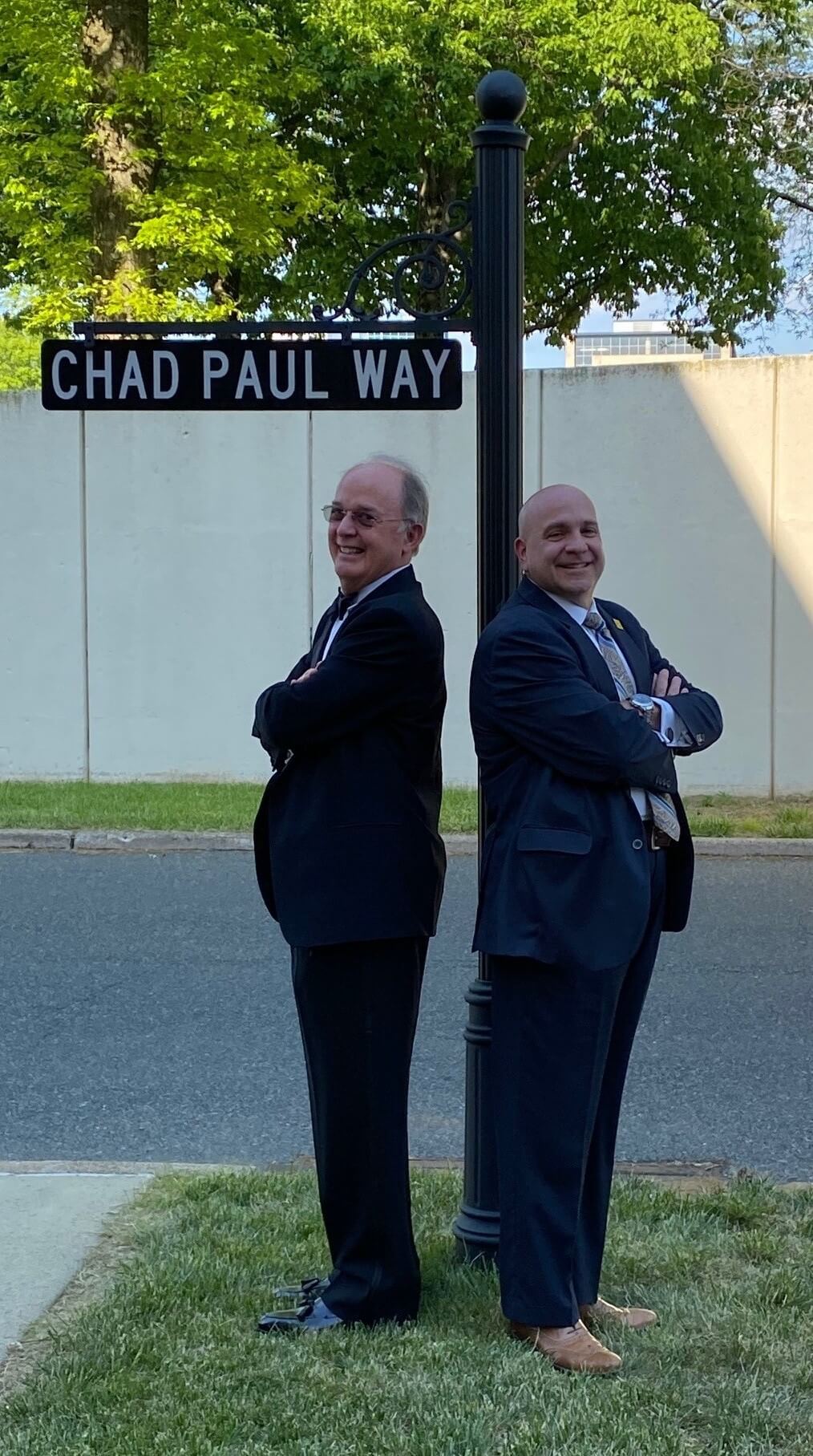
Paul retired as Ben Franklin Northeast’s chief executive in 2021, succeeded by Angelo Valletta. At the farewell celebrations, the board named a meeting and conference room for Paul, renamed an incubator graduate award in his honor, and authorized a private street beside TechVentures to become Chad Paul Way. The photograph of Paul and Valletta beside its sign makes succession look unusually cheerful.
The name continues to accompany working companies. At Venture Idol 2026, Mussel Polymers received the R. Chadwick Paul Jr. Entrepreneurial Achievement Award. The TechVentures business develops water-resistant adhesive technology inspired by the way mussels attach to surfaces in wet environments. It had generated $1.8 million in revenue in 2025. The award recognized the effort involved in taking a scientific concept toward commercial use.
It is a fitting place to leave Paul’s story: with another company finding customers and using the space he helped expand. The student who began with a telephone business eventually helped build places where other people could attempt their own beginnings. A ceremonial set of keys and a private street sign offer the souvenir versions. The everyday version is a company with enough room to keep working.