Angelo Valletta has a hobby that comes with board meetings. Years before he took charge of a technology investment organization in Bethlehem, he described his leisure activities with admirable economy: “I don’t golf, I don’t hang in bars. Nonprofits are my hobby.” It is an unexpectedly revealing line in a career full of executive titles. Valletta likes having something useful to do, preferably with other people.
Today, he is president and CEO of Ben Franklin Technology Partners of Northeastern Pennsylvania. The work involves early-stage companies, established manufacturers, incubators, investment decisions and the stubborn distance between an idea and a business. His route there passed through banking systems and philanthropy. Along the way, he developed a leadership framework that reserves a place for recreation. Even a person who enjoys committee work apparently requires a change of scene.
A career needs more than a job title
In March 2026, Valletta named two women who had shaped him from his first day of work in April 1984: Carolyn Kelly and Thelma Brown. He credited their coaching with establishing his standards for preparation, discipline and accountability. The detail matters because he remembers the people behind his professional formation, alongside the organizations on his résumé.
His education combined a B.B.A. in Computer Information Systems at Temple University with an MBA at Philadelphia University. That combination gave him both a technical vocabulary and a business one. His working life would repeatedly require translation between the two: explaining what a system could do, what an organization needed, and how to bring the people responsible into the same conversation.
There is a family precedent. He grew up in South Philadelphia, and his older brother Lou encouraged him to combine business study with computer knowledge. The advice has an afterlife in the Louis A. Valletta Endowed Scholarship at Temple. A private relationship became an opportunity for somebody else’s education. It is a small, durable example of the way Valletta’s personal commitments have entered his public work.
The bank in your pocket
A useful test of a technology executive is a project customers can actually use. In 2010, Sun National Bank introduced mobile banking with the help of mFoundry’s cloud infrastructure. Valletta, then the bank’s CIO and senior vice president, described a rollout that moved from a fourth-quarter decision to a February soft marketing campaign and delivery to customers in March.
The services included account information by text message, access through a phone browser, and an application. They sound ordinary now. Their implementation at a regional bank required choices about external providers, internal systems and security. Sun National required its provider to have SAS 70 Type II certification, an assessment of a service organization’s internal controls. Convenience had an administrative underside.
The deployment took less than four months. That is a more telling detail than a general claim about embracing innovation. The bank used an outside platform to make something available to customers quickly, while placing conditions on the provider. Technology adoption here had a schedule, a partner and a set of checks. A customer checking an account on a phone need never think about any of them.
Sun National’s mobile banking deployment using cloud services, reported in 2010.
Valletta later held executive responsibilities at FIS and led the Catholic Foundation of Greater Philadelphia. Ben Franklin’s December 2020 appointment announcement described a financial technology business unit serving 100 partner institutions and growing regional revenue twelvefold during his tenure. These were organizations with very different purposes, but each needed the unglamorous machinery of operations to work.
Seven letters, one family argument
His book, 7Rs of Leadership and Life, has a less corporate origin. In a 2026 conversation with Dave Bookbinder, Valletta traced the framework to a discussion with his son about the difficulty of knowing which rules to follow. A parent’s attempt to simplify expectations eventually became a published guide. Anyone who has tried to explain a household rule knows how rapidly the discussion can acquire footnotes.
The book’s publishing announcement in December 2023 described it as a month-long daily study and a family undertaking involving Valletta, his wife and their two children. Its format is part of the point. In discussing it, he distinguished a day book from a chapter book: seven initial principles, followed by 21 additional entries that relate back to them, producing a 28-day sequence readers can repeat.
The seven are respect, resolve, responsibility, readiness, right thing, relationships and recreation. In an earlier essay, he tied them to listening, persistence, accepting accountability, preparing for opportunity and ethical conduct. Relationships require attention. Recreation has a place alongside productivity. The list asks a leader to remember that the people doing the work also have lives.
“I view my role as serving, supporting, and working for them so they have what they need for us all to succeed.”
Angelo Valletta, on servant leadership
- Respect
- Resolve
- Responsibility
- Readiness
- Right thing
- Relationships
- Recreation
That statement gives the framework a practical burden. A person claiming to serve a team has to consider what the team needs. The answer might be a clearer decision, better preparation, permission to question an assumption, or access to expertise. The principles provide a vocabulary for that discussion; the work of leadership still has to happen after the vocabulary is agreed.
Capital comes with questions
Ben Franklin announced Valletta’s appointment in December 2020. His congressional biography dates his tenure as president and CEO to January 2021. He arrived with experience in the systems and operations of established organizations, and began applying it to an organization helping other businesses take their next steps.
He has described his entrepreneurial interest as a longstanding part of his career. In a 2021 interview with Don Cunningham, he discussed innovation inside organizations: connecting systems, improving processing and putting strategy into practice through technology. That experience provides a recognizable link to his current role. An entrepreneur’s new company and an established bank’s new service both have to survive implementation.
In his March 2026 interview with Bookbinder, Valletta discussed coachability, hiring people for the right roles and maintaining culture as companies expand. He described ten-week mentorship programs and candid “tiger sessions” that challenge founders. Advice delivered this way is meant to be worked through. The conversation becomes useful when a founder can examine a decision without treating every question as an objection to the whole enterprise.
He also took the funding discussion to Congress. On April 16, 2024, he testified about the Small Business Innovation Research and Small Business Investment Company programs. His argument concerned the practical passage from research to products and services, and the sustainable jobs that can follow. He described Pennsylvania’s Innovation Partnership as a support mechanism for businesses navigating the application process.
In his oral testimony, he put the partnership’s success rate at 28 percent, compared with a national average of 18 percent. Those were program figures he presented to lawmakers, rather than personal performance statistics. They illustrate the kind of support he was advocating: assistance that helps an applicant make better use of a funding opportunity.
An idea still needs a room
Some obstacles to starting a company are solid enough to need a floor plan. In February 2026, Ben Franklin Northeast announced $4.8 million in approved federal funding for its TechVentures laboratory initiative. The project would convert more than 10,000 square feet of existing space into additional laboratories, expanding available lab capacity by over 50 percent.
The center in Bethlehem combines specialized space with business support. The expansion is intended to accommodate growing demand, including companies working in microelectronics, advanced materials, photonics and semiconductor design. Valletta linked the investment to helping companies develop in Pennsylvania and keeping talent in the state. The approval describes a project to be carried out; the promised capacity remains the project’s intended result.
There is a plain economic argument underneath the laboratory language. A founder who needs specialized facilities cannot substitute enthusiasm for a suitable room. Access to that room affects the pace at which a company can develop its work. It can also affect where the company goes next. For a regional investment organization, physical capacity belongs in the same conversation as capital.
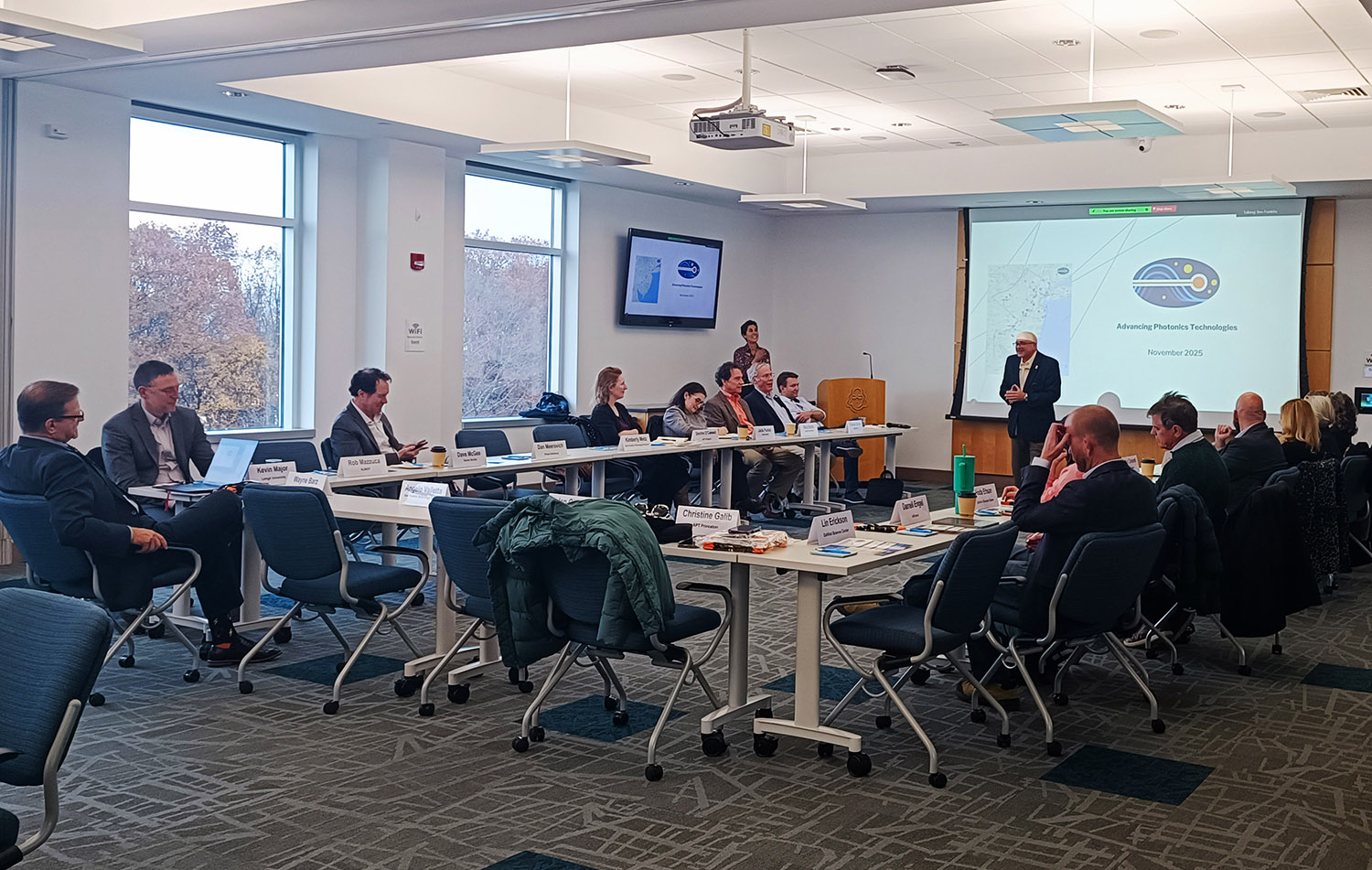
A bright idea needs a table, too. Valletta welcomes regional partners to a working session on photonics at TechVentures. Photo: Ben Franklin Northeast.
The gathering shown here puts faces around that argument. In November 2025, Valletta welcomed regional leaders and representatives of Advancing Photonics Technologies to TechVentures. The discussion connected research, industry partnerships and workforce development. Universities, employers and public agencies were involved because a technology sector needs people and institutions that can work together beyond a single project.
The advice travels back
At Alvernia University, Valletta became executive in residence for the 2025–2026 academic year. He had served on the O’Pake Institute’s Innovation Advisory Board since 2021. The university described a fireside conversation with students, moderated by MBA candidate Nicholas King, followed by plans for smaller class discussions. His experience could be questioned across a table rather than delivered only from a lectern.
His stated aim was to help students connect classroom learning with leadership experience, think creatively and act with integrity. In July 2025, he also began a term as board chair of the American Red Cross Rivers Chapter, extending a connection that began with the Philadelphia chapter in 2011. Mentoring and community service occupy a continuing place alongside his executive responsibilities.
The current work keeps producing ordinary, consequential decisions. Ben Franklin Northeast announced $977,564 in investments for 16 companies in September 2026, divided between ten early-stage businesses and six established manufacturers. Earlier that year, Valletta joined Wayne Barz in welcoming entrepreneurs and investors to Venture Idol. In October, the organization reported his participation in a Reading discussion about AI.
Those activities leave him moving among founders, students, investors and community organizations. The useful question changes with the room: a system to connect, an application to improve, a company to advise, a student to encourage. His brother’s old advice still fits. Understand the business. Learn what the technology can do. Remember the person who needs to use it.
Continue the conversation
- Ben Franklin Northeast: work, news and investment programs ↗
- Angelo Valletta on LinkedIn ↗
- 7Rs of Leadership and Life: the book ↗
- Behind The Numbers: the March 2026 interview ↗
- The conversation with Don Cunningham ↗
- Ben Franklin Northeast videos on YouTube ↗
- His 2024 congressional statement ↗
- The South Philadelphia family profile ↗
- TechVentures lab expansion announcement ↗