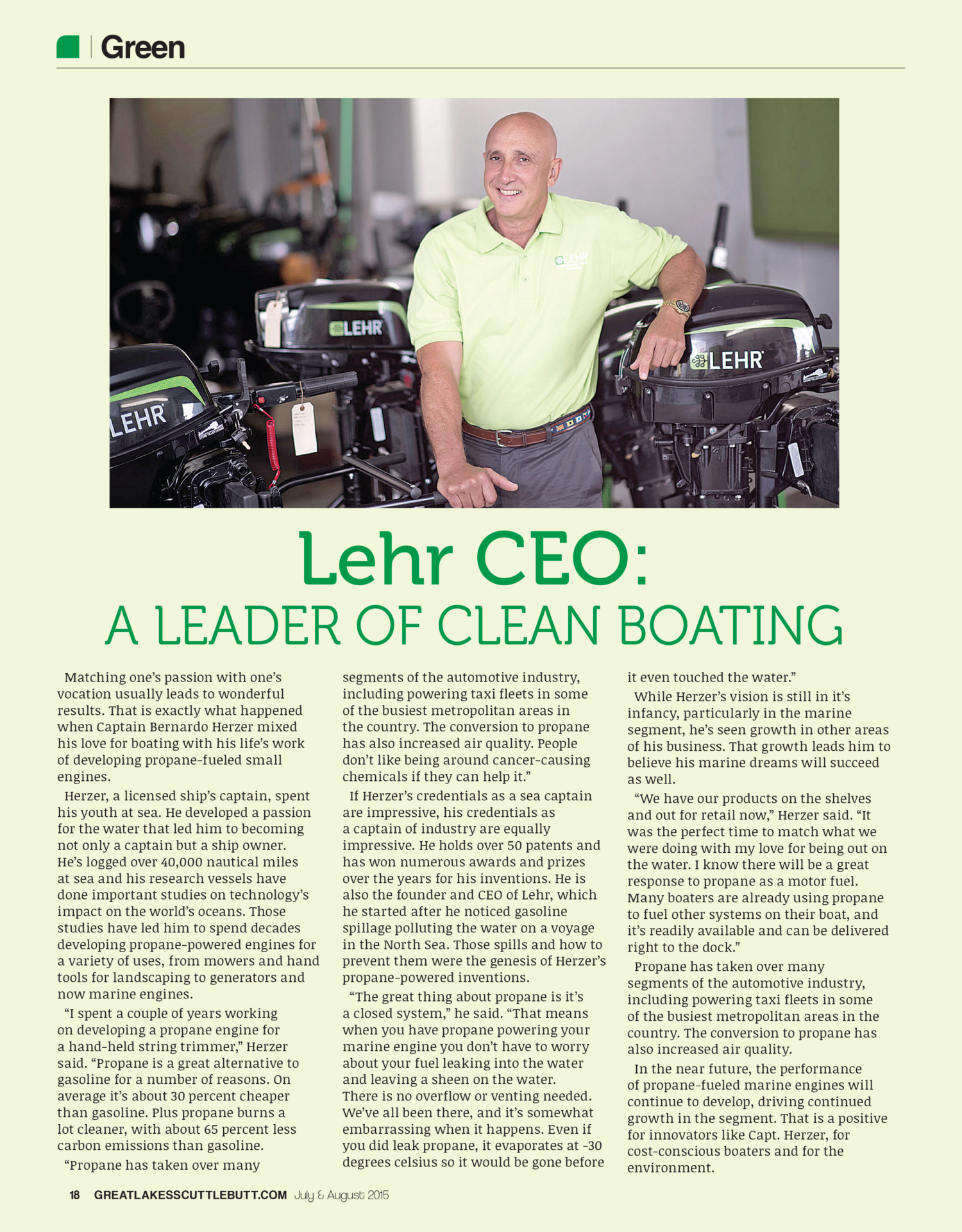
The most persuasive climate hardware often looks slightly ridiculous before it looks inevitable. LEHR’s little outboard motor wore a black cowling, a green stripe and, tucked beneath the cover, the same one-pound propane bottle found beside camp stoves. Twist it in. Pull the cord. Go boating. There was no gasoline to slosh over a transom, no choke to fuss with and no half-used tank turning into varnish between weekends.
That visual gag contained a serious product insight. Small gasoline engines are often punished by occasional use. Fuel sits. Ethanol attracts water. Carburetors gum up. Owners discover the problem on the one Saturday when the dinghy must start. LEHR did not merely promise a cleaner combustion event. It removed an annoying ritual from the customer’s life.
For a while, the bet looked shrewd. The Los Angeles company moved from lawn tools into marine engines, won an Environmental Protection Agency award, collected recognition from boating groups and magazines, landed on national retail shelves and attracted private-equity backing. Then the updates stopped. By 2019, marine reporting said the company had gone out of business. Owners began swapping rumors and repair tips online, trying to keep unusual machines alive without the company that had made them.
The broken motor that would not leave him alone
Bernardo J. Herzer grew up around boats and began his maritime career as a teenager. In one account, an engine on his family’s ship failed when he was about 15. He improvised a propane conversion. Later, as the owner and captain of oceanographic research vessels, he saw gasoline residue and fishing damage in the North Sea. The memory of the conversion met the sight of polluted water.
The company’s own materials date LEHR’s founding to 2004; business profiles variously cite 2006 or 2007. The precise birthday matters less than the sequence. Herzer returned to land as his family grew, spent a couple of years developing a propane engine for a handheld trimmer, filed patent applications and chose lawn care as his first commercial beachhead. The engines were small, dirty and familiar. The customer already understood portable propane.
LEHR’s patent covered using common one-to-two-pound LPG tanks to feed small internal-combustion engines without demanding one fixed tank orientation. That bit of plumbing was the commercial hinge. An alternative fuel stops feeling alternative when it connects with one turn of the wrist.
“It’s not the ultimate thing, but a step in the right direction.”Bernardo Herzer, discussing the early lawn-tool line
Sell the missing headache
The 2009 Eco Trimmer arrived in straight- and curved-shaft versions at roughly $199 to $230. A reviewer found the $209 machine easy to start, quieter than a gasoline trimmer and powerful enough for ordinary yard work, though a little heavy. LEHR followed with a leaf blower, a 139cc mower and even propane scooters. The distribution list included Home Depot, Ace Hardware, True Value, Sears and Amazon. Retailers got an extra attraction: the tool created repeat sales for fuel canisters.
This was climate marketing with work gloves on. Lower carbon monoxide and hydrocarbon emissions mattered, as did the absence of evaporative gasoline fumes. But the everyday pitch was almost tactile: clean hands, clean storage, no mixing oil and fuel, no priming, no choke. Propane could sit without degrading. A closed fuel system made accidental spills less likely.
LEHR’s adoption loop: familiar interface first, unfamiliar fuel second.
The EPA recognized the Eco Trimmer with a 2008 Clean Air Excellence Award. Popular Science featured the mower in its 2010 Best of What’s New coverage. These were useful stamps, but LEHR’s best proof remained the pull cord. A cleaner engine that would not start was a science project. A cleaner engine that started more easily was merchandise.
From Saturday mowing to Sunday sailing
In 2012, LEHR introduced 2.5- and 5-horsepower outboards. The smaller motors could run from an onboard 16.4-ounce cylinder or connect to a remote barbecue-style tank. They were four-strokes with electronic ignition and no gasoline carburetor to clog. A 2.5-horsepower model listed around $1,200; 5-horsepower versions approached $1,920. The 9.9-horsepower line followed, with configurations from roughly $2,400 to more than $3,100. Later catalogs showed 15- and 25-horsepower models.
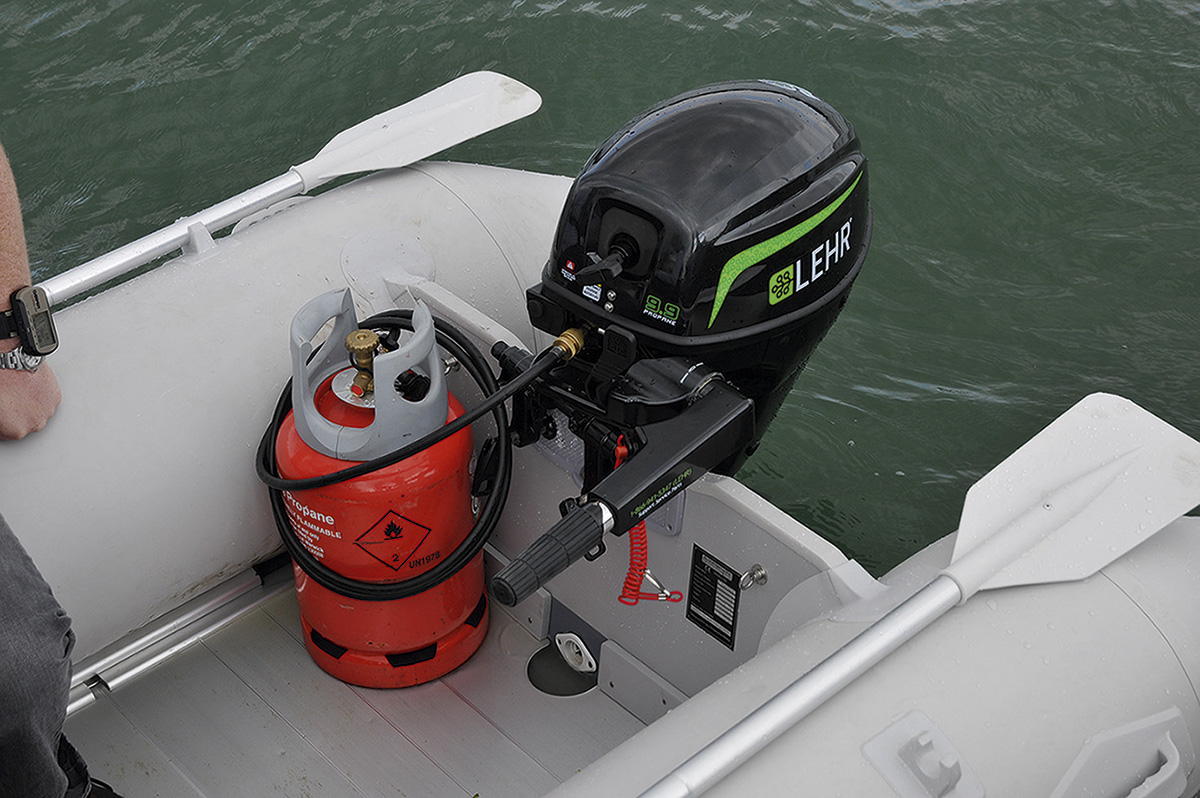
The target was not a speedboat owner chasing triple digits. It was the sailor needing auxiliary power, the dinghy operator crossing a harbor and the small-boat owner who might leave an engine untouched for months. Many sailboats already carried propane for cooking. Reservoir operators cared about fuel entering drinking water. Marinas could arrange cylinder delivery without installing a gasoline pump.
Tests captured the trade-offs. The smallest LEHR could start on the first pull and push a test boat competitively. It was also noisy and vibrated more than some alternatives, and its tiny onboard cylinder meant limited range. The 2.5 had no reverse gear; the operator spun the entire motor around. Propane availability varied by location. Cleaner did not mean frictionless.
Still, the industry noticed. LEHR won environmental recognition at the 2012 Miami boat show and West Marine’s Green Product of the Year. Popular Mechanics put the propane outboard among its 2012 technology breakthroughs. Herzer said the first marine year produced millions of dollars in revenue and that the company had grown beyond 50 employees.
Capital arrived. So did complexity.
Solis Capital Partners made an undisclosed equity investment in 2014. In 2015, LEHR acquired EnviroGard from Onyx Environmental Solutions, adding propane fuel systems, conversion kits and relationships with original-equipment manufacturers in outdoor power and construction. The strategic logic was tidy: use the same certification and fuel-system knowledge across more engines, sell B2B as well as B2C, and depend less on one product category.
The operating logic was heavier. Marine engines require dealers, trained technicians, warranty reserves, stocked components and the patience to support a machine long after the initial sale. More horsepower raises consequences. More product families multiply inventory. An acquisition adds integration work just as customers expect the original machines to be boringly dependable.
LEHR also occupied an awkward middle channel. It sold consumer machines through big retailers, where shelf velocity matters, and technical marine equipment through dealers, where expertise and parts availability matter. It sold a patented difference but still competed against Honda, Mercury, Yamaha, Suzuki and Tohatsu, names with deep service maps. Torqeedo attacked the same clean, quiet tender job from the electric side. Every LEHR sale therefore carried two acquisition costs: persuade someone to choose propane, then persuade that person to trust a smaller manufacturer. The first cost could be paid with a sparkling demonstration. The second accumulated for years.
The hidden invoice
A $209 trimmer and a $3,100 outboard may share fuel technology, but they do not share customer risk. If a trimmer becomes unrepairable, the loss is irritating. If an auxiliary motor fails away from shore, the support promise is part of the safety case.
The machines became orphans
LEHR’s public news feed ends in late 2017. A supplied company record notes $1.5 million in debt financing in August 2018, but does not name the lender. By the summer of 2019, boat owners were reporting clearance inventory, an unavailable online store and confirmation from service shops that the company was gone. Boats.com later added an editor’s note stating that LEHR went out of business in 2019 and no longer produced outboards.
What failed first, from the customer’s point of view, was continuity. Owners could possess a working engine and still face a shrinking map of service options. Forum posts describe leaking fuel lines, lower-unit trouble and searches for compatible impellers or generic parts. Those anecdotes do not prove one universal mechanical defect. They reveal a universal commercial defect: uncertainty about who will answer.
The market also changed around LEHR. Electric outboards improved and became an obvious alternative for short tender trips. Established engine makers introduced LPG models. Gasoline remained available almost everywhere. Propane’s sweet spot was real but conditional, and LEHR had to fund a specialized support system while larger competitors spread that cost across broad catalogs.
The product removed stale fuel from the engine. It could not remove stale obligations from the balance sheet.
Copy the wedge. Finance the wake.
LEHR’s useful lesson is not “build a propane startup.” It is to find a public-good improvement that also eliminates a private annoyance. Customers may applaud lower emissions; they pay to avoid clogged carburetors, fuel spills and bad Saturday mornings. The environmental gain becomes more durable when it rides inside a product that is simply nicer to own.
Make the demo one sentence
“Screw in a camping bottle and pull” did more work than a page of combustion statistics.
Borrow infrastructure
LEHR used propane cylinders already sold for grills and campsites instead of inventing a fuel package.
Sell convenience twice
The same closed system reduced evaporative emissions and kept gasoline off hands, decks and water.
Pre-fund the afterlife
Use common parts, publish compatibility, reserve for warranties and give service partners a viable decade-long business.
The approach would not work everywhere. Skip it when customers cannot reliably buy the fuel, when battery range already covers the job, when cold-weather or storage rules complicate LPG handling, or when the company cannot promise long-term parts. A niche fuel system is most attractive when the surrounding network feels ordinary.
Herzer was right about one thing that outlasted LEHR: “green” works best as an improvement over the state of the art, not as a halo floating above it. His outboards made alternative fuel understandable, useful and a little funny. Their stranded afterlife completes the lesson. In durable hardware, the company is one of the replaceable parts. Someone has to keep it in stock.