Consider a worker who has earned enough to buy groceries but cannot buy them today. The work is finished. The money is coming. The refrigerator, unfortunately, does not accept that explanation. Between earning and receiving sits a small interval in which ordinary expenses can become expensive problems. Beem has made that interval its business.
- Emergency cash is the entry point; a wider wallet is the ambition.
- Membership and fast delivery cost money, even when interest is zero.
- The intended customer may earn from several places, on several schedules.
Operated by Line Financial, PBC, Beem serves Americans whose finances do not always resemble a neat payroll spreadsheet: gig workers, shift employees, freelancers and the self-employed. Everdraft, its cash-access feature, sits alongside budgeting, transfers and credit-building services. The interesting proposition is about timing. A household can have income and still have a Tuesday problem.
First, get in the car.

Founder Akshay Krishnaiah had worked at PayPal. In his account, the problem with financial product design was distance: the people making the tools were removed from the lives those tools were supposed to improve. “They lacked the customer’s point of view,” he told Pulse 2.0 in 2023.
His response was unusually literal. He says he spent more than a year driving Uber and Lyft around the extended San Francisco Bay Area, covering 36,000 miles. The exercise put him beside workers and passengers coping with financial strain. Beem’s origin story turns on that change of vantage point: the product brief began to look different from behind a steering wheel.
The company took shape as Line in 2020 and brought its service to the public in 2021. In May 2022, it announced $25 million in equity and debt financing led by Massive, intended to expand the team and service. The announcement reported more than 600,000 registrations across all 50 states. That established an audience, though registrations alone say little about repeated use.
The business also depends on what happens after that first visit. Subscription revenue continues across billing cycles, while transaction charges depend on particular actions. A customer who arrives for emergency access may stay for the wider bundle. For Beem, that makes the usefulness of the less dramatic features commercially important.
The calendar is part of the product.
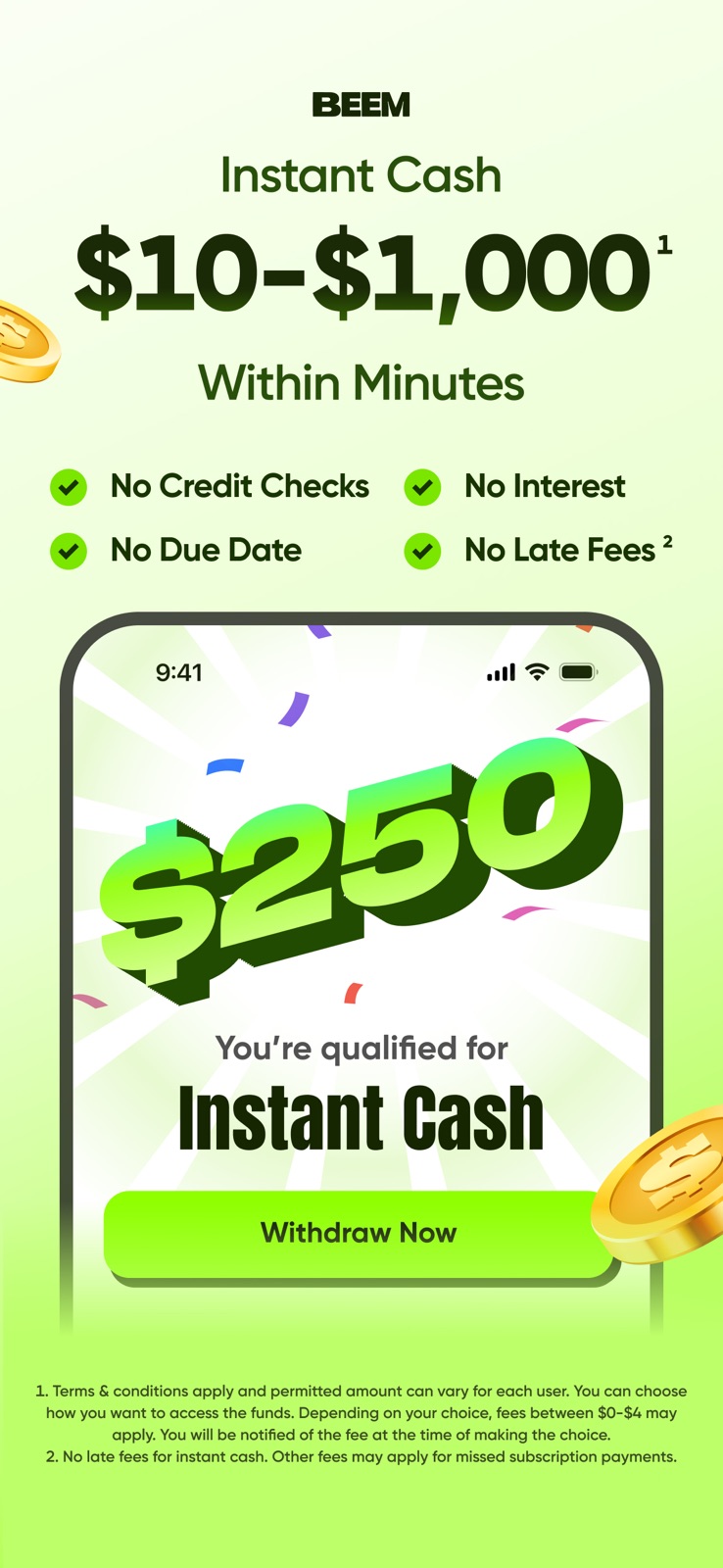
Everdraft offers eligible customers early access to verified incoming funds, advertised up to $1,000. No FICO check or interest is attached to that feature. The amount someone can actually receive depends on eligibility. Buying the highest subscription does not make the largest advertised amount automatic.
Timing is the problem this feature is designed to address.
Beem describes its approach as looking at account activity and incoming money rather than treating a conventional paycheck as the only useful signal. Budgeting and alerts add another layer: see the approaching bill before it becomes a scramble. This is where the company’s risk-assessment and personal-finance work meet. Both require an intelligible picture of money moving through an account.
Dave, EarnIn and Brigit occupy nearby territory. Beem’s pitch combines emergency access with a broader subscription bundle and an emphasis on customers with unconventional income. For someone comparing apps, the decisive differences are concrete: the approved amount, delivery time, total charge and whether the other tools get used.
Zero interest. Do the arithmetic anyway.
Beem’s public pricing page lists four monthly memberships. Lite costs $1.99, Basic $3.99, Plus $6.99 and Pro $13.99. Their advertised cash-access ceilings range from $10 to $1,000. Standard ACH delivery is listed as free and can take three to five business days. Optional expedited delivery adds a separate charge.
Public web plans, checked October 24, 2026. Maximums are subject to eligibility; individual offers may differ.
Take a clearly hypothetical Basic member receiving $50 once in a month. At the published $3.99 membership price and a $4 fast-transfer fee, the combined cost would be $7.99, assuming no other charges. That is roughly 16% of the cash received. It is a cost ratio, not an annual percentage rate. The same membership might also provide other useful services.
The distinction matters because Beem’s “no interest” message can otherwise swallow the calculation. Its terms also allow late fees for unpaid subscriptions. Membership, delivery and advance terms need separate attention. Someone who can wait for standard delivery faces different arithmetic from someone whose bill is due this afternoon.
An emergency app wants an everyday habit.
A tool used during a cash shortage has a curious commercial limitation. People may stop opening it when the shortage passes. A partner case study from adjoe describes precisely this challenge: Beem wanted to become a daily destination. Its answer included Beem Arcade, with games placed on the homepage and in the Earn tab.
Rewards flow into the main Beem account. That design choice is worth copying: put a benefit where the customer can actually use it. adjoe reports 2.3 times as many sessions among Arcade users and 11% higher revenue per user among cashback earners than nonparticipants. Those are partner-reported comparisons between groups. They do not establish that gaming caused either result.
The bundle reaches beyond games. GoodTrust announced estate-planning access for Beem members in February 2026, including wills and trusts. TruStage supplies a protection relationship addressing covered job loss and disability. Beem’s banking and card terms identify Cross River Bank and program manager Upward Financial. Beem is the consumer interface across services delivered with partners.
That arrangement puts Beem between several familiar markets: cash-access apps, personal-finance software and everyday banking. Bundling can reduce the number of separate services a customer needs. It also makes the purchasing decision harder: a long list of benefits has little value if the customer uses only one.
How much of a wallet can one app earn?
Beem’s current company positioning describes an AI-managed unified account spanning several asset types. That is a wider ambition than bridging a grocery bill. Its immediate execution problems remain tangible: recent app release notes describe clearer bank-linking guidance, phone verification and cancellation flows. A wallet becomes useful only after those ordinary steps work.
Beem’s help pages make the bank connection problem specific. Names must match, an account cannot be linked across multiple Beem accounts, and some verification delays take 24 to 48 hours. Those constraints matter most when someone downloaded the app because time was already running out.
The limits are equally practical. Bank verification can delay access; eligibility can change. A recurring subscription needs recurring value. And advancing money does not repair a household budget that stays short every month. Beem’s strongest use case is narrower and easier to understand: income is on its way, an expense cannot wait, and the total cost of closing that gap makes sense.