The modern hockey skate begins with a mildly strange retail ritual. You remove your shoes, step onto a machine and watch your feet become a topographic map. In about 20 seconds, Bauer’s FitLab can capture length, width, girth, instep and arch height, then add static pressure and the movement of your gait. The result is not merely a size. It is a recommendation for a skate family, an orthotic and even the profile of the steel beneath the boot.
For Bauer, this is a neat inversion of its founding idea. The company made its name by joining parts that had been separate. In 1933, six years after the business began in Kitchener, Ontario, it introduced a skate with the blade permanently attached to the boot. Today, Bauer is taking a product that looks finished and separating it again - digitally - into a stack of tunable choices.
A catalog built around a body
Bauer is a full-line hockey equipment company. It sells skates, sticks, helmets, gloves, shoulder pads, pants, shin guards and goalie gear. It also sells apparel, bags, street and roller equipment, training aids, tiny collectible sticks and home skate sharpeners. The range stretches from a child taking a first lesson to a professional who can detect a small change in blade geometry during a turn.
That breadth matters because hockey equipment is not a collection of independent objects. A stiff boot changes how a player loads the blade. The curve, flex and kick point of a stick alter a shot. A helmet works properly only when it fits closely. Bauer’s current pitch is that product selection should begin with the player rather than the shelf.
The portfolio is arranged in recognizable families. Vapor is associated with quickness and agility, Supreme with power, and Bauer X with players entering the game. Nexus remains a central stick franchise. Those names help a shopper move across price points without starting over each season. They also give Bauer a durable frame for product launches: materials, geometry and graphics can change while the family continues. For a parent, that continuity simplifies the next purchase. For an equipment manager, it creates a familiar vocabulary for comparing a new model with the one already in the room.
Safety sits beside performance, sometimes uneasily. Bauer’s 2012 RE-AKT helmet was designed to manage rotational acceleration as well as high- and low-energy linear impacts. But no technology turns hockey into a risk-free sport, and no helmet works independently of fit. Bauer’s own guidance puts the practical point plainly: less empty space between head and helmet means less distraction and a better chance that the equipment performs as intended. Here again, the company’s expertise is not simply molding plastic. It is matching anatomy to an engineered object.
“Fit is absolutely a factor to unlocking performance.”Bauer, on its Game Fit system
FitLab is the most visible expression of that idea. Built with Aetrex scanning technology, the in-store system launched in 2024 with a planned 420 locations across the United States, Canada and Europe. Its measurements feed a recommendation. From there, a player can select stock skates, add performance pieces or move toward MyBAUER custom and pro-custom builds. Bauer allows certain customers to specify details down to quarter sizes, tongues, holders, toe caps and eyelets.
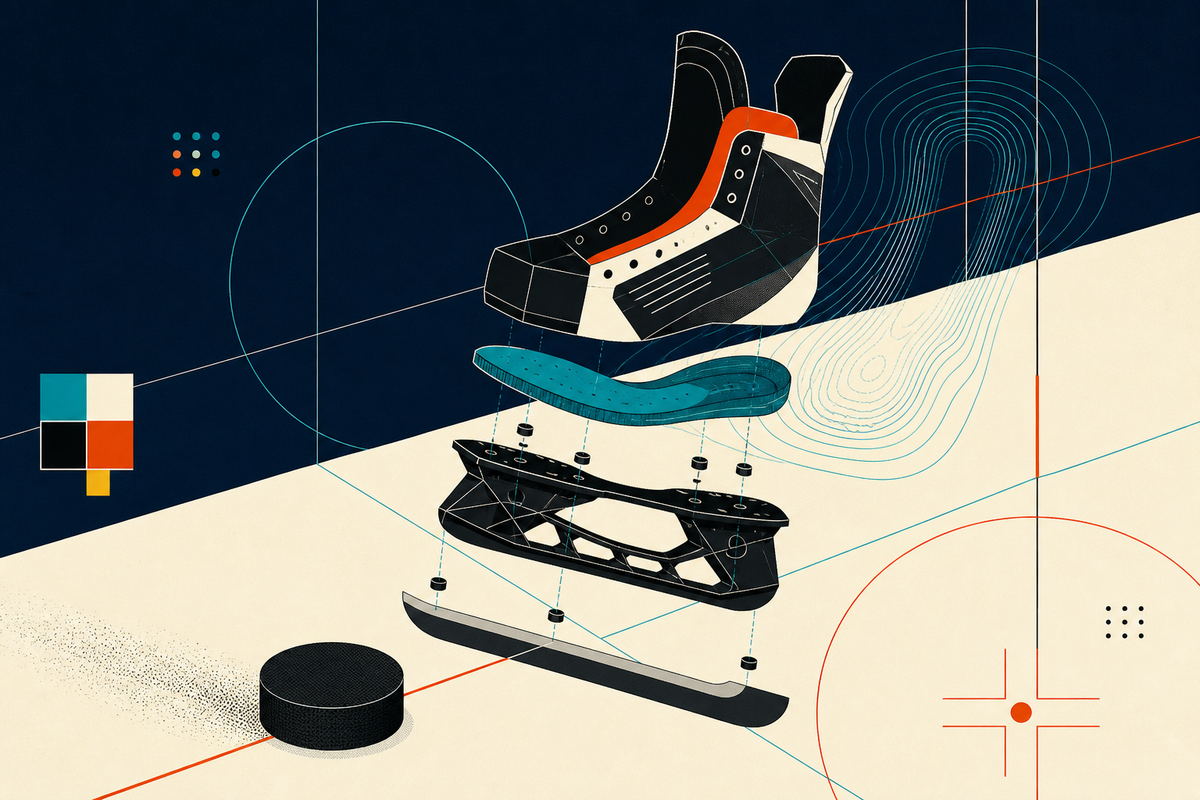
The loop under the laces
The clever part is what happens after the scanner chooses a boot. Bauer can recommend an orthotic based on the foot map, steel for a preferred feel, and a blade profile organized around four zones: stability at the heel, speed through the stride, transition through pivots and acceleration in the first steps. Sharpening then adjusts the hollow, trading bite against glide.
This is where Bauer’s 2021 acquisition of Sweden’s ProSharp looks more strategic than it first appeared. ProSharp makes portable home and travel sharpeners, along with commercial machines for teams and high-volume retailers. The deal gave Bauer a role after the skate leaves the box. A player returns for an edge, experiments with a profile or buys a machine. A retailer gains a service and a reason for the customer to come back.
In business terms, the scan connects several revenue pools: a premium skate, custom options, orthotics, replacement steel, profiling and sharpening. It also helps the independent hockey store do something an ecommerce product grid cannot easily replicate. Bauer sells directly online, but its most interesting technology sends a customer into an authorized shop and puts a trained fitter in the middle.
That makes Bauer a hybrid business. Wholesale distribution provides reach and lets local stores carry inventory, fit players and service skates. Ecommerce gives Bauer a direct relationship, a place for exclusive drops and a channel for apparel, accessories and replenishment. Team and league sales move volume and place the equipment in visible competition. Custom orders raise the value of an individual purchase, while the MVP loyalty program gives online and in-store shoppers a reason to identify themselves across channels. None of these pieces is unusual alone. Their coordination is the model.
Pros at one end, parents at the other
Bauer’s customers occupy unusually distant ends of the expertise curve. Elite players arrive with precise preferences and years of sensory memory. First-time families arrive with questions: Why is the skate smaller than the shoe? What is a hollow? Does this helmet move too much? Which side of the stick goes on the ice?
A fitting system translates both customers into measurements and choices. The professional gets specificity. The beginner gets relief from guesswork. That matters in a sport where a complete bag is expensive, the equipment is unfamiliar and an uncomfortable first experience can end participation before it begins.
The same system that fine-tunes a professional’s edge can stop a new player from buying the wrong boot.
Bauer has paired this commercial work with participation programs. First Shift, created with Hockey Canada and later joined by the NHL and NHLPA, packages equipment and an introduction to the game for new families. During the pandemic, those organizations and Bauer also assembled an equipment-relief program valued at $2 million, designed to distribute as many as 7,000 sets of gear. These efforts lower the category’s front door. They also help create the next generation of customers in a market worried about youth participation and cost.
A brand that needs the rink
Bauer’s difference from CCM, True, Warrior, Sherwood and specialist goalie brands is not that it alone makes premium gear. The distinction is the attempt to connect a broad product range, digital fitting, customization, blade care, athlete feedback, specialty retail and direct ecommerce. Its R&D center in Blainville, Quebec, and its long list of skate and stick experiments give that system technical credibility.
Equipment
Full head-to-toe player and goalie catalog, from entry level to professional.
Fit
Scanning and custom programs turn product selection into a guided service.
Care
ProSharp extends the relationship into profiling, sharpening and repeat visits.
Culture
League deals, athletes, apparel and learn-to-play programs keep the brand visible.
The company’s partnerships show how the edges of that market are expanding. Bauer is an equipment partner of the Professional Women’s Hockey League and became its exclusive official and replica jersey supplier beginning with the 2024-25 season. The arrangement supplies elite players, gathers feedback for equipment designed around women and sells the league’s identity to fans. Collaborations with lululemon, OOFOS and ORORO move Bauer into lifestyle clothing, recovery footwear and heated apparel without pretending that it has stopped being a hockey company.
The business sits inside Peak Achievement Athletics, alongside Cascade and Maverik lacrosse. In December 2024, Fairfax Financial affiliates acquired all outstanding Peak equity from Sagard and minority holders. Bauer remains private, so standalone financial detail is limited. A supplied company-intelligence estimate puts annual revenue near $291.1 million and employment around 840 people. The more revealing numbers are operational: product families, retail doors, repeat sharpening visits and the number of choices a scan can organize.
Ninety-nine years of interfaces
The blade becomes permanently attached to the boot.
The Tuuk holder creates a new interface between boot and steel.
LightSpeed Edge makes removable steel widely accepted in the NHL.
ProSharp brings sharpening and profiling into Bauer’s system.
FitLab maps the foot, pressure and gait before the skate is chosen.
There is a consistent pattern in that timeline. Bauer keeps finding the interface: blade and boot, holder and steel, head and helmet, hand and stick, foot and scanner. The company does not need every experiment to become a classic. It needs enough of them to make its product families feel like one evolving system.
The risk is familiar. Customization can become complexity, premium add-ons can feel like upselling, and a recommendation is only as credible as the comfort a player feels on the ice. Competitors can buy scanners and design fitting systems of their own. Bauer’s defense is accumulated context - product history, retailer training, athlete use and the ability to manufacture most of what the scan recommends.
A skate still ends in a thin piece of steel. That physical fact keeps the strategy honest. Bauer can make the retail theater more technical and the apparel more fashionable, but the customer will judge the result during a hard stop, a first stride or a Saturday-morning lesson. Nearly a century after fastening blade to boot, the company’s newest proposition is almost modest: before selling the skate, look carefully at the person standing in it.