The first useful CCM Hockey product was hiding on the factory floor. In the early 1900s, Canada Cycle & Motor Company had too many bicycles, an automobile experiment that had not worked out, and leftover steel. Hockey, meanwhile, was moving from pastime toward institution. So the company turned scrap bicycle steel into skate blades. The move sounds obvious only after 121 years of hindsight.
CCM had been assembled in 1899 from five leading Canadian bicycle makers, a defensive consolidation meant to control a crowded market and answer a large American rival. The bicycle craze cooled almost immediately. The founders had raised money to modernize factories and make automobiles, but the adjacent bet that endured was the cheaper, stranger one: attach steel to boots and follow Canadians onto the ice.
Today the name belongs to Sport Maska Inc., a private Montreal company owned principally by Altor. CCM designs, manufactures and markets sticks, skates, helmets, protective equipment, goalie systems, apparel and accessories. It sells through hockey shops, team channels and its own ecommerce sites in more than 40 countries. Its customer can be Connor McDavid asking for a minute change to a stick, a PWHL player needing a shoulder pad that does not float, or a parent trying to equip a six-year-old without refinancing the kitchen.
01 / The original pivot
Failure gave the company a better question
CCM’s founding category failed first. Bicycle demand saturated, seasonality hurt, and the Canadian market collapsed with spectacular speed after 1899. Importing and manufacturing automobiles did not become the rescue. The company changed its mind because it could see a nearby activity growing and already possessed useful material, metalworking skill and distribution. It launched the CCM Automobile Skate around 1905.
The cost of that first hockey move is not publicly documented. The inputs tell us more than a heroic number would: scrap steel reduced the material risk, existing machinery reduced the capability risk, and a rising sport reduced the demand risk. Within roughly three decades, CCM says more than 90 percent of hockey players wore its skates. In 1936 it signed King Clancy as its first official spokesman, beginning the athlete loop that still anchors the brand.
The thing to copy is not “pivot into hockey.” It is the sequence: reuse an unfair capability, follow visible demand, and make the first test cheap enough to survive.A practical reading of CCM's origin story
That sequence has limits. It does not work when the new customer requires wholly different manufacturing, when demand is fashionable rather than durable, or when the old asset is actually a liability. Scrap steel and Canadian skating culture were unusually compatible. A software company cannot staple unused server racks to a sneaker and call it adjacency.
02 / What the company actually sells
A portfolio organized around hockey’s small annoyances
A skate should transfer energy without making the foot feel embalmed. A stick must load and release predictably. Pads have to stay where the designer placed the protection. A helmet must fit comfortably enough that the player wears it correctly. CCM’s major families divide those jobs: Tacks leans toward power and protection, JetSpeed toward speed and mobility, Ribcor sticks toward quick release, while Axis and EFlex serve goalies. Custom fitting and 3D scans give premium customers another layer of adjustment.
Its best-known manufacturing experiment is the Super Tacks X helmet liner developed with Carbon. Instead of relying only on conventional foam, the partners digitally manufactured a lattice whose geometry and density could vary by location. The system reached NHL certification for professional use, then a related retail helmet arrived in 2021. The defensible claim is not that printing makes concussions disappear. It is that digital manufacturing can tune ventilation, comfort, fit and impact management in ways a uniform slab cannot.
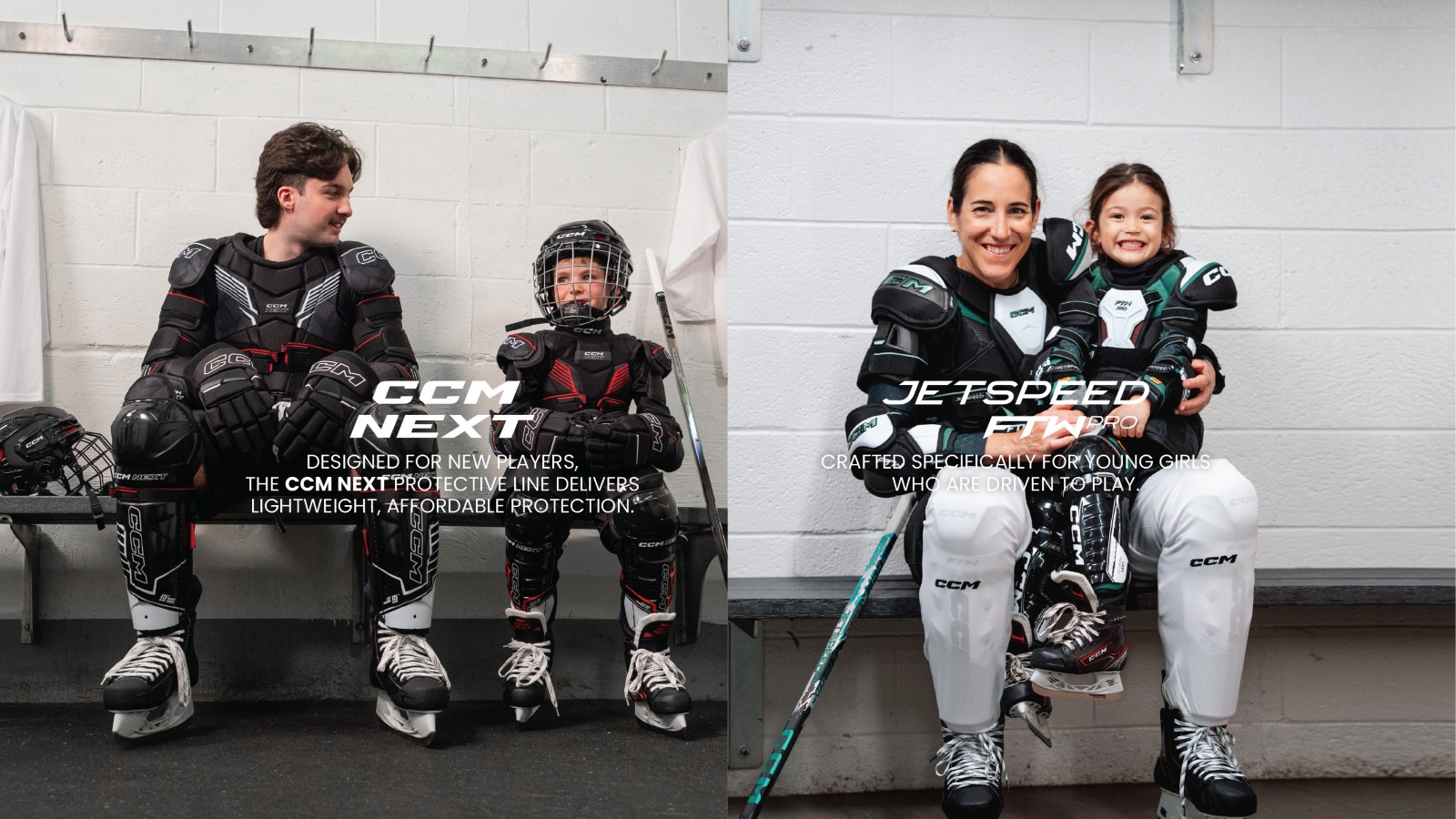
The more consequential line may be less exotic. CCM introduced JetSpeed FTW protective equipment and a stick in 2024, then completed a head-to-toe offer with skates and a helmet in 2025. Product staff studied differences that generic senior and junior sizing had blurred: narrower forearms, longer and narrower shins, different hand proportions, heel fit and chest volume. Pants open wider and adjust by waist; shoulder pads offer three-way adjustment for width, length and volume; gloves change palm and finger geometry.
Those are not pink accents applied after engineering. They are engineering decisions. Toronto Sceptres forward Emma Maltais described squeezing into smaller gear and getting bruised because the protection sat incorrectly. CCM’s useful move was to treat that complaint as a specification. In 2026, a Barbie collaboration added bright youth gear and apparel. The colors are the invitation. The fit work is the reason to stay.
03 / The machine around the product
Pros supply edge cases; partnerships supply reach
CCM says it equips more professional hockey players than any other company, including stars across the NHL and PWHL. The boast matters commercially, but the deeper advantage is access. Elite players repeat the same motion thousands of times at absurd speed. A tiny balance problem, pressure point or release delay becomes obvious to them before it becomes legible in a retail survey. When product engineers can capture that signal, a locker room becomes a hostile testing lab.
The other end of the system is institutional. CCM supplies the AHL, the PWHL, USA Hockey national teams, several national associations and development programs. Its 2026 CSSHL agreement reaches 124 teams at 38 accredited schools. Partnerships with Hockey Equality, World Para Ice Hockey and the Montreal Canadiens Children’s Foundation put equipment into communities the premium shelf does not naturally reach. The latter program is designed to provide skates and helmets to more than 650 children for a six-week learn-to-skate course.
This is part product testing, part distribution and part trust. A federation relationship can create team orders and licensed merchandise. A Try Hockey For Free day can introduce a family to the brand before anyone knows their flex rating. An AHL contract keeps CCM visible at the bridge between junior and NHL hockey. The business sells physical products, but endorsements and agreements lower the buyer’s uncertainty.
04 / The money
A mature market, priced like a share-taking machine
Adidas sold CCM to Birch Hill Equity Partners for about US$110 million in 2017. In 2024, Altor agreed to buy a significant majority stake, with management reinvesting. Reports placed the enterprise value between C$500 million and C$600 million; one deal account put the price at C$600 million including debt. The currencies differ, and the 2024 figure includes capital structure, so a neat return multiple would be false precision. The direction is not subtle.
Two reported transactions, two currencies
The attraction is understandable. Hockey equipment is a replacement business with high trust requirements and room for premium prices. A player may experiment with tape; fewer want to gamble on a badly fitted skate. CCM can sell one consumer several categories, from a helmet and gloves to a stick that eventually breaks and must be replaced. Retailers add fitting, sharpening and local credibility, while ecommerce adds assortment and direct customer data.
The constraint is the sport itself. Hockey is expensive, logistically awkward and mature in its core markets. Bauer is the closest full-line rival; Warrior, True, Sherwood and goalie specialists attack individual categories. Used equipment competes with all of them. Growth therefore comes from taking share, raising value per customer, entering geographies, or making hockey workable for people whom traditional equipment and culture kept outside.
Where the playbook breaks
Elite feedback can overfit products to elite budgets. A women-specific line fails if stores do not stock enough sizes to try on. A grassroots sponsorship fails if ice time and travel remain unaffordable. And a colorful collaboration becomes costume if the underlying fit is wrong. CCM’s conditions for success are unglamorous: distribution, fitting, credible testing and an entry price a family can tolerate.
05 / What readers can steal
Interview the body, not only the buyer
The portable CCM tactic is to collect complaints that users have normalized. “The pad slides.” “My fingers reach but my palm swims.” “I cut the stick down and ruin the flex.” These statements are more valuable than asking whether somebody likes the brand. They expose a mismatch between the product model and the human using it.
Next, convert language into variables: width, length, volume, density, flex and temperature. Build adjustment where bodies vary and fixed structure where protection demands it. Give prototypes to the most sensitive users, but do not let them define the whole market. Then test whether a retailer can explain the benefit in one sentence and fit the product without a laboratory. If not, the idea is still a prototype.
CCM’s history is not a smooth tale of Canadian inevitability. The original company went bankrupt in 1982. Its hockey assets passed through Sport Maska, The Hockey Company, Reebok, Adidas, Birch Hill and now Altor. Product families disappeared and returned. Yet the useful habit survived the ownership parade: notice where equipment fights the player, and remove the fight.
That is what CCM does at its best. It turns anatomy, motion and irritation into objects that help a player skate, shoot, stop a puck or simply feel entitled to take the ice. The C$600 million question is whether a century-old specialist can make that loop work for a wider population without making hockey’s admission price worse. Scrap steel was the cheap experiment. Inclusion is the harder engineering problem.