Bart Shuldman has a football expression for the moment a business plan meets an inconvenient fact. Call an audible. The quarterback reaches the line, sees a defense he was not expecting, and changes the play. Shuldman has been using that analogy for years. It is a revealing choice for an executive whose working life has involved manufacturing, sales, public markets, casino printers and the small, repetitive chores behind a restaurant meal.
A plan, in his telling, needs people who can spot when its assumptions have expired. That sounds agreeable until somebody has to abandon a project, disappoint a department or explain the change to shareholders. There is usually a beautifully prepared presentation involved. The presentation, unfortunately, gets no vote on what customers do next.
For 27 years, Shuldman occupied the CEO’s chair at TransAct Technologies. He led its initial public offering, became chairman, and pursued a shift from transaction printing toward connected restaurant operations. He stepped down in April 2023. Today, his work includes executive coaching and board advice. The setting has changed; his interest in what happens between a decision and its execution has survived the move.
Before the bell, the factory
Shuldman studied electrical engineering at the University of Hartford. His early career included General Electric’s Manufacturing Management Program and manufacturing and sales management roles at GE, followed by management positions at Mars Electronics International. Those jobs placed him on both sides of a familiar business argument: what a company can build, and what somebody will actually buy.
In April 1994, he joined Magnetec, a subsidiary of Tridex. By August he was its president. In December 1995, he became group president of printer operations. The following August, he led the printer operations through an IPO and became president and CEO of the newly public TransAct. His chairmanship began in February 2001.
The dates matter because this was a business assembled around existing operations and physical products. The founding CEO’s assignment included taking those operations into public-company life. A printer needed to work in a customer’s equipment; a public company needed to answer for its decisions every quarter. Shuldman’s career would keep those two forms of accountability close together.
In August 2016, Nasdaq scheduled him to ring its closing bell for TransAct’s twentieth anniversary and twenty years on the exchange. It was an unusually tidy anniversary: the same chief executive, the same listed company, two decades later. The bell made a photogenic punctuation mark. The less photogenic work involved customers whose machines still needed to print.
- 1996TransAct IPO
Founding CEO - 2019BOHA! launches
Hardware + cloud apps - 2023CEO departure
April 4 - 2024Coaching chapter
Announced in April
The kitchen was asking for more
TransAct’s casino business gave Shuldman a market in which an unglamorous component had a consequential job. At the 2018 Global Gaming Expo, the company displayed its Epic Edge ticket printer and Epicentral promotional software. Better barcode printing, easier firmware updates and reduced machine downtime were among the selling points. This was technology judged at the point where it had to function.
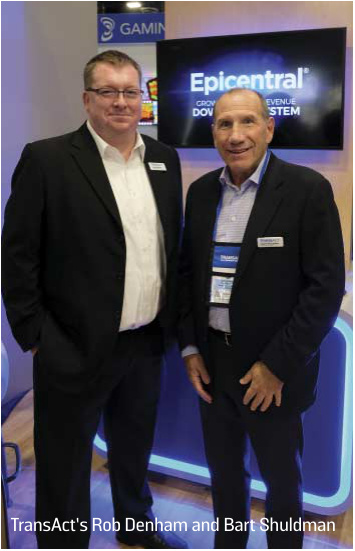
A photograph from the show catches Shuldman beside TransAct’s Rob Denham, standing in front of an Epicentral display. There is no grand stage in the frame. There are two executives, exhibition badges and a product to explain. For this part of his career, it is an economical portrait.
The restaurant opportunity asked a larger question of a printer business. In a March 2019 earnings discussion, Shuldman explained that restaurants wanted more than a terminal. Customers had helped push the company toward a broader set of tools. The response was BOHA!, introduced on March 4, 2019: cloud-based applications paired with hardware for the work that happens behind the counter.
Inventory, labeling, checklists, timers and equipment service management were part of that proposition. These are the jobs a diner rarely applauds. Nobody orders the tasting menu and compliments the checklist. Yet a restaurant still has to coordinate people, ingredients and equipment, repeatedly, across shifts and locations. BOHA! put TransAct closer to that daily routine.
The commercial change was substantial. Hardware could create an initial sale; software subscriptions, labels and support could create repeat business. In its first-quarter 2019 results, TransAct described its casino and gaming operation as providing cash flow for BOHA! investment. Shuldman was asking an established business to help finance a different kind of customer relationship.
A sale is only the beginning
The connections between those markets could be quite literal. In July 2019, TransAct announced a BOHA! agreement with a casino resort in Macau. The plan covered 100 terminals for the property’s kitchens, together with labeling software and related services. The company projected at least $1,200 in annual recurring revenue per unit. Those were expectations attached to an agreement, rather than a claim about revenue already earned.
The kitchen and the gaming floor belonged to the same customer’s world. That made the move into foodservice less of a conceptual leap than it might appear from outside. Shuldman’s company could approach an industry it already knew with a product for a different room in the building. The route to a new market ran through an existing relationship.
Execution still had its own timetable. In the March 2023 results discussion, Shuldman reminded investors that a restaurant opportunity could take almost eighteen months to travel from lead to close. He also described finding customers among convenience stores and grocers. A promising demonstration and a completed rollout were separated by a great deal of work.
Supply could be as awkward as demand. During a 2022 earnings discussion, he described production constraints moving from processors to motor drivers to oscillators. He talked about operations and engineering working to increase output while the company reviewed spending. This is the audible with the romance removed: parts, production capacity and a budget that has to respond.
Twenty-seven years, then a different seat
On April 4, 2023, Shuldman stepped down as CEO and as a director. TransAct appointed board member John Dillon interim chief executive. Its formal filing said Shuldman’s resignation as a director did not result from a disagreement over company operations, policies or practices. The record places a clear end date on his executive tenure.
His later account was more pointed. In a February 2025 interview, he described feeling that the board wanted him to leave and said he regretted the effect on his team. That was Shuldman’s account of the departure. A long tenure can have an exact final day without producing a single shared interpretation of its ending.
By April 2024, he had announced that he was joining Chief Executive Coaching. The organization now presents him as a coach with experience in scaling, IPO preparation, investor relations and strategic changes. Those subjects fit the practical problems he had spent decades handling. He had moved from owning the operating decision to helping another executive make it.
His work also extends to boardrooms. AH Group lists him as a board member and strategic advisor. Dress for Success Worldwide lists him as treasurer. The latter role brings his financial and governance experience to an organization focused on women’s economic independence. There is more than one way to keep using the habits accumulated in a public-company job.
The meeting after the strategy meeting
With fellow coach Russ Howard, Shuldman has discussed the gap between strategy and execution in a Chief Executive Coaching webinar. His argument returns to adaptability. “A business strategy must allow for an audible,” he says. The phrase has followed him from running a company to advising its peers.
His current writing gives that approach a name: the Alignment System. Corporate objectives connect to departmental goals and individual responsibilities. A regular executive council makes progress and obstacles visible. The ambition is straightforward enough to explain without a software demonstration: people should understand how their work affects the rest of the company.
He also advocates meetings where executives present progress in front of their peers. Finance can hear what operations is struggling with. Sales can see where a promise will require help. The room becomes a place to expose dependencies and make decisions together. A calendar invitation alone accomplishes rather less.
There is room for dissent in this picture. In another public post, Shuldman recommends deliberately questioning assumptions and rotating responsibility for challenging a plan. Agreement becomes more useful when someone has been allowed to examine it. His writing also warns CEOs that employees follow the boss’s attention, which can redirect a company even when its stated priorities have not changed.
“A business strategy must allow for an audible.”Bart C. Shuldman
An editorial diagram of his publicly described management process.
Still willing to call the play
Shuldman remains an interested participant in the company he once led. On April 23, 2026, he issued an open letter as a former CEO and shareholder, reporting ownership of approximately 93,500 shares. He argued that TransAct should emphasize its hardware capabilities and consider partnerships with established software providers. These were his recommendations, offered from outside management.
The position gives his earlier software push a complication worth keeping. He had helped take TransAct into restaurant applications; in the letter, he questioned the case for further investment in competing directly with established software businesses. His stated reasoning concerned the competitive landscape and the company’s capabilities. The letter turns the familiar question back toward his own corporate legacy: what should change when the conditions change?
That question links the engineer, the printer executive and the coach more convincingly than a list of titles does. Shuldman’s career has repeatedly involved finding a workable connection: between a machine and its customer, between a hardware sale and repeat revenue, between a corporate objective and somebody’s Monday morning work.
The football analogy leaves him with a demanding condition. A revised play only helps if the people around you understand it. After decades spent explaining products, results and decisions, Shuldman is still occupied with that part of the job. The plan can change. Everyone else needs to hear the call.