At a manufacturing ceremony in North Little Rock, the investment story came with a brick. Justin Carmody, the owner and CEO of Conveyor Technology, held one up while describing the work that had helped pay his way through college. Todd Denton was there too, speaking about why his firm had backed the business. The object was Carmody’s. The occasion offered a useful introduction to Denton: an investor standing close enough to the machinery to discuss the person running it.
Denton is the founder, owner and CEO of FoxDen Capital in Little Rock. His business interests put restaurants, truck parking and industrial equipment in the same conversation. The combination has a certain dinner-party inconvenience. Asked what he does, he would need more than the interval before the bread arrives.
Yet there is a way to follow the story without treating it as a collection of acquisitions. Start with the work a business has to perform. A truck needs a place to park. A restaurant needs to give regulars a reason to return. A production line needs its motor to keep turning. Each is an ordinary requirement with a business behind it.
The education before the investment office
Denton’s own beginnings were in Arkansas, with two public school educators for parents and a family farm where work was part of growing up. Basketball became another commitment. A scholarship took him to Ouachita Baptist University, where he studied business administration and finance, graduating in 1993.
The farm, the classroom and the basketball court make a pleasing biographical trio. They also deserve to remain actual places in a young person’s life, rather than being pressed into service as a miraculous explanation for every later success. The documented next step was straightforward: after university, Denton went into commercial insurance.
Trucking and logistics became his specialty. By 2014, he had risen to managing director in Aon’s National Transportation & Logistics Practice. His work included alternative insurance arrangements for businesses carrying substantial risks. It was a career concerned with the consequences of operations, with what a company does each day and what happens when a working arrangement fails.
The insurance work described in his early professional biography included risk retention groups and captive programs. Those arrangements require attention to how exposure is carried and financed. They add a particular dimension to the later investment story: Denton’s background included helping companies think about liabilities as well as opportunities. A business may have a convincing plan for what it wants to earn while still needing careful answers about what it could lose.
Insurance career begins
Aon transportation practice
Founded in Little Rock
A place to stop, a business to build
Truck parking gives that background a concrete setting. Denton chairs the board of TRUX Parking. When TRUX and Truck Park Management joined forces in 2024, the announced purpose was to expand access to managed parking across the United States. The proposition involved sites, facilities and management, as well as the ability to reserve a space.
Consider the distance between the phrase “parking asset” and the experience of arriving at one. An investor can discuss land and revenue. A driver encounters the entrance, the lighting, the gate and the space itself. Both descriptions concern the same business. The second supplies a fairly exacting test of the first.
Trucklots supplies another part of that experience: software for locating and reserving parking. Denton has shared its explanation of the service on LinkedIn. A reservation connects a decision made on a screen with a physical place that must be ready when the truck arrives. The software and the site need each other to keep the promise.
There is specialist company around Denton in this venture. The TRUX board includes Danny Loe, whose background includes ArcBest, and Chip Patterson, a parking entrepreneur. The arrangement gives the project expertise in the movement of freight and in managing the places where vehicles stand still. Denton’s transportation experience belongs naturally in that company.
- Find itSearch and reservation software
- Reach itA physical parking location
- Use itAccess and site management
Buying a place people already love
Restaurants put a different sort of expectation on an owner. In January 2025, Yellow Rocket Concepts announced a partnership with FoxDen to support growth and expansion beyond Arkansas. Yellow Rocket’s management team was to remain in place. Its brands included Big Orange, Local Lime and Lost Forty Brewing.
That detail about management matters. A restaurant group has people who understand its food, service and customers. Capital enters an organization already doing things in its own way. The interesting work begins with deciding which experience should travel into a new location and which decisions belong to the people who created it.
In May 2025, FoxDen acquired U.S. Pizza Co. The chain’s beginnings reach back to Judy Waller’s first restaurant in 1972, in a former clock shop in Levy. Thin-crust pizza and stone ovens gave the business a recognizable offering. By the acquisition, it had eight corporate locations and a separate franchise network.
A former clock shop is an agreeable place for a business about timing to begin. The more consequential inheritance was a customer base with decades of expectations. Buying a familiar restaurant means taking responsibility for a place whose meaning has already been established by other people, meal after meal.
The announced work included refreshing existing locations, developing staff, seasonal menu offerings and introducing Lost Forty selections. Ken Vaughan became president of U.S. Pizza. These were practical priorities attached to the acquisition, giving the next chapter a shape more useful than a general promise of growth.
The brewery connection also made the portfolio visible at the table. A relationship between businesses could become something a guest orders. There is no need to imagine a secret system linking every investment. In this instance, the connection was specific enough to fit on a drinks list.
The money reaches the factory floor
At Conveyor Technology’s June 2025 expansion ceremony, Carmody credited Denton with bringing financial support, wisdom and insight. Denton, in turn, explained his interest in people with enthusiasm for their businesses and substantial specialist knowledge. The exchange put a relationship behind the investment.
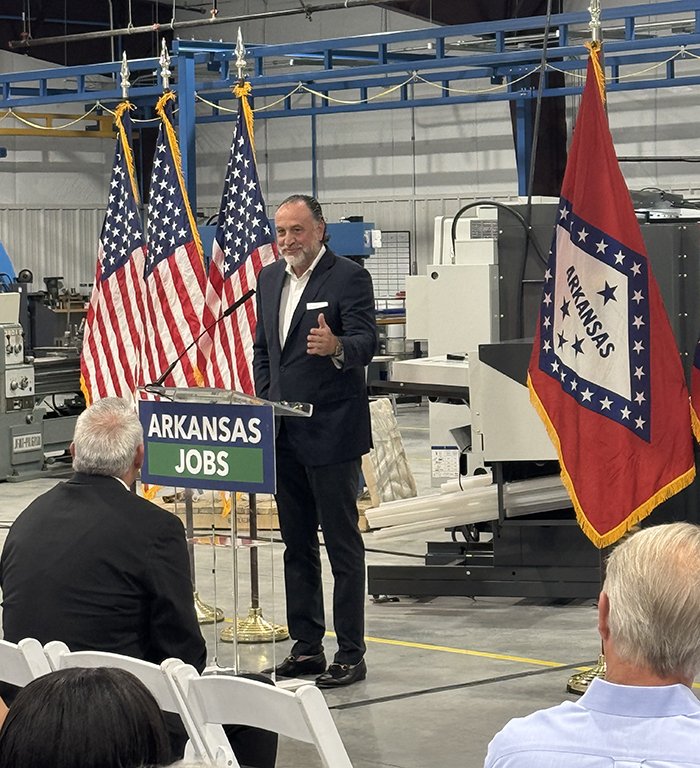
The company’s expansion carried ambitions that were measurable. Carmody said it would add 100 jobs and generate an estimated $54 million in revenue. Those were expectations stated at the ceremony. They help explain the scale of the undertaking while leaving room for the work required to turn a plan into results.
Additional jobs projected by Conveyor Technology’s CEO at the opening ceremony.
Later that year, Conveyor Technology introduced its TechRoll electric drum motor and Predictive Failure Analysis technology at an industry event in Chicago. Denton was identified as the company’s chairman. The product announcement described a combination of equipment, sensors and monitoring intended to help customers anticipate problems and reduce interruptions.
A drum motor is an unusually candid investment subject. It has a job to do. Customers need the equipment to run, and maintenance teams need information they can act upon. In that setting, a claim about technology eventually meets a production schedule. The factory supplies its own form of editorial judgment.
The second question is usually harder
By 2026, Denton was giving entrepreneurs advice with a similarly practical emphasis: prepare for investor questions and understand the money a business will require. His arithmetic for an initial estimate was memorable.
“We usually figure out what we need and then double it.”
Todd Denton, on estimating startup funding needs
The remark is advice about preparation, rather than a valuation rule. It belongs to the period when an entrepreneur must connect an idea to the resources needed to operate it. The first sale and the first comfortable month are different milestones. A financing plan has to make room for the journey between them.
There is another useful detail in his account of investing: FoxDen typically avoids startups. Advice to someone starting a business and a preference for investing in established enterprises can coexist. The distinction helps explain why so much of Denton’s visible portfolio comes with a history already attached. The customer, the staff and the product are present before the new owner arrives.
FoxDen’s team reflects the number of responsibilities sitting behind such a plan. Amy Denton is owner and chief people officer. Will Peeples is president and chief operating officer. John Novack is chief financial officer. Other roles cover restaurants, product, marketing and systems integration. An investment office acquires a different texture when the titles include the work of keeping organizations functioning.
Denton’s LinkedIn introduction adds a quieter personal detail: he is an avid golfer. His earlier basketball scholarship and the interview that introduced him as an owner of HoopLife give sport a recurring place in his public biography. Beyond the investment roles, there is someone who has spent time playing games with rules, equipment and other people.
That is also why the portfolio resists a tidy description by industry alone. Hospitality puts the customer at a table; logistics puts a driver at a gate; manufacturing puts an operator beside equipment. The setting changes, along with the skills required to serve it. Reading the businesses individually gives Denton’s career more detail than a list of sectors ever could.
The most revealing route through his career remains close to the businesses. Follow it to a parking entrance, a restaurant dining room or a motor on a factory floor. Denton’s ownership becomes understandable in those places, where another person needs something to work. The brick at the ceremony belonged to Carmody’s story. Denton’s part was helping make room for what came next.
Follow the working details
Continue with Denton’s public profiles, businesses and recorded conversation.