Kenny Gunderman began his Hendrix basketball career near the end of the bench. A walk-on forward from Hattieville, Arkansas, he was rarely used. When the college moved into Division III competition, he stayed, found more playing time and finished as a second-team all-conference selection in 1993. He also helped younger players, including Jason Rhodes, find their footing. Coach Cliff Garrison remembered him as a person who set the team’s work ethic during the transition.
There are grander ways to begin a chief executive’s biography. This one has the advantage of a bench, a change in circumstances, and someone who found a useful place in the new arrangement. It is also a decent introduction to a career that has repeatedly involved deciding what belongs together.
Today Gunderman runs Uniti Group, the communications company based in Little Rock. His central professional story has a pleasingly circular shape. He became chief executive of a business separated from Windstream in 2015. In August 2025, the two companies reunited, with Gunderman leading the combined enterprise. Corporate finance rarely offers such tidy geometry. The work inside that circle has been considerably less tidy.
A banker takes the keys
Gunderman graduated from Hendrix in 1993 and later earned an MBA at Yale. His route into telecommunications passed through KPMG, where he worked as a certified public accountant, and Lehman Brothers’ telecom investment-banking group. In 2006 he joined Stephens in Little Rock as a senior telecom banker. He became co-head of investment banking the following year.
That background matters because a fiber network is both a physical system and a financial undertaking. Someone has to pay for the construction before the future customer begins paying for the service. An executive must be able to think about routes, contracts, debt and time in the same conversation. Gunderman arrived with experience on the side of the table where transactions are assembled.
In February 2015, Windstream announced his appointment to lead its proposed real estate investment trust spinoff, Communications Sales & Leasing. The appointment took effect in March. He was leaving an advisory role for responsibility over the business itself. A banker can eventually close the presentation and move to the next assignment. The operator inherits tomorrow morning.
The new company, later called Uniti, owned communications infrastructure and leased it to operators. Windstream became its defining tenant. The arrangement divided ownership of the network from the business using it to serve customers. There was a straightforward idea underneath the paperwork: expensive infrastructure could support a separate enterprise devoted to owning it.
By November 2015, Gunderman was already describing a pipeline of possible transactions. He wanted the company to grow beyond its initial position as a single-tenant landowner. That early ambition is useful to remember when looking at the later merger. The company he took over was a starting configuration, with expansion built into the assignment.
The college connection continued while the job grew. Hendrix recognized him with its Outstanding Young Alumnus Award in 2008, and he now serves on its board of trustees. The institution appears twice in his life: first as a place where he studied and played, later as a place for which he shares responsibility. A biography can contain continuity without standing still.
The reunion changes the job
Uniti and Windstream announced their proposed combination in 2024 and completed it on August 1, 2025. Legacy Uniti shareholders received shares in the combined company and collectively held approximately 62% of its outstanding common stock at closing. Both businesses became subsidiaries under the new Uniti parent. The name and the Nasdaq ticker, UNIT, continued.
A deal like this invites the easy description of coming home. That captures the corporate family tree, but only part of the practical change. A landlord and a tenant were becoming parts of one organization. The relationship between them would no longer have to do the same work through a lease between separate companies.
The customer base also put different kinds of responsibility under one roof. Uniti’s infrastructure business and Windstream’s Kinetic residential broadband operation would sit within the combined organization. A connection sold to a large network customer and an internet service sold to a household share physical foundations. Their daily demands are different.
Gunderman also had to explain a change in financial identity. At a June 2024 investor conference, analyst David Barden pressed him on the decision to leave the REIT structure he had previously defended. Gunderman’s explanation was practical: the combination altered the income mix, while Kinetic offered opportunities to put capital into replacing copper with fiber.
He described structures as something to evaluate for shareholders rather than preserve out of habit. Asked about his own place in the resulting business, he answered with a shorter statement: “I’m a shareholder first.” He said he would stay in the role while he was the right person for it. That is his stated standard, and a fair one against which to read the next chapter.
“I’m a shareholder first.”
Kenny Gunderman · June 2024
The reunion also involved other people’s expertise. John Harrobin, whose background included Frontier and Verizon, was named president of Kinetic. Paul Bullington continued as the combined company’s finance chief. Leadership at this scale means choosing the people who will turn a corporate arrangement into operating decisions. The transaction provides the organization chart; the executives have to make the working relationships.
Little Rock, looking outward
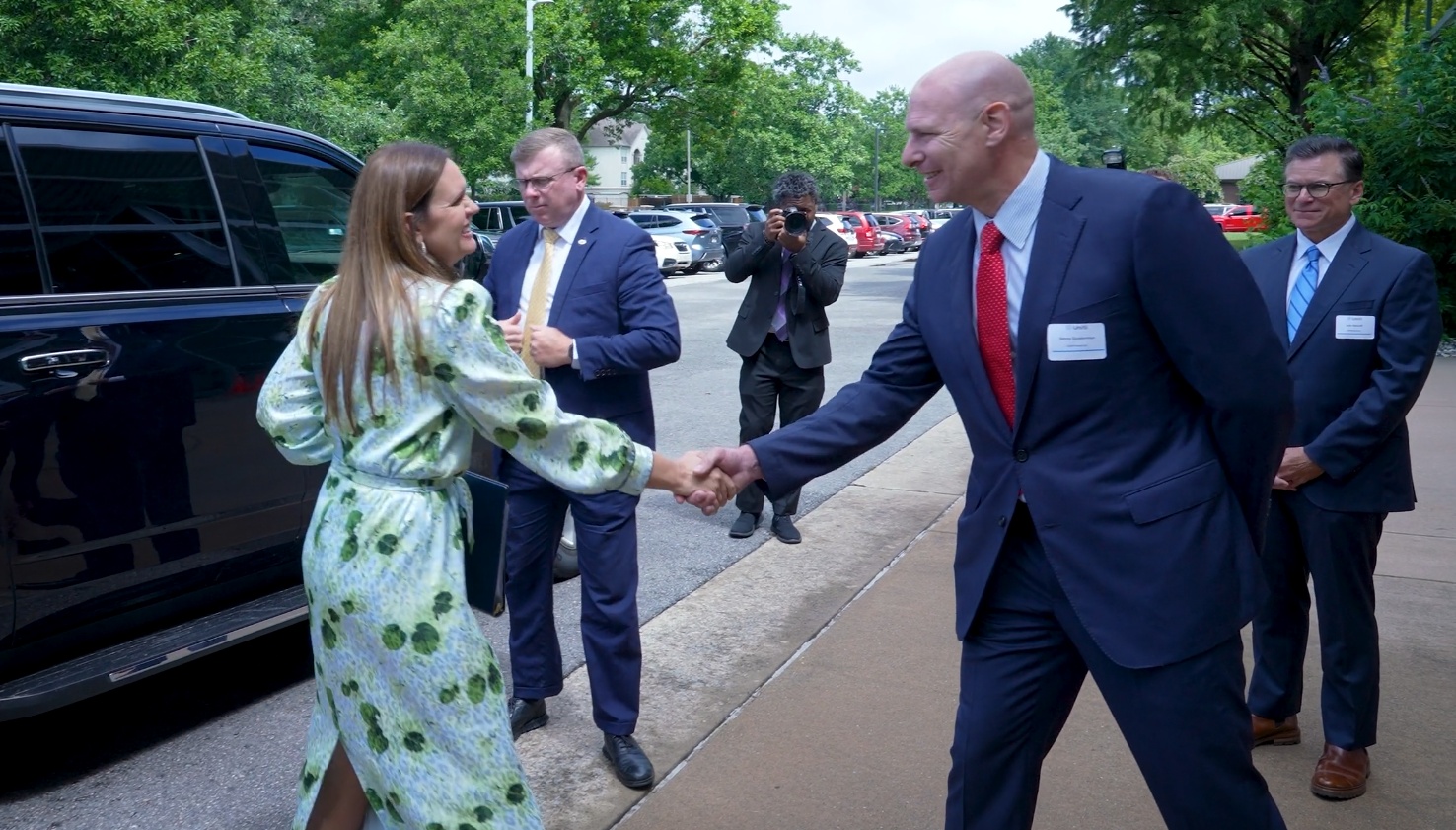
In the summer of 2024, Gunderman spoke about the planned combination with an unmistakable sense of place. He presented it as an opportunity for two Arkansas companies and for the state where they were based. Little Rock’s mayor, Frank Scott Jr., welcomed the decision to keep growing in the city. The public occasion brought a national infrastructure plan into a local gathering.
For Gunderman, Little Rock is a recurring address. Stephens is based there. Uniti is based there. His verified LinkedIn profile places him there. Alongside his Hendrix trusteeship, he serves on the Arkansas Game and Fish Foundation board. These are concrete connections to institutions beyond the company, without requiring a theory about his private life.
The geography of the business follows a related, though much wider, line of thought. Gunderman’s case for fiber investment gives considerable attention to smaller cities and communities. In an industry often described through enormous technology customers, those places supply another part of the opportunity. A household in a smaller market still has to get online.
The strategy asks readers to picture two maps at once. One shows the long routes that carry traffic between networks. The other shows the local streets where broadband service reaches a home. A company operating on both maps must consider how its large infrastructure investments translate into ordinary customer relationships.
His public language makes that connection explicit. In his LinkedIn celebration of the merger closing, Gunderman paired large corporate customers with homes and businesses in small-town America. He thanked existing colleagues, welcomed Windstream employees and ended with an enthusiastic send-off. The tone was rather less restrained than an earnings table, as a reunion announcement is entitled to be.
That enthusiasm is part of the public portrait. So is his insistence on service. It would be easy to let the vocabulary of finance swallow the people at the end of the cable. His merger message put them back into view. Customers do not experience an organizational structure. They experience whether the service works and whether someone helps when they need it.
Uniti’s combination brings infrastructure and Kinetic’s consumer business into one organization.
After everyone leaves the ceremony
A year after the merger, the conversation had moved toward construction and customers. Uniti’s second-quarter 2026 results reported 141,000 consumer fiber premises constructed and roughly 38,000 consumer fiber net additions. The company also reported a consolidated net loss of $155.9 million. These measures describe different things: progress in expanding service, progress in winning users, and a financial result that remains a loss.
The figures deserve to sit together. Construction activity does not settle the question of profitability. A new connection creates an opportunity for revenue, alongside the costs of building and operating it. Gunderman’s next chapter has to be read across those measures, rather than through whichever number makes the most agreeable headline.
Second quarter 2026 · Construction and customer additions measure different stages of the work.
In his 2025 annual-report letter, Gunderman described approximately 1.9 million homes reached with fiber at year-end and reiterated the ambition to pass 3.5 million by the end of 2029. That is a company goal, with work still to be done. The distance between those figures is occupied by crews, capital, permissions and customers deciding whether to subscribe.
By September 2026, he was discussing post-merger execution at Citi’s Global TMT Conference. His argument continued to emphasize where Uniti’s networks are located and how the company can serve wholesale demand as well as residential users. He also described the need to follow construction with additional business on shared infrastructure. The cable earns its commercial purpose through use.
There is a satisfying career arc here, but no need to manufacture a final victory. Gunderman has gone from advising telecom transactions to operating the company those transactions shape. He has overseen separation, expansion and recombination. Each phase has left him with a new version of the same obligation: make the arrangement useful to the people depending on it.
The Hendrix bench belongs near the beginning because it supplies a small, specific memory of someone finding room to contribute during a change. The network belongs at the end because the contribution is now measured differently. More than a decade into the job, Gunderman’s story continues through the places that get connected, the customers who stay, and the organization that has to deliver after the handshake.