The useful thing about a long wire is that it refuses metaphor. It must leave one place, cross actual ground and reach another. In western Montana, that ground may be frozen, on fire, waiting on a permit or simply too broad for the arithmetic to behave. Jason Williams runs a communications company in this landscape. His working vocabulary includes fiber, radios, operating expense and easements. It also includes patience.
Williams is the chief executive of Blackfoot Communications, the Missoula company descended from a telephone cooperative formed in 1954. Ten farmers, ranchers and business owners each put in $50 because the established phone system did not serve their rural communities. The technology has changed several times since. The complaint has not: distance should not disqualify a place from modern life.
His route to the job was less engineered. A South Dakota native, Williams studied literature at Notre Dame, moved into telecommunications regulation, then earned a law degree at the University of Montana. During law school he interned at Blackfoot. He left for private practice, where rural telephone companies became clients, and later worked inside NorthWestern Energy and Idaho Power. A year in Washington as an adviser to a Federal Communications Commission member added federal policy to the mix.
In 2012, Blackfoot CEO Bill Squires recruited him back as general counsel. Williams moved to chief operating officer in March 2016. When Squires died later that year, Williams became interim chief executive and then CEO. The sequence is neat on paper. The experience was not. He inherited a role attached to a colleague's sudden absence, inside a company whose future required expensive choices with long consequences.
The ascent“I started at the bottom rung, and now I’m leading a company I love.”
The advantage of arriving without a cape
Williams does not pretend his résumé was designed for a network operator. He has said that accepting the CEO job was his largest professional risk. His formal education was in literature and law, not engineering or business. A board of nine cooperative trustees gave him the chair anyway. The decision makes more sense when his career is read as an education in translation: between regulation and operations, public purpose and private cost, technical expertise and the customer whose internet has stopped working.
His leadership advice carries the fingerprints of that background. Trust subject-matter experts, but keep a measure of skepticism. Hold the long-term view without excusing weak short-term results. Repeat anything important enough to survive the day's distractions. Williams jokes that repetition may make his employees wonder about him. The joke serves a serious point: strategy disappears quickly if it is only announced once.
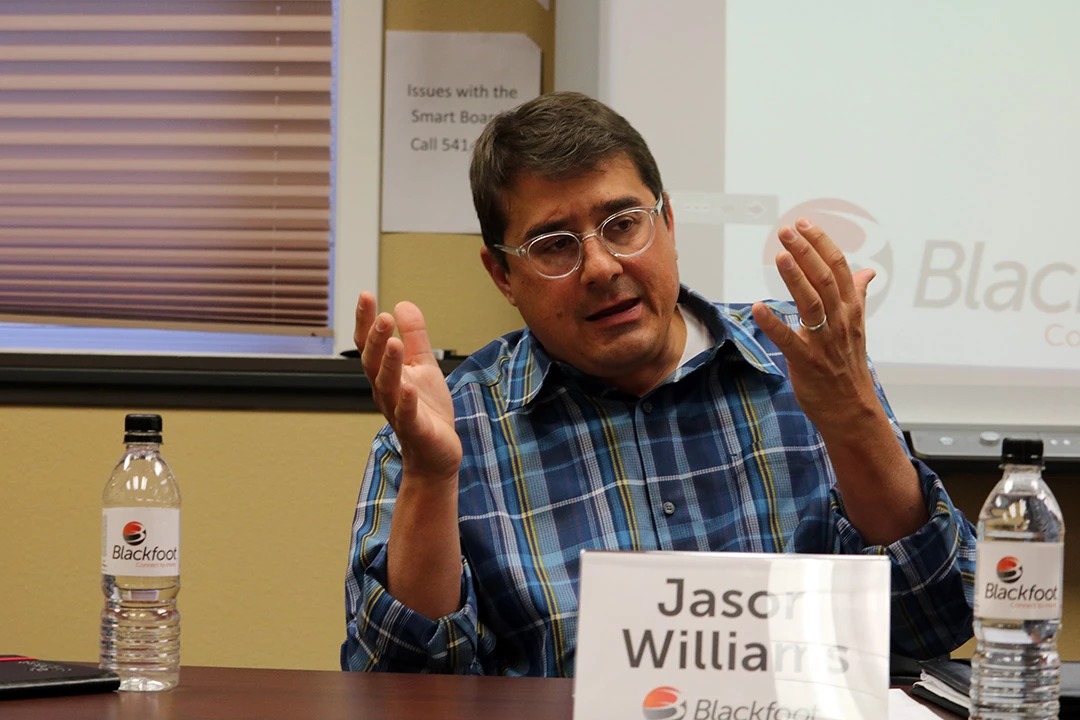
This is a CEO comfortable with an unfashionable sentence: the company should have begun its fiber conversion earlier. Blackfoot had spent years growing its competitive business operation while portions of its rural copper network aged toward the half-century mark. Copper still carried service, but it also carried rising maintenance bills. Fiber offered more capacity and lower operating friction. The difficulty was paying for it and reaching everyone.
When the map joins the meeting
A rural fiber plan has more actors than the org chart suggests. Snow can close the season. Wildfire can rearrange priorities. A federal approval may sit still while crews and equipment wait. Railroad crossings introduce another authority, another clock and sometimes another beginning when personnel change. Williams's answer is to engineer more projects than Blackfoot can construct at once. If one route stalls, crews can move to another instead of losing Montana's brief building window.
Fiber is the preferred destination, not a religious doctrine. Blackfoot also operates fixed-wireless networks on licensed and unlicensed spectrum. Wireless costs less at the entrance to a market, but tower rent, labor and radio replacements follow. In thinly populated country, limited subscriber revenue must support those recurring expenses. Some homes remain too expensive to reach with fiber, so Williams treats the choice as a ledger rather than a slogan.
Two routes across difficult ground
Illustrative, not a technical scorecard. Williams uses fiber for long-life capacity and fixed wireless where the last physical connection is uneconomic.
The result is measured in unromantic increments. Blackfoot reported 257 miles of fiber, 1,027 fiber drops and nearly $20 million invested in broadband infrastructure during 2020. In 2022, it reported more than 500 miles built and more than 1,500 connections added. Nearly 1,800 locations followed in 2023. By the time Williams discussed the program in 2024, 35 percent of rural customers had been converted to fiber since 2017.
A cooperative remembers the porch
Blackfoot's ownership structure gives the work a particular tempo. Williams reports to trustees who represent more than 15,000 member-owners. Surplus can return to members as capital credits or go back into the network. A disappointing quarter matters, but so does whether a line built today will serve a valley decades from now. The constituency has names, roads and an annual meeting.
That local compact appears in places beyond a trench. Williams has described employees driving Blackfoot trucks in parades, turning up at fairs and rodeos, and volunteering on community projects. Participation in the company's ambassador program has reached as much as 40 percent of employees. He is especially fond of the rural skate parks created by Jeff Ament's nonprofit and supported in several Blackfoot communities. When Williams drives by, he sees them full of children. In a small town, a concrete bowl can be social infrastructure too.
He has also worked beyond Blackfoot's footprint. In 2023, after serving as vice chair, he was elected chair of USTelecom's board. He later joined broadband executives and policymakers at the association's 2025 American Connectivity Forum. In Missoula, he serves as a past chair and director of the local economic partnership. The connections are useful: rural networks are built locally but governed, financed and supplied through systems that extend far beyond the county line.
Modernize the network, then the habits
The physical conversion is only half of Williams's project. Blackfoot spent its first 50 years as a heavily regulated telephone company. By his account, the old institutional reflexes can outlive the system that created them. His preference is for simpler, sometimes off-the-shelf software rather than complexity produced for its own sake. Better circuit records, geographic data and network monitoring should help staff spot failing optics, damaged fiber or looming capacity limits before urgency raises the bill.
Artificial intelligence enters this story quietly. Williams has supported baseline AI training for employees and the controlled introduction of tools into everyday applications. In operations, the ambition is predictive rather than theatrical: collect better data, identify root causes sooner and automate repeatable work as the customer base grows. He places network security beneath the whole effort, a foundation rather than an accessory.
That security concern has begun to produce institutions as well as products. In 2025, Blackfoot became the first corporate community partner in Montana for the University of Montana's PISCES program, which gives students supervised experience monitoring public infrastructure while helping rural communities improve their defenses. In February 2026, the company announced a private point of presence for a managed secure-access service that combines wide-area networking, controlled access and threat protection. Neither project makes for the old photograph of a telephone lineman on a pole. Both belong to the same obligation: a connection is useful only when people can trust it.
The changes also expose the peculiar burden of longevity. A cooperative founded around shared party lines must now explain zero-trust access, while still supporting customers whose geography leaves them without reliable mobile service. Blackfoot has one foot in each era. Williams's task is to move the newer one forward without pulling the older one out from under anyone.
There is a nice symmetry here. A literature student became a regulatory lawyer; the lawyer became an operator; the operator now oversees engineers laying glass through rock and soil. His contribution is not to out-engineer them. It is to ask whether the plan survives the weather, the permit, the balance sheet and the promise made to the member at the far end.
The operating standardWilliams wants colleagues who never settle for “good enough.” The phrase is less motivational poster than maintenance schedule.
He does permit himself one extravagance. Asked for an opinion on which nearly everyone disagrees with him, Williams chose the Seattle Mariners and baseball immortality. This is a safe form of executive dissent: brave, cheerful and unlikely to disturb a fiber splice.
Blackfoot's oldest story begins with ten people putting down $50 apiece because nobody else intended to connect them. Williams now works with more zeroes, more technology and more regulators. Yet his task remains recognizable. Build the line. Keep it working. Admit when the route needs changing. Remember the people waiting at the other end.