The first version looked less like the future of internet infrastructure than the aftermath of a hurried garage repair. A reprogrammed router sat duct-taped to the back of a solar panel. It was rough, literal and useful. Danny Gardner had reduced his idea to the parts that needed proving: a network node could power itself, speak to its neighbors and carry a connection beyond the reach of convenient cables.
That prototype was born at the University of Illinois Urbana-Champaign, where Gardner studied electrical engineering and spent his senior design project covering the engineering quad with a solar-powered mesh network. The assignment ended. The problem did not. In 2017, the year he graduated, the project became Mesh++, a company built around making outdoor Wi-Fi less dependent on the expensive rituals of trenching, wiring and finding an outlet.
Gardner had been absorbed by wireless communications and electronics since he was young. His public project list has the particular cheerfulness of someone who considers a 6GHz synchronous vector network analyzer a recreational activity. He described that 2016 build as a personal project, “for funsies.” One year later, the hobbyist’s instinct had acquired customers, prizes and a mission.
“A lot of people talk about developing a business one day - no. Do it now.”Danny Gardner, 2017
A local question changes the map
Mesh++ was initially aimed at emerging markets. The premise was clear: stable communication is a foundation for education, commerce and participation, yet the physical infrastructure behind a connection can be painfully costly. Gardner looked at places such as Tanzania and India while researching the market. Then a chance campus encounter with Chicago Mayor Rahm Emanuel introduced a useful complication. Why travel so far to solve a problem that also existed in Chicago?
The question did not shrink the ambition. It made the map more honest. Connectivity gaps are not confined to one continent or income category. They can sit inside a wealthy city, beside homes where students struggle to get online, or across a public park where traditional installation remains too cumbersome to justify. Mesh++ tested its technology at Bessemer Park on Chicago’s South Side. A global problem had found a local workbench.
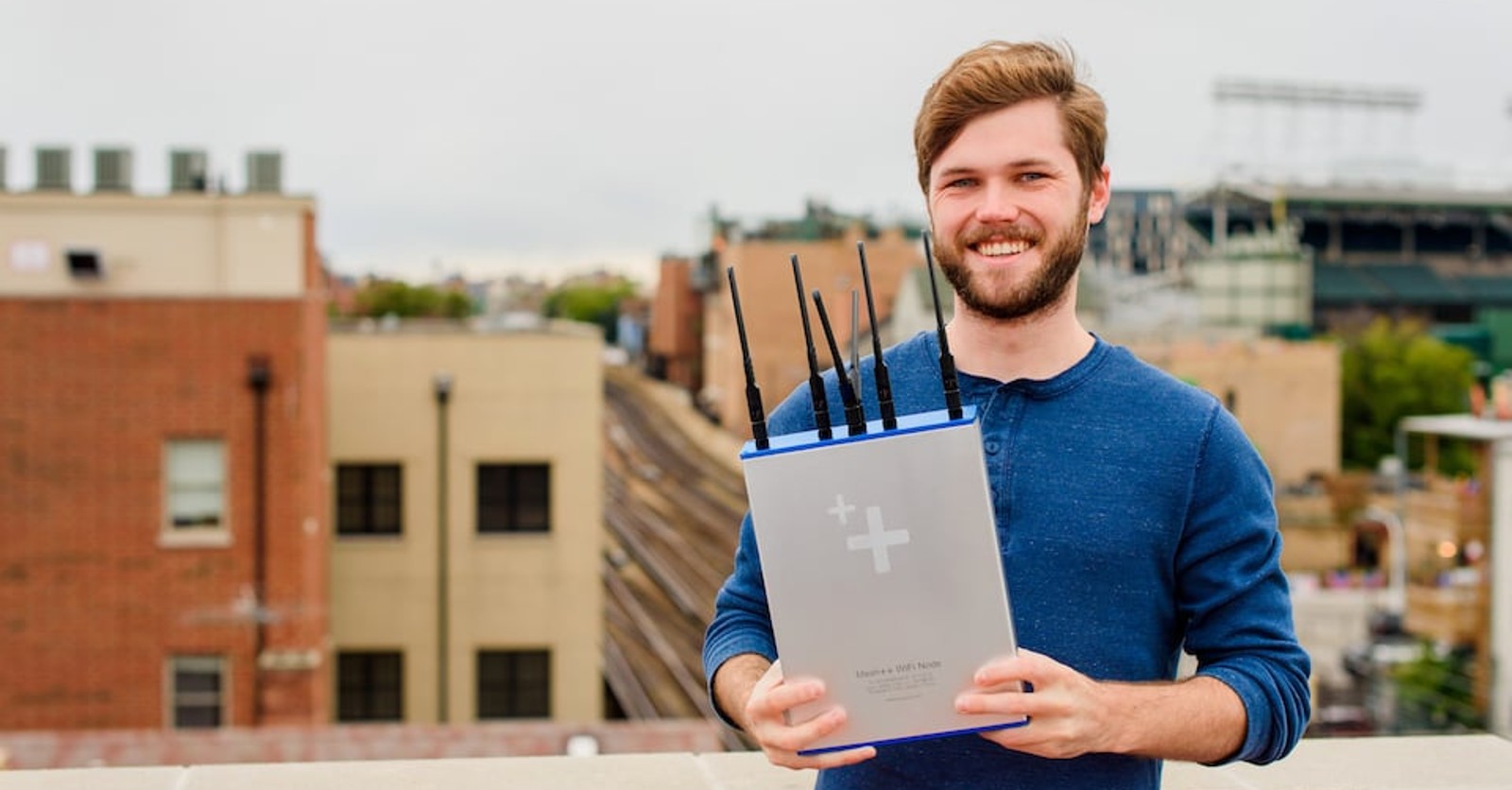
Gardner finished his degree in 2017, began graduate study at Stanford and worked at Apple, then left both paths to put his energy into Mesh++. By the end of that year he had moved to China. The company joined HAX in Shenzhen, an accelerator where a hardware idea has to confront suppliers, production tolerances and the stubborn fact that atoms decline software’s invitation to update instantly.
The product is what you can remove
Solar-powered Wi-Fi already existed. Gardner’s wager concerned the total burden of deployment. Traditional outdoor coverage can require power lines, Ethernet, fixed supports and a crew. Once placed, a node may become awkward to move, even when a wall, a tree or an unexpected crowd alters the radio environment. Mesh++ combined onboard power with a proprietary routing protocol and remote management so nodes could be installed quickly, rearranged and monitored from elsewhere.
In a mesh, routers relay traffic to one another rather than asking every user to reach a single central access point. Outdoors, where node placement can preserve clear lines of sight and sensible spacing, that arrangement becomes especially useful. The company’s S618 specification lists Wi-Fi 6, a line-of-sight range up to 350 meters under test conditions, support for 25 to 500 users depending on use, an IP67 enclosure and battery options lasting up to ten days. The numbers matter because the device is designed for places where a service visit is not a casual stroll down the hall.
Gardner summarized the philosophy with engineer’s economy: “Mesh networks are designed to be flexible.” The sentence also describes the company’s education. Each deployment has been a conversation between a diagram and a place.
“There are areas in every country, even in the U.S., where internet is desperately needed.”Danny Gardner
The field grades the work
By 2018, Mesh++ had installed a network for officially sponsored events around Super Bowl LII in Minneapolis. That summer it covered a Special Olympics event at Soldier Field. The venue offered a hardware founder’s preferred form of clarity: little time, a real crowd and no patience for a laboratory excuse. During setup, the team caught a code glitch it would not have found in an office or a smaller test site.
In 2019, Mesh++ provided connectivity for media at the Academy Awards. Gardner was also named to Crain’s Chicago Business 20 in Their 20s. The juxtaposition was useful. Glamorous locations may attract attention, but Gardner repeatedly returned to the places where a signal changes access rather than convenience.
When school moved online in 2020, the physical edge of the internet became impossible to ignore. Mesh++ helped provide free access for underserved students in Champaign County and supported an Ignite Cities initiative serving families in Chicago, Columbia, Miami and New Orleans. A lesson delivered through a browser still depends on a radio, a power source and the distance between a home and the nearest reliable connection.
The quad becomes a company
Gardner graduates, wins university venture prizes and turns his senior design network into Mesh++.
Networks meet crowds
Deployments support Super Bowl events, Soldier Field and media at the Academy Awards.
Access becomes the assignment
Remote-learning projects expand while Mesh++ raises a $4.9 million seed round.
Manufacturing moves closer
A partnership begins to manufacture solar-powered internet routers in Uganda.
From research mode to reach
Mesh++ announced a $4.9 million seed round in October 2021 with investors including Lateral Capital, Anorak Ventures, First Leaf Capital, SOSV, GAN Ventures, TechNexus and Illinois Ventures. Gardner described the financing as a turn away from years dominated by research and development and toward sales, distribution and a more mature organization. A machine can work beautifully and still fail its mission if too few people can buy, install or support it.
That same year, Illinois ECE selected Gardner for its Young Alumni Achievement Award, recognizing both the creation of Mesh++ and his contributions and mentorship in the university’s entrepreneurial community. He was the youngest recipient in the award’s 23-year history at the time. In his own note about the honor, Gardner promptly widened the frame to include his team and thanked the office security guard who had taken his conference-room picture.
The recognition completed a tidy loop back to campus. Gardner had entered the university’s startup programs as an engineering student who openly admitted he did not know how to turn an idea into an impact. The Technology Entrepreneur Center, iVenture Accelerator and faculty mentors gave him places to test both the device and the business around it. In 2017, Mesh++ placed second in the Cozad New Venture Challenge, earning the Dr. Paul Magelli Innovation Prize, while Gardner received a runner-up award in the Illinois Innovation Prize. Five years later, the former participant was being honored in part for mentoring the same entrepreneurial community. The circuit had found its return path.
The joke has four legs. Mesh++ lists Hershey the Dog as “Security” beside its engineers, operators and sales staff. It is a small bit of company-page mischief in a story otherwise filled with stern nouns: infrastructure, throughput, deployment, inequality. Hardware benefits from somebody remembering that the humans still have to enjoy the room.
The network kept traveling. Mesh++ units reached Ukraine in 2022. In July 2023, the company and Uganda’s Research and Education Network announced a partnership to manufacture solar-powered internet routers in Uganda. The arrangement put production nearer to communities dealing with unstable electricity, limited grid coverage and the high cost of conventional network construction. It also linked manufacturing with universities and technical education.
By November 2024, Gardner and Mesh++ chief operating officer Tamara Hamdan could present a broader deployment map at an IETF gathering in Dublin. It included a network serving 30,000 residents of Mandela Park in South Africa, donated nodes used at shelters after the 2023 Maui fires, a mobile classroom in Kenya, 50 units sent to Ukraine, and installations in Goma, Chicago, New Orleans and Colombia. The collection is less a victory lap than a catalogue of awkward conditions. Each place asks the same hardware to negotiate a different mix of distance, weather, power and local operation.
Infrastructure that travels lightly
Gardner’s story resists the usual fantasy that digital products float above the physical world. Every wireless connection has a body. It needs an enclosure, power, antennas, mounting hardware and a route through the air. It must survive heat, rain, crowds, bad placement and good intentions. The elegance of Mesh++ lies in acknowledging those constraints, then reducing how many of them an installer has to solve before anyone gets online.
The lesson is portable beyond networking. A product for underserved places cannot assume abundant support. It has to arrive with fewer demands. It should be movable when the first plan meets the actual terrain. It must let local operators do more without waiting for a specialized crew. And it should turn the founder’s grand mission into a series of ordinary actions: mount this, point that, switch it on.
The duct tape in the first prototype has long since given way to engineered enclosures and production hardware. Yet it remains the perfect artifact from Gardner’s career. It held together exactly enough of the future to test it in the present. For a company trying to put Wi-Fi beyond the comfortable edge of the grid, that was the right place to begin.