A ten-paragraph explanation of a congressional bill is a peculiar invitation to democracy. The door is open. Behind it waits a small examination in legislative procedure. Bart Myers had a practical objection to this arrangement: making information public did little for a reader who could not make sense of it. His company, Countable, put writers and editors to work on the distance between the document and the person.
In 2015, he offered a concrete example. An official summary of a cybersecurity bill ran to ten dense paragraphs. Countable’s team made its explanation three paragraphs long. Readers could understand what the proposal would do without first acquiring the professional vocabulary of the people who wrote it.
That modest act of translation gets close to the central preoccupation of Myers’s career. He has built businesses around finding things, understanding them, and doing something next. The things have included television shows, congressional bills, and candidates looking for their first supporters. The stakes have changed considerably. The inconvenience of the first step keeps turning up.
A government document, translated
Myers’s argument about government information was unusually specific. Publishing legislative data in bulk was useful to developers and reporters. An ordinary citizen still needed an explanation. Countable’s summaries assembled a proposal’s purpose, cost, status, and arguments for and against it on one page. The work depended on people reading the material carefully before anyone could tap a button.
He also acknowledged the open-government work that made his own product possible. Other activists and technologists had opened up the information Countable used. He imagined someone else eventually building on what his team produced. There was room in that account for successive contributors, each making the material more useful to the next person.
official bill summary
Countable’s explanation
This was a founder arguing for the importance of editing. Much of the appeal of a political app could fit in its interface, but somebody still had to decide which words belonged there. A short explanation carries responsibilities of its own. It must leave the reader with enough information to make a choice.
First, find the television
Myers came to this work through a route that included corporate technology and online entertainment. He graduated from The Evergreen State College in 1997, began his career at IBM Global Services, and later worked at the video company Guba. His academic background included international studies and political science. Technology and politics both had a place in the story before Countable acquired a name.
At SideReel, which he co-founded, the immediate task was to help people find, track, and watch television online. Rovi bought the company in February 2011. Its subsequent financial filing recorded a cash purchase price of approximately $35.5 million. That figure belongs to the transaction; the more relevant detail for Myers’s next chapter is the kind of business he had helped build.
SideReel organized a scattered viewing experience. Myers then worked at Rovi as vice president of consumer web. In 2013, he helped reacquire SideReel under All Media Network. He had experience making a consumer service, selling a company, and continuing to operate inside a larger business before turning his attention to the machinery of government.
The political spark was less orderly than a television guide. Looking back on the period after the 2012 presidential election, Myers described a country arguing across a divide. His memorable complaint was simple: “But no one was listening.” Countable would try to give an opinion somewhere useful to go.
Congress gets a feedback button
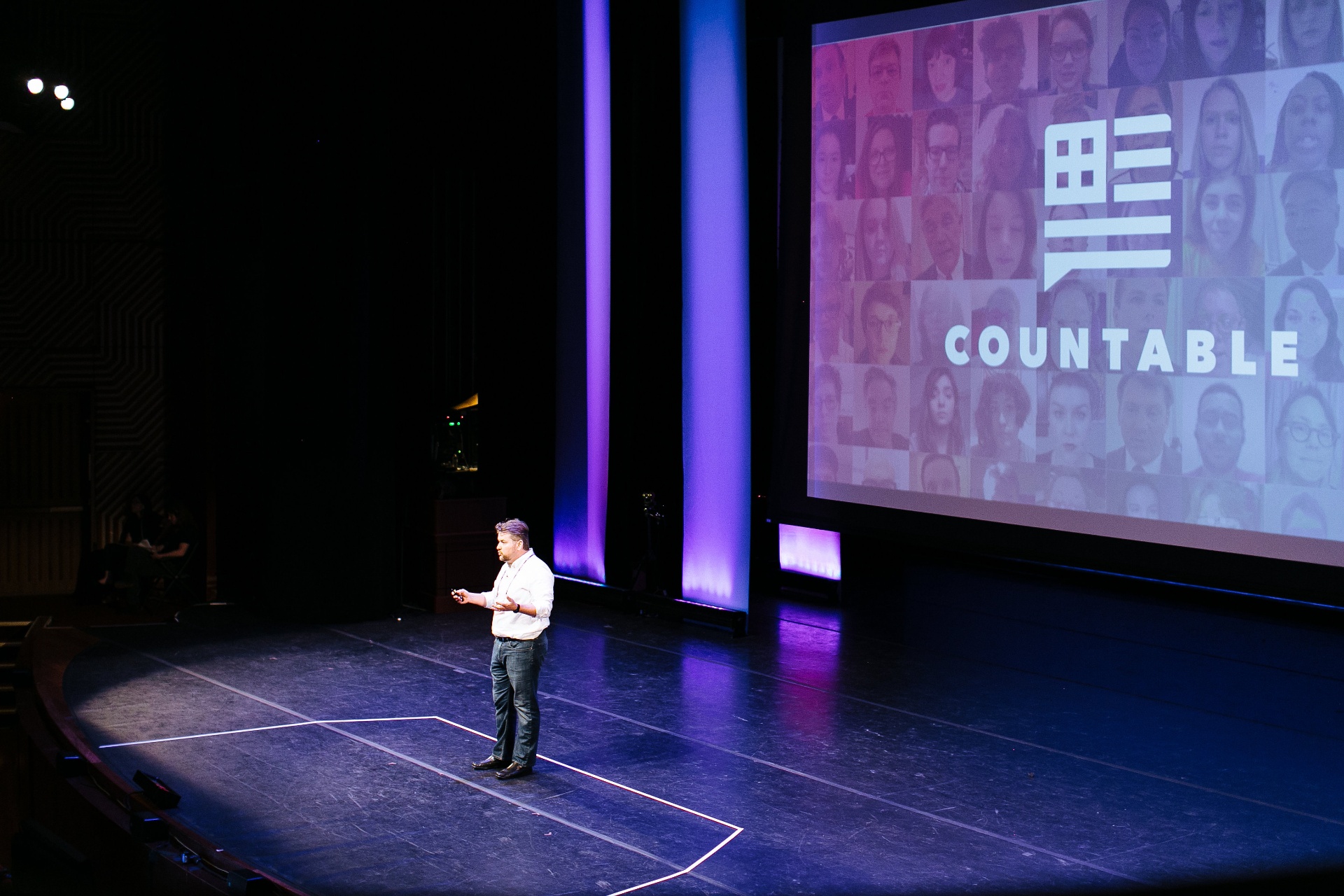
Myers and Peter Arzhintar founded Countable in 2013. The service launched publicly in May 2014. Its proposition was direct: learn what Congress was considering, decide where you stood, and communicate that position to your representatives. The website and app connected the reading to the response.
In his own introduction to the product that July, Myers described large YEA and NAY buttons above each bill. Users could register a position, personalize a message, and compare their views with their representatives’ eventual votes. He wanted following Congress to fit into ordinary daily habits, alongside the other things people already checked on their phones.
By September, Countable had added the opportunity to “boo” or “high five” a lawmaker after a vote. The vocabulary had the informality of a stadium. The sequence was deliberate: tell the official what you want, learn what the official did, and respond. Government had acquired a feedback button, with rather less ceremony than it usually prefers.
- 01Read the bill
A plain-language explanation - 02Take a position
Support or oppose - 03Contact Congress
A message to your lawmakers - 04Check the vote
See how your view compares
There is a companion detail in Myers’s writing from that year. In December, he urged people to show appreciation to congressional staffers, the workers answering constituents and handling complicated issues while their bosses received the attention. His civic technology operated at the sending end of an inbox. He also took time to consider the people at the receiving end.
A 2016 account of Countable’s San Francisco coworking home supplied a smaller glimpse of his working life. Myers appreciated the friendly atmosphere and the places available for conversations. The surroundings were less formal than Congress, though apparently no less inclined to discuss politics. The company’s effort to connect people was being built among other people doing exactly that.
The audience starts doing things
Countable’s business widened beyond its original consumer service. Organizations wanted the machinery for their own communities. Countable Pro and its Impact Hub gave companies, campaigns, and causes a branded setting for activities such as polling, petitions, advocacy, and contributions from users. The tools could be adapted to the community using them.
By May 2020, Myers reported that people had taken more than 40 million actions on Countable. The figure described activity on the platform at that time. It did not mean 40 million laws changed, or 40 million separate people. Still, it explained why the company was selling the ability to do something after encountering a piece of information.
The customers he discussed included Starbucks, Levi Strauss & Co., Patagonia, and the Environmental Defense Fund. Their purposes differed. Each had a reason to gather people around an issue or a shared interest and give them a next step. Countable’s product had to serve the organization commissioning it and the person being asked to participate.
Rovi acquires
SideReel
Countable
launches publicly
EV3 acquires
Countable
Crowdpac becomes
CrowdBlue
In October 2021, Countable announced a $12 million Series A led by Canaan Partners, with Ulysses Management and Global Catalyst Partners participating. The financing supported an enterprise engagement business whose ambitions now extended well beyond explaining the next congressional vote.
EV3 Global announced its acquisition of Countable in June 2024. The buyer emphasized employee engagement: communication, access to resources, and connections among people working in different places. Myers spoke about listening to employees and connecting them with one another. The same company that had begun with constituents now also had a place inside the workplace.
Before someone becomes a candidate
In April 2025, Crowdpac announced Myers as its new CEO alongside a $4 million funding round led by chairman Chris Tavlarides. The appointment brought him into political fundraising and campaign infrastructure. In June, the platform relaunched as CrowdBlue, with an explicitly Democratic and progressive focus.
One feature addressed a moment that precedes the usual campaign announcement. A prospective candidate could gather financial pledges while deciding whether to run. Supporters would be charged once the candidate launched. The arrangement gave someone a way to test support before committing to the entire undertaking.
Myers was now working on another side of political participation. Countable had helped constituents approach elected officials. CrowdBlue could help someone approach the possibility of becoming one. Head of campaigns Jaime Peters worked on the practical obstacles facing newcomers: learning the process, building a network, and getting a campaign underway.
“At its core, it’s really a social platform.”
Bart Myers, on CrowdBlue, January 2026
By January 2026, Myers was describing a platform modeled on the visual feeds familiar from Instagram and TikTok. Campaigns could be found by state, election year, political affiliation, and other filters. Fundraising sat alongside that social experience, including integration with ActBlue. The candidates included people pursuing school board seats and other offices far down the ballot.
The tools continue to change. CrowdBlue’s current public site also offers an AI-powered Campaign Coach, described as providing strategy, messaging, and fundraising advice tailored to a campaign. It adds another kind of guidance to a product already concerned with helping people get started.
Finding people after the feed scatters
ConnectBlue, another Myers venture, addressed distribution. It went live in October 2025, connecting independent and Democratic-aligned media properties so advertisers could reach their audiences through a coordinated network. Newsletters, podcasts, and creators were part of the picture. The audience was spread across places that required separate conversations to buy.
Myers described the difficulty of reaching those outlets individually and the interest in advertising through trusted media brands. ConnectBlue also sought advertisers outside politics. Its commercial proposition depended on making a fragmented landscape easier to navigate while leaving the participating publishers with their own identities and audiences.
His current roles bring these strands together: founder of ConnectBlue, CEO of CrowdBlue, and chairman of Countable. The early television venture can seem a long way away. Yet the work still involves helping people find a route through an abundance of information, with consequences that extend beyond what to watch tonight.
Asked in 2015 for the leading mistake entrepreneurs make, Myers answered with one word: “Hubris.” It was an economical warning from someone whose work has required considerable ambition. His products are easier to understand at their smallest scale: three readable paragraphs, a message that reaches an office, a pledge that lets a possible candidate begin.