Will Bodewes gave himself a fairly unglamorous instruction when he started Phonely. He wrote it on a sticky note and kept it on his desk for two years: “there are no shortcuts for you, Bodewes.” The surname makes it sound like a coach addressing a player who has suggested skipping practice. In this case, player and coach shared a desk.
By April 2026, Phonely had announced a $16 million Series A. The company makes AI agents that answer business phone calls, book appointments and move information into the systems businesses already use. Bodewes is its co-founder and CEO. The financing makes a convenient place to begin his story, although convenience is a slightly suspicious virtue in a life with this much pedalling.
His earlier projects were more tangible. There was a mountain bike, a mechanical engineering degree, and a picture on the wall that could play music. They belong in the story because each involved making an idea behave outside the agreeable conditions of the imagination. A trail has rocks. A speaker has components. A customer has a question and would prefer an answer before lunch.
Seventeen days, ten hours, eleven minutes
In 2015, Bodewes entered the Tour Divide at 17. The finishing list records him as a rider from Hazelhurst, Wisconsin, with a time of 17 days, 10 hours and 11 minutes. Count down the finishers and his name appears ninth. Those numbers are sufficient to establish the scale of the undertaking without adding a legend to them.
Years later, he described a phone call to his father during the race. He wanted to stop. His father asked whether he could manage another day. Bodewes says he began breaking the remaining distance into smaller units: a day, an hour, a mile, a pedal stroke. In his telling, the same habit followed him into building a company.
The interesting part is the size of the question. Finish an entire continent-spanning ride? That is a difficult proposition to consider from the saddle. Ride a little farther? There is something available to do immediately. His account makes persistence sound less like a personality bestowed at birth and more like an arrangement with the next piece of road.
“Can you do one more day?”The question Bodewes recalls his father asking during the Tour Divide
The engineer who objected to ugly speakers
At the University of New Hampshire, Bodewes studied mechanical engineering and raced on the Nordic ski team. His athletics record lists four appearances on the National Collegiate All-Academic Ski Team, the men’s Nordic MVP award in 2019 and a co-captaincy in 2020. That year, he also qualified for the NCAA championship. The academic and athletic calendars were both full.
His personal website records a B.S., earned magna cum laude between 2016 and 2020. It also lists work as a physics learning assistant, a resident adviser and involvement in the engineering honor society Tau Beta Pi. The picture is of someone trying several forms of responsibility while still technically occupied with being a student.
Alongside school, he accumulated business ideas. By his account, the list grew beyond 150. After graduating, he chose a speaker that looked like a picture. Conventional speakers offended his eye; he wanted good sound without the bulky object announcing how the good sound was being made. Mechanical engineering had supplied a useful vocabulary for this particular complaint.
Spoke Sound’s first product arrived in early 2021. It used licensed distributed mode loudspeaker technology, turning a flat surface into the sound-producing element. Customers could choose artwork or upload their own image. Bodewes arranged suppliers for the printing and circuit boards, then brought the parts together in Durango. At the time, the speakers sold for $195 to $375.
His brother Luke helped him get started with the legal and business work while he concentrated on engineering. The division was practical and affectionate: an idea pitched to a brother became a company with things to manufacture. Bodewes later moved on from Spoke Sound, saying he wanted his next venture to address a more pressing problem. A good-looking speaker had taught him to ask how urgently somebody needed the thing he was building.
A grocery-store solution to a mountain-bike problem
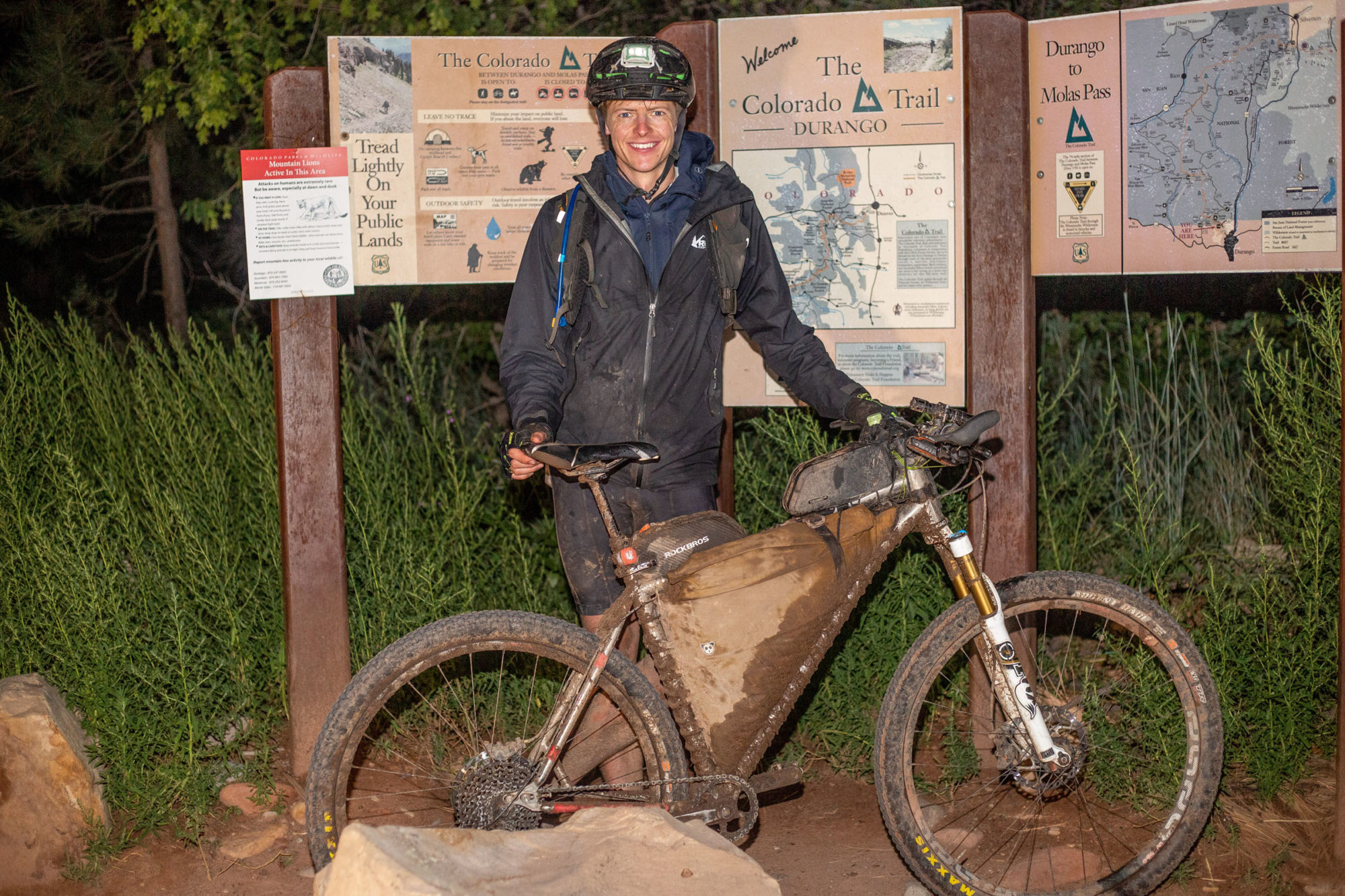
Business did not absorb all his attention. In July 2021, Bodewes finished second in the Colorado Trail Race, completing the route in four days, 11 hours and 30 minutes. The following year he returned and won. This time, the clock stopped at four days, 18 hours and 36 minutes. The slower time and better placing are a useful reminder that a race result includes the conditions, not merely the rider.
His 2022 equipment list was an exercise in selective extravagance. He rode a titanium Kona Raijin with a custom frame bag, supplemented by inexpensive bags bought online because, he explained, the money had run out. There is something reassuring about a future venture-backed founder whose equipment budget had already met an accountant in the form of an empty wallet.
On the trail, his bottle of chain lubricant leaked. He bought olive oil at a grocery store and used that instead. A broken chain and a troublesome derailleur added further complications. He reached Durango ahead of the other riders, with his brother waiting with pizza. For all the elaborate gear available to cyclists, dinner still gets its own place in the finishing arrangements.
Bodewes wrote a lengthy account of the race on his own blog. Among its quieter details, he asked Siri to tell him stories while riding. Hansel and Gretel and the big bad wolf supplied a short-lived entertainment service before the repertoire began repeating. His later career would involve asking rather more of a talking computer.
The phone call that became the company
Phonely began with a problem in his father’s business: calls arrived together, receptionists could not keep up, and customers were being missed. Bodewes and Nisal Ranasinghe were researching AI at the University of Melbourne. Here was a task that was easy to state and difficult to deliver. Could software answer the telephone and actually help?
They started Phonely in 2023, after working in Professor Saman Halgamuge’s research group. Ranasinghe became co-founder and CTO. The early proposition was straightforward: use a business website to help create an AI receptionist, connect it to tools such as a calendar, and let it handle questions, bookings and routing. Beneath that simple description sat several systems that had to cooperate quickly.
In May 2024, the founders interviewed with Y Combinator at 3 a.m. Hours earlier they had won the People’s Choice Award at a Startup Victoria AI pitch event; Bodewes had a flight to Sydney shortly after the interview. It was an untidy little cluster of opportunities. Phonely joined YC’s summer 2024 batch, with an initial $500,000 investment.
Moving to San Francisco supplied less photogenic milestones. Bodewes recalls an apartment without furniture or bowls, Ranasinghe eating cereal from a cup, and cheese pizza appearing on his own menu night after night. Sticky notes on a wall served as project management software. Later, when the team made a Series A announcement video involving a burning table, he preferred to tell the story of those people and those early dinners.
Four seconds is a long time to say hello
An AI receptionist has a demanding audience. Someone calling a business is usually trying to accomplish something. A voice can be pleasant, and an answer can be correct, yet a long pause still makes the conversation awkward. Bodewes described the wait as one of the giveaways that a caller was speaking to a machine.
By June 2025, Phonely was working with Maitai and Groq on custom models and faster inference. In a company-published benchmark, the final model iteration completed its output in 339 milliseconds at the 90th percentile, compared with 1,446 milliseconds for the listed GPT-4o baseline. These were measurements of model completion in that evaluation, rather than a stopwatch reading for every complete phone exchange.
The engineering detail matters to his story because it explains what the research background was for. A demo could show that an AI could talk. A business needed it to keep talking at the right pace, follow the conversation and complete the work. In June 2025, Bodewes described the intervening year as the work of making those early demonstrations function consistently across different organizations.
The commercial model changed too. Phonely began with smaller businesses and moved toward enterprise call centers. Bodewes has described the attraction of larger customers: the company could give them the support needed to configure and run their workflows. In his Series A announcement, he said the team had grown from five to 30 in a year and call volume had reached millions per month. Those were his reported milestones, attached to a product still being revised.
Model completion time
The people who stay at the table
Bodewes’s account of the early customer work is unusually plain. There was a period, he says, when roughly 30 percent of calls failed. He took early-morning customer calls, explained changes and declined to charge for things that were not working. One customer who stayed later paid about $78,000 a month. He presents the relationship as the reason the account survived long enough to grow.
The April 2026 financing was led by Base10 Partners, with Y Combinator and customer-investors including TSA Group, Etech Global Services and Engage CX participating. Total funding reached $19 million. Customers becoming investors give the round a particular shape: some of the organizations supplying capital had already been on the other end of the product.
His public recollections keep returning to people: his father on the phone, Luke helping with the first company, Ranasinghe over a cup of cereal, colleagues staying to fix what had broken. In the Series A story, he described hiring for intelligence and low ego, putting the people before their eventual roles. The ambition is a business that answers calls well enough for other businesses to depend on it. The working method still has the scale of that note on the desk: take the problem in front of you, and give it another day.