Barry Maxon had a complaint about the job description. Companies recruited educated, capable people to oversee quality in their factories. Then those people spent hours tending paperwork. Somewhere between the hiring interview and the filing cabinet, the work had acquired a rather different purpose. Nobody, he observed, had advertised for someone whose specialty was “filing paper, managing mounds of papers on your desk.”
It was a small observation with a business attached. Maxon co-founded SafetyChain Software in 2011, helping build a company around the information that manufacturers already collected and struggled to use. A recorded check could satisfy an auditor months later. In the right hands, at the right moment, it might also help someone improve the production run still taking place.
The distinction sounds modest until you consider the people involved. Someone must enter the number. Someone must review it. Someone must notice when it needs attention. Maxon’s career at SafetyChain became an extended effort to shorten those journeys. The paperwork had enjoyed a long and comfortable tenancy. He proposed a less accommodating landlord.
A Navy officer enters the software business
Before SafetyChain, Maxon served as an officer in the U.S. Navy and worked as a management consultant at A.T. Kearney, helping companies improve their operations. He also attended Virginia Military Institute. Those are substantial changes of setting: military service, consulting, enterprise software. The recurring subject in his later work was how an organization turns information into something people can act on.
At Enwisen, the enterprise software company, he worked on the executive team and built sales and solutions consulting capabilities. His work included sales efforts involving Kellogg’s, ConAgra and Hershey’s. The food industry therefore appeared in his professional life before it became the focus of SafetyChain. Selling software meant understanding the organization buying it, including the practical case its own employees would have to make.
There was another connection waiting there. Walter “Wally” Smith led Enwisen as president and CEO. Smith and Maxon would become SafetyChain’s co-founders. Their partnership joined people who had already worked in the business of delivering software to employers. The new company would take them into the everyday records and routines of manufacturing.
SafetyChain’s early leadership descriptions put Maxon in charge of sales and consulting before he became president and then CEO. That route matters to the story. His public explanations return repeatedly to the buyer’s circumstances: pressure on margins, increasingly complicated requirements, and employees who have very little spare time. The product had to earn its place in that working day.
The number was already there
Maxon’s argument began with an awkward fact about data collection: manufacturers were already paying for it. People made checks, entered results and maintained records. The expense had occurred. Yet much of the potential value remained inside a spreadsheet, a separate system or a cabinet. His proposed opportunity was to put that existing effort to more immediate use.
In a July 2017 essay introducing SafetyChain Analytics, he laid out a distinctly unglamorous set of ambitions. Reduce overfilling and overpacking. Reduce defects, scrap and waste. Improve yield and on-time shipment. These are the sort of improvements that rarely produce a memorable photograph. They can, however, change the economics of a production line.
There is an appealing lack of ceremony in that list. An overfilled package leaves the factory looking perfectly respectable. The manufacturer has simply supplied more product than intended. A late response to a process problem can be expensive without ever becoming dramatic. Maxon was interested in giving those ordinary losses a place on the screen while someone could still do something about them.
That broadened the conversation beyond keeping records for inspection. The same information could help quality teams and operating teams discuss the same run, the same deviation and the same corrective action. For Maxon, a record’s usefulness extended beyond the moment somebody asked to see it.
Give the factory’s records a shorter commute.
- CaptureRecord the check or equipment reading.
- EvaluateCompare it with the required limits.
- RespondBring an exception to someone’s attention.
Conceptual illustration of the workflow Maxon described; no performance figures implied.
More visibility, fewer things to stare at
SafetyChain’s acquisition of Vigilistics in 2016 gave that ambition more machinery. Vigilistics brought technology for extracting data from equipment controllers, along with visualization capabilities and tools concerned with process operations. Information could enter the system from the equipment itself, widening the picture beyond records entered by people.
Maxon described the attraction in seven plain words: “Customers want better ways to unlock data.” The deal linked SafetyChain’s existing quality and supplier work with a closer view of production. It also brought another software team into the company’s effort to make operating information accessible.
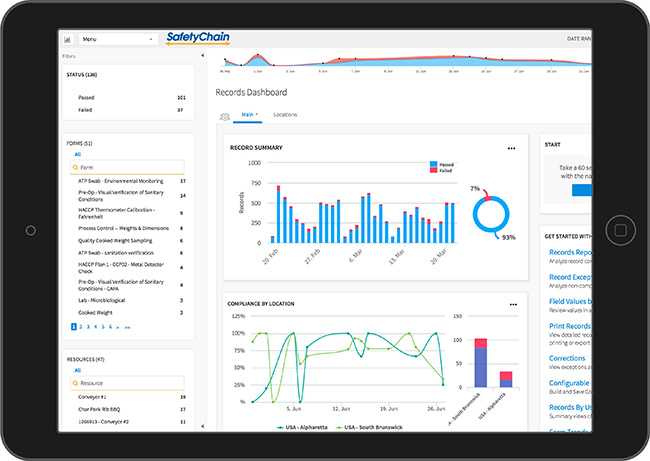
But visibility can become its own nuisance. A supervisor confronted with an endless procession of charts has acquired another task. In his 2017 discussion of the analytics product, Maxon stressed a simpler arrangement: people should see what matters to their responsibilities, and the system should highlight exceptions. Routine results could pass through without demanding an equally routine performance of human attention.
“Data can very quickly become overwhelming.”
Barry Maxon, 2017
It is a revealing concern for someone selling analytics. More information creates little advantage if the person who needs it must excavate it first. Maxon talked about prebuilt reports, intuitive organization and different views for different users. A person working on the line and an executive reviewing several facilities had different questions. Giving them the same screen would be an odd form of equality.
First, help the customer buy
By December 2020, Maxon was also explaining the purchasing problem. In his introduction to an executive guide to plant management software, he acknowledged that manufacturers could understand technology’s promise and still struggle to decide where to begin. Each plant had its own variables. Estimating the return required knowing what the software would actually change.
The guide’s accompanying discussion sorted possible benefits into recognizable jobs: reviewing records, starting lines on time, reducing rework, preparing for audits and avoiding unplanned downtime. That is the vocabulary of a business case. A general claim about modernization becomes more useful when somebody can connect it with a task, a delay or an expense.
The full publication ran to 41 pages when SafetyChain announced its release in January 2021. Maxon’s explanation was practical: manufacturing leaders often knew technology could improve operations but were uncertain about the starting point. The seller was helping the buyer work out the question, as well as offering an answer.
There is continuity here with his earlier sales and consulting responsibilities. Software has to survive the meeting where a customer asks why this project deserves money and attention now. A founder who can discuss the work in those terms gives that meeting somewhere concrete to go. The spreadsheet, meanwhile, has the considerable advantage of already being employed.
Ten years, then $50 million
In October 2021, SafetyChain received a $50 million minority growth investment from JMI Equity. The company had reached its tenth year. Its announcement described a platform used by more than 1,500 facilities and named customers including Driscoll’s, JBS and Tyson Foods.
The scale changed; Maxon’s explanation of the original purpose remained familiar. Manufacturers needed a unified cloud platform to improve yield, productivity and compliance in an industry still heavily dependent on manual processes. The new capital would support further development and expansion into additional markets and geographies.
For the founder, the milestone joined two kinds of work: developing the platform and establishing trust with customers over a decade. Both appeared in his remarks about the investment. In this corner of software, the buyer is asking a product to participate in the ordinary running of a factory. The relationship continues long after the demonstration ends.
The funding belongs to the company’s history. Its relevance to Maxon’s story is the length of the effort behind it: years spent making a case for using operational records differently, followed by investment intended to take that approach further. The filing cabinet had become a sufficiently interesting competitor to attract a growth equity firm.
A different seat at the table
On January 8, 2024, SafetyChain announced Dean Brown as its incoming CEO. Maxon would continue on the board, contributing to the company’s strategic direction. At the time, SafetyChain said its platform was trusted by more than 2,000 facilities.
The handover changed Maxon’s responsibilities while preserving his connection to the company he had helped start. He welcomed Brown and described an intention to work with him on its next phase. The founder’s place in the story continued beyond the chief executive’s office.
His public remarks across the preceding years offer a consistent way to understand that contribution. He discussed people spending time on records, customers struggling to get useful answers and managers needing a manageable view of their operations. His recurring subject was the distance between collecting something and being able to use it.
That is a fairly human problem to spend a software career on. The employee doing the check has already done some work. The person making the decision needs the result soon enough to matter. Maxon helped build a business in the space between them. A well-kept file can wait patiently for years. A factory has a shift to finish.