Bari Abdul has built a career around products that ask customers to believe in something they cannot easily see. A beverage has a taste. A video game has a screen. Security software mostly has an absence: the breach that did not happen, the stolen password that stayed put, the ransomware note that never arrived. Marketing an absence is peculiar work. It requires enough technical understanding to respect the machinery and enough human understanding to explain why anyone should care.
Abdul has crossed that divide for decades. His public resume begins with consumer goods at Procter & Gamble and PepsiCo, moves through early internet commerce at Egghead.com, takes in SONICblue's audio and video products and Capcom's video games, then settles into a long run across consumer and enterprise cybersecurity. McAfee, Check Point's ZoneAlarm, Deep Sentinel, Optiv and Randori all appear along the way. Today, his professional profile presents him as a fractional or interim CMO and SaaS and AI go-to-market adviser, with a current association to Picus Security.
It looks, at first, like a collection of unrelated aisles in the technology supermarket. Look again and a theme appears. Abdul keeps showing up where a complicated system needs a plain-language reason to matter.
“How does the average user know if they should let a DLL file in or not?”Bari Abdul, while discussing McAfee's consumer products in 2007
A consumer marketer walks into a firewall
The DLL question is almost comic in its specificity. It is also a tidy piece of positioning. Most people buying security software in 2007 did not want a minor education in dynamic-link libraries. They wanted the computer to stop asking questions that sounded like a pop quiz from the IT department.
At the time, Abdul was McAfee's vice president of worldwide consumer marketing. He had arrived with an unusual stack of experiences: a BS in Engineering from the University of California, Berkeley; an MBA from the Wharton School; and operating lessons from large consumer companies and Silicon Valley businesses. The engineering education offered a way into the mechanism. The consumer-brand years offered a way out of the jargon.
A national study released with McAfee that year made the translation problem measurable. Most respondents believed their computers were protected, yet scans showed a much smaller share had recently updated antivirus software. Abdul called it a false sense of security. The observation mattered because it separated confidence from condition. People did not merely lack software. They lacked a reliable picture of their own defenses.
That gap between belief and proof would follow Abdul into enterprise security. The nouns became grander - attack surfaces, external assets, automated red teaming - but the buyer's predicament stayed recognizable. A security leader may own dozens of tools and still not know which exposed asset an attacker would choose first. A board may fund controls and still not know whether they work when tested.
The career is a stack, not a sequence
In 2002, Abdul was named vice president of marketing at SONICblue. Reports from the period noted earlier executive work at P&G, PepsiCo, Egghead.com and Buckaroo. Another biography describes him later serving as chief operating officer at Capcom Entertainment before leading worldwide consumer marketing at McAfee. Each stop added a layer: packaged-goods discipline, international experience, e-commerce, physical electronics, entertainment software and security.
The usual career story asks what title came next. Abdul's is more interesting when read as a set of accumulated translations. A consumer product must earn a spot in a household. An e-commerce site must earn a click and a credit card. A game must earn attention. A security platform must earn trust before the buyer can fully experience its value. The categories differ, but none can hide forever behind product specifications.
What the career kept adding
This helps explain why his career includes both CMO and COO roles. Marketing, in this telling, is not decoration applied after the product is built. It is part of the operating system: who the customer is, what problem feels urgent, how demand gets created, and what promise the company can repeatedly keep.
A layoff counter with a human premise
The most revealing detour arrived during the 2008 financial crisis. Abdul launched Telonu, an employer-review site whose name sounded like “tell on you.” Users could rate workplaces and write anonymously about being employed or laid off. He also devised a free Layoff Tracker widget that compiled job-cut announcements into a running count.
The idea sat somewhere between utility, media object and catharsis. The numbers were grim, but Abdul's explanation centered on an everyday imbalance: someone might read 15 reviews before spending $50 at a restaurant, yet know far less about a company where they might spend 40 hours every week. Reviews could make a hidden institution more legible. Shared stories could make a layoff feel less like a private verdict and more like the result of a business failure.
The restaurant-review comparison made Telonu's premise instantly understandable. A small purchase invited extensive research. A workplace, with far greater consequences, often did not.
Telonu did not become the defining name on Abdul's resume. It did reveal an entrepreneurial instinct that fits the rest of it. Find an information gap. Give people a clearer view. Turn that view into a decision or, at minimum, a sense that they are not navigating alone.
Security advice for the airport lounge
In 2014, while publicly identified as the head of Check Point's ZoneAlarm consumer business, Abdul authored a travel-scam guide for Entrepreneur. It covered fake rentals, phishing messages, unsecured airport Wi-Fi, stolen laptops and fraudulent calls to hotel rooms. The work is a time capsule: Craigslist rentals, airline loyalty accounts, hotel menus slipped under a door. Yet its structure remains useful. The threat is never left floating as vague menace. Each risk is paired with a behavior.
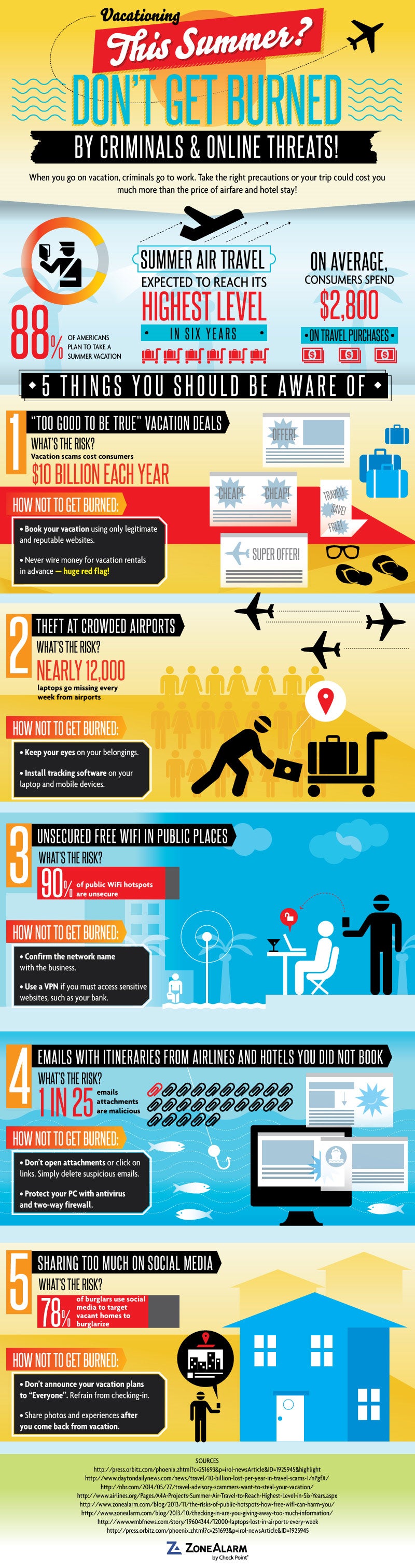
The infographic is not subtle, and that is its charm. Good consumer security guidance should survive a distracted reader, a small screen and the mild panic of an airport gate change. The format also shows Abdul's recurring preference for action over atmosphere. Do not simply fear phishing. Type the address yourself. Do not merely worry about a laptop. Keep it close and set a password.
Seeing the company from outside
By 2021, Abdul was back in an executive seat at a cybersecurity startup. Randori hired him as chief marketing officer, with responsibility for accelerating marketing and the revenue engine. The product mapped a customer's exposed internet assets and ranked them from an attacker's point of view. Abdul described a market concerned about ransomware and large-scale breaches, and argued that CISOs needed access to that adversarial perspective.
There is a neat echo here. McAfee's consumer study compared what users believed with what scans found. Randori compared what an organization believed it exposed with what an attacker could see. The scale changed from one PC to an enterprise attack surface. The dramatic tension did not: confidence is cheap until someone tests it.
In June 2022, IBM announced plans to acquire Randori and integrate its attack-surface view with the QRadar security portfolio. IBM presented the acquisition as a way to bring an attacker's perspective into detection and response. Abdul's public role in the preceding go-to-market chapter belongs to a broader career pattern: joining technical capability to a market story at the moment a category is becoming easier to name.
“Every organization is wondering how to protect against the big bads of the day, like ransomware and large-scale data breaches.”Bari Abdul on joining Randori in 2021
The fractional chapter
Abdul's current public description shifts the job from one company to a portfolio of founder-led businesses. He presents himself as a fractional or interim CMO and an adviser on go-to-market for SaaS and AI companies. Picus Security appears as a current affiliation, with third-party organization listings identifying him as a member of its board of advisers.
Fractional work suits a career made portable by repetition. Products change. Markets cycle from exuberance to caution. New acronyms arrive wearing old problems. A founder still needs to decide whom to serve, which pain to name, what evidence to show, and how a sales motion becomes repeatable rather than heroic.
The useful part of Abdul's story is not a secret funnel diagram. It is the durability of a point of view. Start with the buyer's confusion. Respect the technical truth. Replace ambient anxiety with a concrete next move. And when a product sells protection from an invisible danger, do not settle for asking the customer to feel safe. Help them see whether they are.