The strange thing about the internet is how little its front door reveals. A person arrives, or a script does. A crawler wants to index a page. A scalper wants every ticket. An assistant wants to buy a birthday present. To the website, each begins as traffic: a request at the gate, asking to be let in. Aurelie Guerrieri has spent her career learning how much business depends on knowing what happens next.
Her route to that question did not begin in a security operations center. It began with engineering chemistry, an MBA, and a role at McKinsey in Paris covering telecom and retail. Then came Silicon Valley. Guerrieri has said she moved there about two decades ago because she wanted to try “that tech startup thing.” The phrase is disarmingly casual for a decision that became the organizing wager of her working life.
At QuinStreet, she ran performance-marketing business units in health care, women, and education. At SendMe, she worked in corporate development while the app economy was still teaching companies how quickly a good product could disappear beneath thousands of other good products. Later, through her consultancy Akila One, she advised technology companies on scaling, partnerships, acquisitions, and international expansion. One client, mobile advertising company MobPartner, recruited her to run North America before Cheetah Mobile acquired it in 2015.
The useful death of the shortcut
For a while, the job was getting humans to install apps. The mobile boom produced its own folklore: viral tricks, hidden acquisition channels, sudden chart climbs. Guerrieri, who wrote and taught mobile marketing, was interested in the less glamorous machinery underneath. What does a user cost? How long do they stay? What does their attention earn? Can the product keep the person whom the advertisement persuaded?
In a 2018 essay titled “Growth Hacking Starts to Grow Up,” she argued that the serious version of growth rested on science, technical innovation, and durable marketing principles. There was no secret tunnel around the big platforms or well-funded competitors. A marketer had to understand economics, psychology, creative work, measurement, and product. The late-night pizza joke could stay. The wishful spreadsheet could not.
That insistence on traffic quality now reads like an early chapter of her cybersecurity work. Ad fraud punishes marketers for counting machines as people. Bot fraud punishes businesses for treating every request as harmless. Both thrive in complexity. Both turn a comforting number into an unreliable one. A million visits mean little until someone knows what made them, what they intended, and what happened after they arrived.
“It's really like shifting your mindset from blocking bots to figuring out how you can build a business around bots.”Aurelie Guerrieri, The Fraud Boxer Podcast, 2025
From the campaign to the perimeter
In 2020, Guerrieri joined Open Systems as chief marketing officer. The company worked in secure networking and the then-emerging category of secure access service edge, or SASE. Her assignment put marketing close to cloud infrastructure, network performance, and security. It was less a departure from growth than a move deeper into the systems growth depends upon.
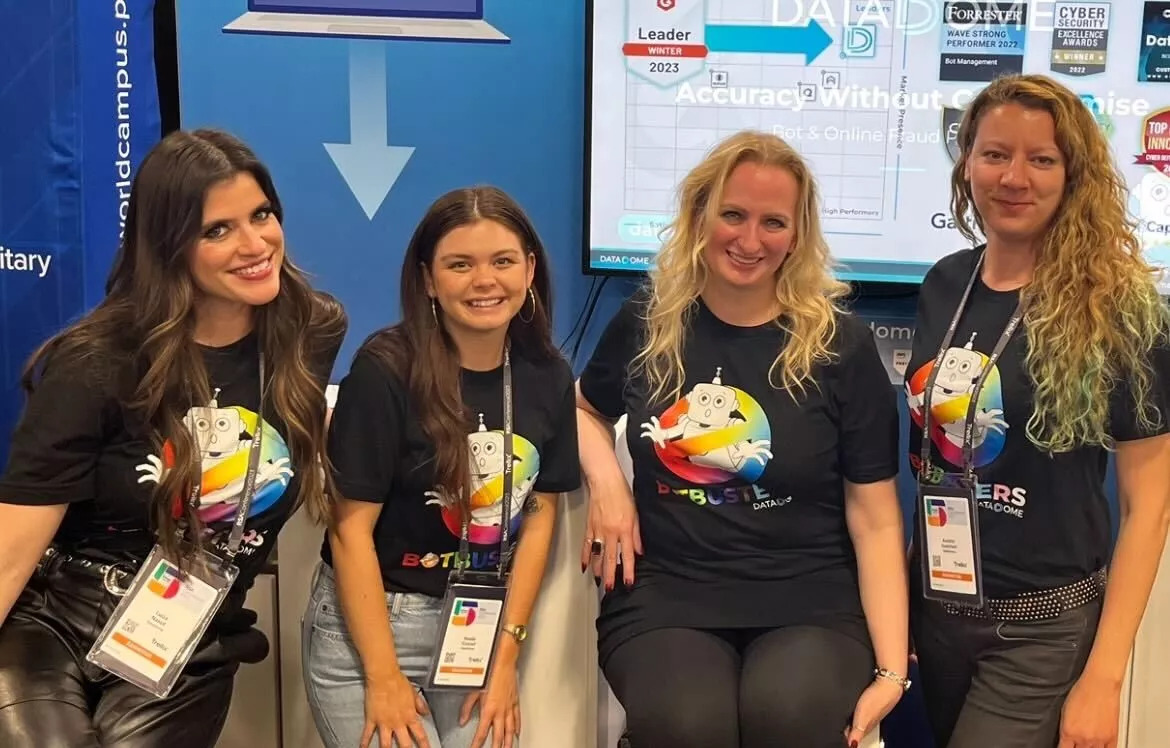
She joined DataDome as chief marketing officer in July 2022 and later added alliances to her title. Today she leads go-to-market and partnership initiatives for a company that protects websites, applications, and APIs from automated fraud. The job connects a market story to a partner ecosystem: cloud platforms, infrastructure providers, security teams, publishers, merchants, and the technologies that sit between a request and a response.
Her public language keeps returning to trust. When she joined DataDome, she called trust “the basis of our digital world.” The idea can sound soft until a credential-stuffing attack empties an account, a scraper copies a catalog, or a swarm of fake shoppers clears a ticket queue. Online trust is not a warm abstraction. It is an operational decision made at very high speed.
AI agents have made that decision more interesting. Old bot-management language invited a binary answer: bot or not? Now a machine might compare products for a customer, execute an authorized purchase, license a publisher's work, or check stock. The machine may be legitimate while its behavior still creates new risk. A declared identity can be spoofed. A useful agent can be compromised. A malicious operator can build an agent that behaves politely until it does not.
Guerrieri's current argument is that identity alone is no longer enough. Businesses must assess intent and context, then separate useful automation from theft and fraud. The commercial implication is as important as the defensive one. Blocking every agent may close a new route to demand. Welcoming every agent may corrupt analytics, expose content, and enlarge the attack surface. The gate needs judgment.
The ladder should remain where you found it
Guerrieri's other long-running project is access. From 2011 to 2016 she served as president of Women in Wireless, later known as mBolden. Her public biography credits the organization with growing to about 12,000 members and 13 chapters during her tenure. She built an executive network, worked with technology conferences, and helped turn a professional group into infrastructure for women navigating a young industry.
Her most memorable career advice is not about branding. It is about architecture of another kind. She urges women to find a “mentoring circle”: peers who can compare experiences, act as sounding boards, and pass along openings, introductions, and practical help. A circle avoids the theatrical wisdom of the distant guru. It treats judgment as something colleagues sharpen together.
She has also spoken about sponsors who believed in her before she believed in herself. Their offers could leave her feeling like an impostor at the edge of a precipice, unsure whether they had noticed she had never done the job before. The answer was not to wait for the feeling of readiness. It was to accept the opening, learn, and remember who opened it.
“We all win when there are more women as role models, more women in positions of influence.”Aurelie Guerrieri, 2021
The reciprocal rule is blunt: do not remove the ladder once you have climbed it. Guerrieri has continued that work as a mentor with SHE-CAN, which supports young women from post-conflict countries seeking higher education, and as a Global Entrepreneur in Residence with Founder Institute, teaching growth to pre-seed founders. The pattern matches her commercial work. Build a system that allows good participants through. Make the pathway legible. Reduce needless friction.
A career built across changing nouns
Read as a list, the career contains a suspicious number of fashionable nouns: telecom, mobile, growth, SASE, bot management, agentic commerce. Read as a story, it is more coherent. Guerrieri keeps arriving where a technical change is forcing companies to rethink how they find customers, measure behavior, and protect the exchange.
Her chemistry training is a pleasing detail because her later work has required a chemist's suspicion of surface appearances. Traffic is a mixture. So is a partner channel. The interesting result comes from distinguishing components, observing reactions, and refusing to confuse volume with value. Even her community work follows the logic: create the conditions in which more useful connections can form.
The newest reaction is between AI and commerce. Agents are moving beyond answering questions toward comparing, deciding, and transacting. Merchants will have to rethink funnels designed for fingers and eyeballs. Marketers will have to explain traffic that may never see an ad. Security teams will have to stop abuse without sabotaging a legitimate customer acting through software. Alliances will matter because no one company owns the whole journey.
The human point of a machine decision
There is an easy irony in a marketer advocating for better treatment of bots. Guerrieri's version is more precise. Some machines are tools used by people. Some are adversaries. Some will become customers' preferred representatives. The question is not whether to love automation. It is whether a business can make a careful decision about each interaction without degrading the experience for everyone else.
That places the CMO in unusual company. Agent traffic can distort acquisition data and pricing, change discovery, create fraud, and open a channel to revenue. It belongs in conversations with security, finance, product, and the board. Guerrieri's title makes the bridge visible: marketing and alliances, demand and trust, story and infrastructure.
Her career began when getting noticed online was the hard part. The next era presents a subtler problem. A business may be noticed by humans, crawlers, assistants, scrapers, fraudsters, and machines pretending to be any of the above. Success requires more than attention. It requires discernment.
The screen has always concealed the visitor. AI simply made the disguise more capable. Guerrieri's practical contribution is to keep the commercial question attached to the security one: after we decide who or what is knocking, what relationship are we willing to build? The future of the web may depend on answering quickly, but not carelessly.