The Company That Turned Video Games Into a Cancer Lab
An Allen, Texas company spent years convincing gamers that tracing a line in Minecraft could help fight cancer. Then it had to figure out how to get paid for it.
Somewhere in a Minecraft world, a player is dragging blocks into tidy clusters. It feels like busywork - the kind of sorting that fills ten idle minutes. What the player does not see is that each cluster is a decision about a chemotherapy co-medication, and that decision is being fed into a deep neural network built to help cancer researchers at Southern Methodist University. The player never signed up for a lab. They signed up for a game.
That sleight of hand is the entire idea behind BALANCED Media|Technology, a roughly two-dozen-person company headquartered in Allen, Texas. Its platform, HEWMEN, is built on a contrarian belief: in a world obsessed with raw compute, the scarce resource is human intuition - and the cheapest way to get a lot of it is to hide the work inside something people already want to do.
For most of a decade, that meant an unusual pitch. Play a video game, watch a livestream, donate a slice of your PC's idle power, and you could help screen drug compounds or train an AI to spot the early signs of blindness. It made great headlines. It won awards. It also ran into the oldest problem in the startup book: a thing people love to do for free is very hard to charge money for.
This is the story of what BALANCED built, why it worked, and what it changed when the applause was not enough.
01What it actually does
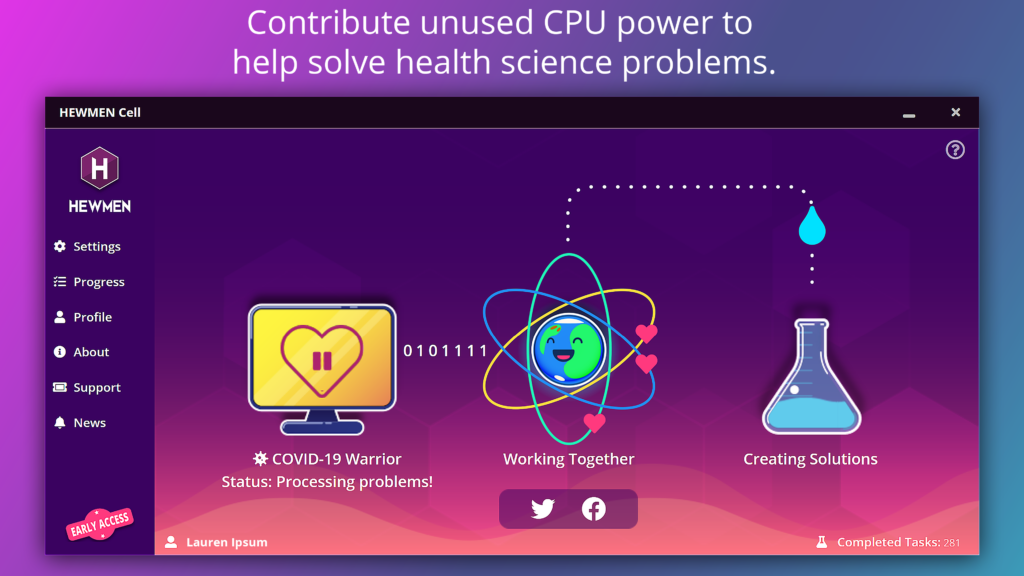
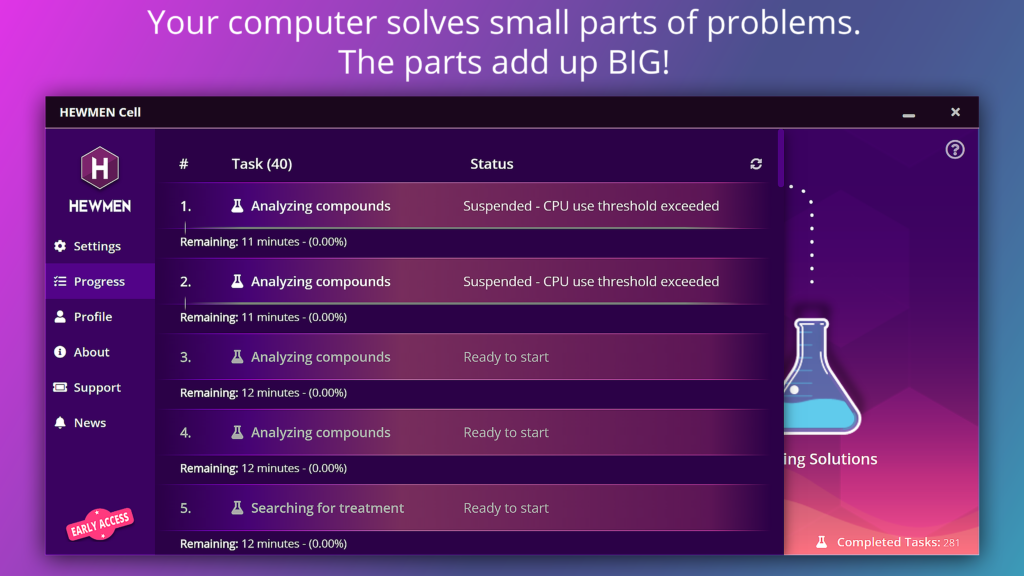
HEWMEN is easiest to understand as two borrowed resources stitched together. The first is distributed computing: a lightweight client, the Cell App, lets volunteers donate spare processing power from their own machines. Instead of buying a supercomputer, BALANCED assembled one out of gamers' idle GPUs. The second is human-in-the-loop labeling: real data-science tasks, disguised as gameplay, so that a crowd's judgment produces and validates the training data machine-learning models need.
The company calls the combination "human-empowered AI." The marketing line - "we bring purpose to play" - is corny, but the mechanism underneath is real. A player tracing a path in a top-down shooter is, in fact, measuring a retinal scan. A Twitch viewer clicking through a mini-game between raid attempts is, in fact, generating computer-vision data.
02The proof: cancer, COVID, and a game that spots blindness
The résumé is more concrete than the pitch. Working with SMU's Center for Drug Discovery, BALANCED built Minecraft-based tasks in which players classified chemotherapy co-medications - sorting compounds by whether they helped or hurt - and clustered them into training data for a neural network. When the pandemic hit, the same grid was pointed at COVID: the company reports that screening roughly 8,000 FDA-approved compounds surfaced more than 30 testable candidates in about three months.
Compound and screening figures are company-reported. Engagement metrics are from the Complexity Gaming partnership announcements.
Then there is the one that sounds like science fiction and turned out to be patentable. With the Retina Foundation of the Southwest, BALANCED built Eye in the Sky: Defender, a game in which the paths players trace are actually measurements taken on OCT retinal scans. Those traces train an AI to detect age-related macular degeneration - a leading cause of vision loss. The method was patented, and the two organizations signed a 10-year exclusive license to commercialize it.
03The Twitch experiment
Research problems need a crowd, and in 2020 BALANCED found a big one. A partnership with the esports organization Complexity Gaming put HEWMEN's Cell client on the machines at the GameStop Performance Center and layered HEWMEN mini-games into Twitch broadcasts of World of Warcraft's "Race to World First" events. Viewers played something called Omega Race between the on-screen drama; behind the scenes, their engagement fed research workloads.
The reach was real - millions of extension views, millions of combined watch hours, hundreds of thousands of participants. It was, briefly, one of the most vivid demonstrations anywhere of a crowd doing science without a lab coat in sight.
04What changed their mind
Here is the honest part. The "fight cancer while you game" model generated press releases, academic papers, and a Tech Titans award. What it did not reliably generate was revenue. A crowd that shows up for a cause is wonderful and fickle; it does not sign an annual contract or promise a service-level agreement. BALANCED's public materials do not dwell on a single failure point, but the pivot itself tells the story.
Around 2023, the company reframed HEWMEN. Instead of selling wonder, it started selling utility - to what it calls SMOGs, meaning small and medium organizations and governments. The pitch became blunt and practical: you have messy legacy data and no data-science team; HEWMEN can ingest and unify it, clean it, let you query it in plain English, and automate the busywork around it.
The technology barely changed. The customer changed completely. That is the move worth studying: the same engine that once ran on the goodwill of gamers now runs on the budget line of a parish government in Louisiana or a coastal-research center at Nicholls State University.
05How it differs from the alternatives
The obvious comparison is to the data-labeling industry - Scale AI, Appen, Labelbox, Snorkel, and the rest. Those companies solve the same underlying problem (machines need labeled examples) with a managed, paid workforce. BALANCED's answer was the opposite: don't pay annotators, motivate volunteers by wrapping the work in something intrinsically fun and tying it to a cause.
| Dimension | Managed labeling | BALANCED / HEWMEN |
|---|---|---|
| Workforce | Paid annotators | Volunteer gamers & viewers |
| Motivation | Wages | Fun + cause |
| Compute | Cloud you rent | Idle machines you borrow |
| Best at | Regulated, SLA-bound quality | Gamifiable, intuition-heavy tasks |
| Weak at | Novel, playful engagement | Certified-expert judgment |
Its closer ancestors are the citizen-science projects - Foldit, EyeWire, Folding@home - that proved crowds can do real research. BALANCED's contribution was to make that repeatable across problems and to attach it to livestream culture rather than a niche volunteer forum.
06Who is behind it
BALANCED Media|Technology was formed in 2016 by a deliberately mixed founding team: CEO Robert M. Atkins, a longtime game developer; president Carl Lapeyrouse, whose original concept of using play to improve childhood health and education predates the company by decades; CTO Corey Clark, who also holds a research post at SMU's Guildhall game-development program; chief medical officer Dr. Christopher Gayle; and executive director Scotty Landry. The blend - studio talent, a data scientist, a physician, a nonprofit operator - maps neatly onto the work.

That university tie is not incidental. SMU is the anchor partner across nearly everything BALANCED has built - the drug-discovery games, a literacy app that helped win a share of the Barbara Bush Foundation Adult Literacy XPRIZE, and later a game to extract and clean human-trafficking case data. The company is, in effect, a commercial studio wrapped around an academic research pipeline.
07Where it fits, and what to steal
On the money side, the picture is modest and a little murky. Public trackers put total funding somewhere in the range of roughly $5.6M to $7.8M across about six rounds, much of it debt; the clearest recent data point is an April 2023 SEC notice for $1.5M in debt financing earmarked for product development. This is not a company trying to look like a unicorn. It is trying to turn a genuinely novel idea into durable, boring revenue.
For a founder, the copyable lesson is sharp: engagement can be a labor supply if you earn it. Embed a real task inside an activity people already choose, attach a reason to care, and you can produce training data or computation that would otherwise cost a fortune. Pair it with one strong institutional partner - a university, an esports org - to supply both the problems and the crowd.
And the honest limit, which BALANCED's own pivot underlines: it does not work everywhere. If a task cannot be turned into intuitive play, if it needs certified experts or regulatory-grade quality, if the data is too sensitive to expose to a crowd, or if the business needs predictable recurring revenue, the volunteer model strains. The company's answer was not to abandon the idea but to point the same machine at customers who will actually pay for the output. That is less romantic than curing cancer with Minecraft. It might also be why the company is still here.