The internet has no shortage of clues. It has a shortage of conclusions. A customs officer gets a name transliterated three ways. A corporate security team sees a threat buried in a chat channel it does not normally monitor. An intelligence analyst spends a morning copying fragments from news reports, public records, social media and the dark web into a document that will be outdated by lunch. Babel Street exists for that ugly middle - the distance between finding data and being willing to act on it.
The private Washington, D.C. software company calls its category risk intelligence. In practical terms, it collects and enriches public and commercially available information, searches it across languages, connects people and organizations, and helps a human investigator explain why the connection matters. Its customers include defense and intelligence organizations, law enforcement, border agencies, banks, logistics companies, corporate-security teams and researchers. These are not casual searchers. A false negative can miss a threat; a false positive can block an innocent person or waste hours of review.
The product is a translation machine for messy reality
Babel Street began in 2009, founded by Jeffrey Chapman and Shon Myatt. Its original wedge was multilingual open-source intelligence: search broad swaths of the public web without requiring the analyst to know every spelling, script or local synonym. Over time, that search layer became a platform. Today's portfolio combines global data, secure research, semantic analysis, entity extraction, relationship mapping, name matching, APIs and professional services.
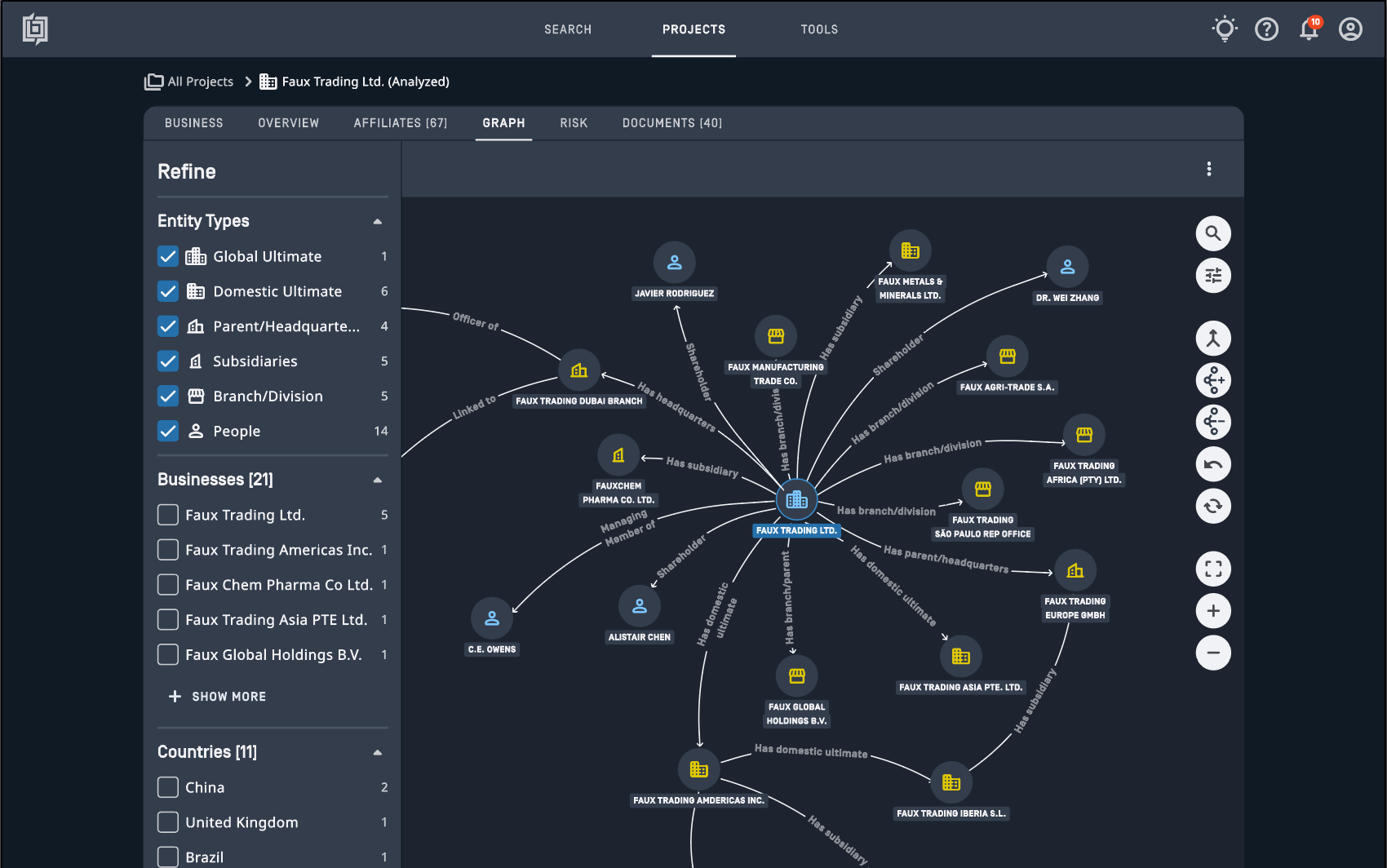
That list sounds like enterprise soup until you watch the workflow. An analyst starts with an objective such as vetting a supplier, identifying a person across aliases, tracing a disinformation network or monitoring threats around an event. Babel Street pulls relevant material from its data estate, extracts names, places, organizations and events, resolves duplicates, and returns evidence that can be reviewed or pushed into another system. The value is not a magical answer. It is a shorter, more traceable trip from question to evidence.
Global news, records, websites, social channels and hard-to-reach regional sources enter one research surface.
Language models, entity resolution and matching expose identities, events, sentiment and relationships.
Analysts review sources, reasoning and audit trails before intelligence reaches a decision workflow.
What failed first: the human copy-paste economy
A public customer story from Mercyhurst University's Center for Intelligence Research, Analysis, and Training is unusually useful because it names the before state. Analysts were manually gathering, validating and compiling open-source information. Sources were fragmented. The volume kept moving. Visiting sensitive corners of the web created operational-security risk. The first thing that failed was not human judgment. It was human bandwidth.
Mercyhurst evaluated several tools and began with a proof of concept. What changed the team's mind was not a grand claim about artificial intelligence. It was the combination of an intuitive interface, broad data access, real-time dashboards and sentiment analysis that performed well on work the team already understood. Babel Street offered the academic program a drastically reduced rate; the exact amount was not published. That pilot turned into a partnership for both classroom training and client investigations.
The lesson is delightfully unsexy: test enterprise AI on the customer's ugliest live workflow. Measure time per source, hours per analyst and effort per finished report. A canned chatbot demo would not have exposed whether Babel Street could preserve sourcing discipline or protect researchers from unsafe browsing. The proof of concept did.
Four products, one expensive problem
Insights
The investigation workspace: multilingual document and people search, entity intelligence, social-network mapping and secure research.
Investigator
AI agents propose and execute a multi-step research plan while the analyst controls scope, logic and final judgment.
Match
A tunable identity engine for names, addresses and dates across scripts, designed to reduce screening false positives.
Data + Modules
Rights-cleared datasets, custom collection, APIs and components for teams that need Babel Street inside their own stack.
Match is the easiest piece to steal as a product strategy. It does not demand that a bank replace its compliance system. The engine can plug into Elasticsearch, OpenSearch, Solr, Java applications or hosted APIs. Buyers can use a free web demo, a five-day downloadable trial with their own data, or a 30-day hosted API trial. The desktop version even arrives with the U.S. Treasury's OFAC sanctions list. Babel Street is selling a precision upgrade to a failure-prone layer, not a renovation of the whole house.
The company says a leading global financial-services provider uses Match for roughly one billion comparisons a day, and it promotes reductions in false positives of up to 90 percent in some deployments. Those numbers are customer and company-reported, not universal promises. They explain the buyer's math, though. Every false alert that disappears is one fewer record a compliance employee must inspect by hand.
The new bet: agents with adult supervision
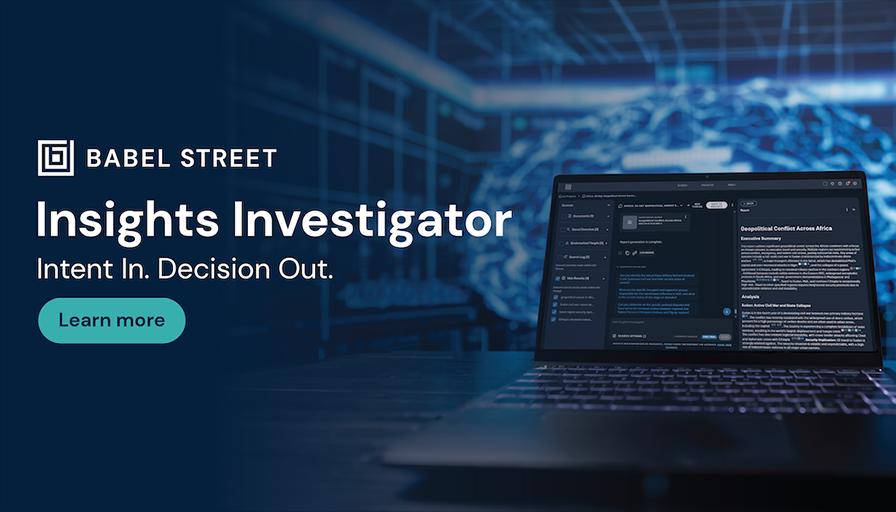
In May 2026, Babel Street launched Insights Investigator, moving its interface from search and AI assistance toward analyst-directed investigations. A user states an objective in natural language. Agents draft a plan, run multiple research steps, connect evidence and produce a report. The human can inspect the query logic, sources and reasoning. So-called Challenge Agents are meant to test outputs before they travel downstream.
This is Babel Street's answer to a problem it helped create: once a company gives analysts access to more sources in more languages, the bottleneck moves from discovery to synthesis. The agent is supposed to eat that new bottleneck. Early users reported research-time reductions above 50 percent, and the company planned image-analysis features as the next layer.
The chart is an editorial map, not a benchmark. It shows the positioning. Dataminr is strongly associated with real-time event alerts. Recorded Future and Flashpoint compete in threat intelligence. Palantir owns a broader data-integration and operations story. Sayari maps corporate and supply-chain risk; Quantexa works in entity resolution and decision intelligence. A capable enterprise can also assemble Elastic, data feeds and general-purpose language models itself. Babel Street's claim is that its data rights, language coverage, tradecraft and control layer arrive as one system.
How the money works - and what it can cost
Babel Street runs a classic high-touch enterprise model: negotiated subscriptions and software licenses, usage-based or contracted APIs, deployable plugins, cloud-marketplace sales, public-sector contract vehicles, training and professional services. Core platform pricing is not posted. Public records show the range can be wide. A Treasury contract described at $154,982 covered Babel X and Locate X subscriptions, while a historical Secret Service contract modification added one Locate X license and increased a broader contract by $35,844. A separate CBP forecast for 1,200 licenses estimated $5 million to $10 million. These are different years, bundles and buyers, so dividing one number by another would produce fake precision.
The business has also bought missing pieces. Dunami's link-analysis intellectual property arrived in 2020. Rosette, acquired from BasisTech in 2022, deepened multilingual natural-language processing and name matching. Vertical Knowledge followed in 2024, adding specialized global data and more than 350 combined employees. The pattern is coherent: acquire the graph layer, the language layer and the data layer, then place agents on top.
The uncomfortable chapter cannot be footnoted away
Risk intelligence has a built-in civil-liberties tension. In 2020, reporting based on contracts and internal records showed that U.S. agencies bought Locate X, a Babel Street product that provided access to location data generated by mobile apps. The reporting raised questions about government purchase of commercially available location information that might otherwise require legal process. Babel Street did not respond to that publication's request for comment at the time.
Locate X is not the same thing as the 2026 agentic platform, but the episode belongs in the company story because it clarifies the stakes. Powerful collection and identity tools can help locate threats, and they can be misused or deployed beyond public expectations. Babel Street now emphasizes rights-cleared data, ethical collection, transparent reasoning, human control and security certifications. Those controls should be tested, not merely admired. In this market, governance is part of the product surface.
Babel Street is a poor fit for a low-stakes team that only needs ordinary web search; an organization without trained reviewers or data-governance rules; an investigation dependent on private information the platform cannot access; or a buyer seeking fully autonomous decisions. If no human owns the conclusion, an audit trail is just decorative plumbing.
What a builder can copy on Monday
First, sell the workflow before the technology. “Investigate this supplier in half the time” is stronger than “use our multilingual model.” Second, make adoption incremental. Match can drop into an existing search stack; the trial runs locally; APIs let customers keep their interface. Third, use a proof of concept with the buyer's own dirty data and define success before it starts. Fourth, show the work. In regulated AI, citations, tunable thresholds, plans and logs are not compliance chores. They are reasons to buy.
Finally, buy or build the substrate before adding an agent. Babel Street had years of domain workflows, language technology and data relationships when it launched Investigator. A thin agent over open web search may be cheaper, but it will struggle where sources are obscure, names mutate across scripts, access must be anonymous, or every conclusion needs a defensible trail.
The company still has to prove that its broad portfolio feels like one tool rather than a shelf of acquisitions. It also must earn trust continuously, especially given the history of location-data scrutiny. But the central wager is sensible: the future of high-stakes AI will not belong to the system that speaks most confidently. It will belong to the one that lets a skilled person move faster, see farther and still explain exactly how they got there.