Consider the concert ticket after it has been bought. One friend cannot come. Another wants the spare. A third will arrive late. The purchase was a single transaction; getting everyone through the door has become a small administrative project. For a ticketing company, this is an unusually revealing moment. The sale is finished. The work is still happening.
- AXS connects ticket sales, official resale and mobile entry.
- Its paying relationships run through venues, teams and promoters.
- The useful trick: keep track of a ticket as plans change.
AXS, the ticketing business owned by entertainment group AEG, is organized around that longer journey. Fans encounter a website and an app. Behind them sits software for event operators: sales, access control, reporting and marketing. The company says it serves more than 1,300 brands, venues and teams. Its customers include Coachella, Red Rocks Amphitheatre and London’s O2.
The ticket has a social life
Start with the detail on AXS’s own Mobile ID illustration: the QR code refreshes every 60 seconds. Screenshots will not work. This is a surprisingly good explanation of the product. A static image can travel independently of its seller. A changing credential keeps admission connected to the ticketing system.
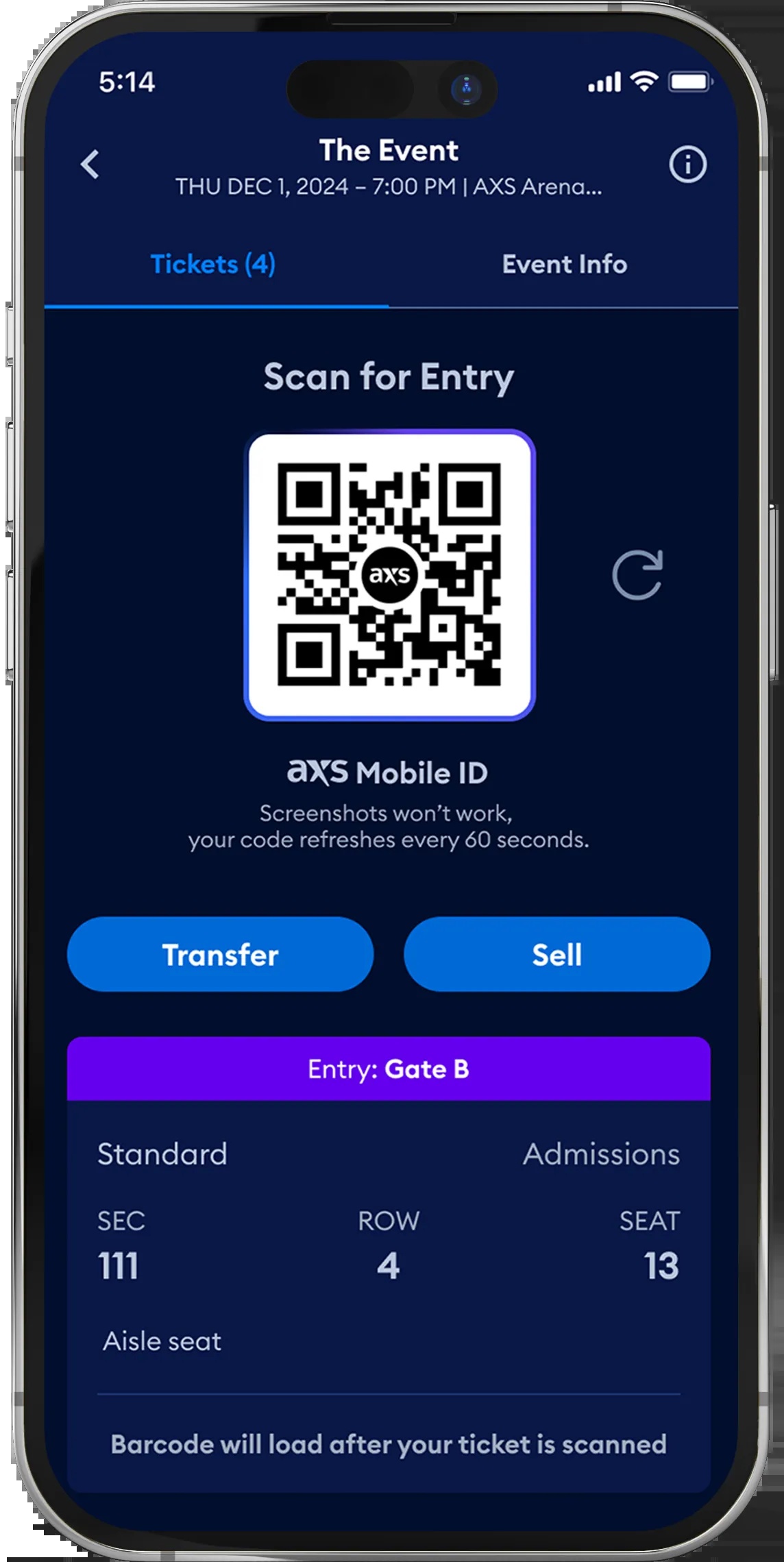
Between code refreshes in AXS’s product illustration. A screenshot cannot keep up.
Transfer and resale sit beside entry. Changing plans is part of the interface.
For the fan, the instructions are ordinary: install the app, sign in and show the ticket at the gate. Groups can enter together or transfer tickets beforehand. AXS says tickets can display on event day without Wi-Fi. The practical habit is to check the account and ticket before arriving, rather than discover a login problem in a moving queue.
Official Resale extends the same logic. For eligible events, tickets can return to sale inside AXS. Standard inventory appears in blue and resale in orange on its seat map. The buyer can see both in one place. AXS guarantees the validity of tickets purchased through its Official Resale service.
There are limits. An absent or disabled Sell button means resale is unavailable for that ticket or event. Sellers should also distinguish a completed sale from money in their bank: AXS says proceeds become transferable after the event. The convenience has rules attached.
The venue came first
AXS’s origin helps explain its priorities. In 2011, AEG approached Outbox about using its ticketing technology in AEG venues. Their partnership produced AXS. Outbox brought software; AEG brought buildings and events. Cirque du Soleil and ticketing veteran Jean-Françoys Brousseau were among the founding partners.
That starting point matters. A venue already has a reason for people to visit. It needs a way to sell access, manage inventory and understand customers. AEG’s existing relationships gave AXS places to deploy its technology. The challenge was embedded in the building’s daily business.
In 2015, AXS merged with Veritix, adding season-ticket management and Flash Seats, its digital, identity-based ticketing technology. The announcement described more than $2 billion in combined annual transactions. That was ticket transaction volume, an important distinction from the company’s own revenue.
“This partnership is about more than ticketing.”
Bryan Perez / 2015 merger announcement
By September 2019, AEG had acquired all outstanding AXS shares. The parent company’s announcement emphasized international expansion and mobile identity. The direction was becoming clearer: connect the event business to the software that manages its audience.
A checkout with a memory
The operator’s problem is easy to miss. Imagine someone buys four tickets and distributes three. The purchase record identifies one buyer. Four people attend. Those are different descriptions of the same evening. Following transfers and entry can help an operator understand the audience beyond the original order.
- 01PurchaseA seat is sold
- 02ChangeTransfer or eligible resale
- 03EnterMobile ID is scanned
AXS sells tools for this operational view. FanSight brings primary, secondary and premium inventory into a single cart. AXS IQ supplies analytics and demographic reporting. Instant AXS streams data; batch feeds support integrations. Apex handles event management. Access-control technology connects ticketing to the entrance.
Marketing services and AXS Anywhere add distribution. For a promoter, these capabilities can help connect discovery, purchase and attendance. Their value depends on execution and integration; putting several products in the same catalogue does not automatically make a venue’s operation simple.
Free delivery. Shared fees.
For consumers, Mobile ID delivery is free. The wider transaction pays for the business. AXS’s US help center says it retains a portion of certain fees, with service fees shared between AXS and its client. Ticket face value goes to the client; facility charges go to the venue.
There is no universal AXS fee percentage to apply to every event. Amounts vary by venue and event, and resale has its own charges. For a buyer comparing options, the useful number is the total payable price. A free delivery method does not make the ticket purchase free of fees.
Ticketmaster and SeatGeek are among the alternatives for primary ticketing. StubHub and Vivid Seats compete for resale transactions. AXS’s particular pitch joins an official consumer marketplace to venue software, identity and AEG’s entertainment relationships. A fan’s choice is often shaped by which provider the event uses.

The Olympic-sized test
The next conspicuous test is LA28. In February 2024, organizers appointed AXS and CTS EVENTIM as joint ticketing service providers for the Olympic and Paralympic Games. Their venture combines technology and distribution, including both companies’ storefronts and LA28’s website. Here, a ticketing alternative became a partner.
Expansion also happens one building at a time. On October 1, 2026, AXS announced that Malmö Arena would adopt its ticketing services from January 1, 2027. These agreements are how the platform gains another audience and another operational setting.
The lesson other businesses can borrow is modest: examine what happens after payment. Customers rearrange plans. Ownership changes. The service must survive those changes. At AXS, that means following a ticket until someone actually uses it. The final scan is where the whole proposition meets a person waiting to get inside.