Consider an empty seat ten minutes before a concert. Ten minutes after the show ends, its commercial value has vanished. Ticket selling is retail with an unusually unforgiving clock. The difficulty is getting a particular seat in front of a particular buyer while both still matter.
TicketNetwork built a business around that difficulty. Fans encounter it as a marketplace for concerts, sports and theater. Professional sellers encounter a different company: software for managing inventory, an exchange for trading it, and connections to other storefronts. The consumer website is one entrance to a much larger operation.
- A marketplace for fans; inventory and distribution tools for sellers.
- POSNext advertises no monthly fees, alongside selling fees.
- New partnerships carry selected inventory into cultural and travel channels.
02The broker meets the database
The pairing was useful. Don Vaccaro brought experience as a ticket broker; Doug Kruse brought software expertise. TicketNetwork traces its origins to 1996 and dates the launch of TicketNetwork.com to 2002. Rather than merely put a broker’s counter online, the company connected sellers’ inventories. A seat could become discoverable beyond the seller’s own shop.
Its corporate website now reports more than 150,000 events with tickets available daily, over $10 billion in listed inventory value, and more than 30 million tickets sold across its history. These are company-reported measures. Inventory value is neither revenue nor a valuation: it describes the tickets available across the exchange.
The customers therefore come in layers. Eventgoers want admission. Brokers want stock management and buyers. Online retailers want inventory without assembling a seller network themselves. Venues and organizers want more places to sell. TicketNetwork’s expertise lies in connecting those needs through inventory feeds, order handling, pricing controls and distribution.
03The crucial moment is the lock
Imagine two storefronts offering the same pair of seats. More visibility is helpful until two people buy them. Then the attractive distribution strategy becomes an argument about who gets to go. TicketNetwork’s Mercury Retail integration describes a mechanism that locks tickets while a client charges the buyer’s card, then accepts and confirms the order in seconds. Coordination is the product hiding inside the product.
Mercury B2B serves professionals buying at broker wholesale prices, including sellers sourcing replacement tickets. It offers weekly invoicing and a guarantee of up to 200%, or equivalent replacements. That professional trading promise is distinct from the consumer marketplace’s 100% Money-Back Guarantee.
POS 11 addresses large professional selling operations. POSNext is web-based and mobile-optimized, with reporting and exchange access. TN Link lets sellers send inventory into the network while keeping a compatible existing sales system. A retailer can use Mercury’s API to build its own customer experience. Seatics supplies interactive seating maps; ezEvent provides event creation and ticketing for promoters. Each solves a different piece of the same journey.
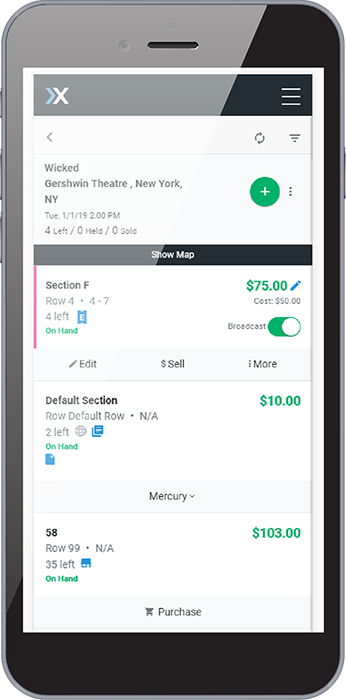
Inventory, orders and exchange access, managed in a browser.
POSNext / mobile interface04Free software, paid transactions
POSNext advertises zero monthly fees and low selling fees. Its website also advertises no Mercury buying fees. “Free” here describes particular charges, rather than the entire business relationship. A seller still needs to understand the applicable selling terms. The retail API gives clients control over markups, service fees and shipping charges; affiliates earn commissions for sending buyers into the inventory.
This is a marketplace and transaction business with software attached. A fan pays for a ticket under the applicable purchase terms; sellers gain distribution; partners can monetize their own audience. Buyers should compare the full payable price, seating details and delivery terms across alternatives such as StubHub, SeatGeek and Vivid Seats. TicketNetwork’s seller tools explain its position, but they do not establish that its consumer prices are always lower.
05The expensive gap between a listing and a promise
The network’s history also shows what can go wrong. In July 2019, New York’s attorney general announced a $1.55 million settlement involving TicketNetwork, Ticket Galaxy and Vaccaro over speculative ticket sales. The allegations concerned tickets sellers did not yet own, with consumers sometimes receiving different seats or no tickets. The settlement required clearer possession disclosures and prohibited misrepresenting why tickets were unavailable.
In November 2023, Canada’s Competition Bureau announced a separate C$825,000 penalty. It found advertised prices and discounts were unattainable because mandatory fees were added, averaging more than 38% of the advertised price. The agreement required clearer pricing, currency and resale identity, plus a compliance program.
These episodes identify a practical failure: the listing did not reliably communicate the purchase being offered. Regulatory agreements required changes to disclosures and advertising. The consumer guarantee supplies protection, but a refund cannot recreate a missed evening. TicketNetwork’s published guarantee also requires evidence from the venue when tickets are invalid. Buyers have work to do as well as rights to invoke.
“Built by Brokers, For Brokers”
POSNext’s product-page promise
06A box office with many doors
The 2026 partnerships extend the distribution idea beyond traditional resale inventory. In August, TicketNetwork announced a vivenu integration allowing eligible organizers to distribute selected inventory through more than 1,000 partners while retaining pricing, branding and customer-data control. Spektrix describes its TicketNetwork connection as reaching more than 1,200 websites, including travel platforms, employee benefits programs and affiliates.
A June partnership with GoNexus Group brought inventory into the NexusCube B2B travel marketplace. The announcement cited GoNexus’s network of more than 17,000 travel partners. Tickets can be encountered while someone plans a trip, rather than only after they decide to search a ticket marketplace.
TicketNetwork is also arguing for the conditions this approach needs. A September 22 announcement described its Justice Department comments seeking ticket portability and nondiscriminatory access to credentials, transfers and APIs. That is a business interest expressed as a competition argument. If tickets cannot move reliably between systems, adding storefronts adds friction rather than useful reach. Competitors are pursuing open distribution too; the advantage must be earned in execution.
07The network, and the llamas
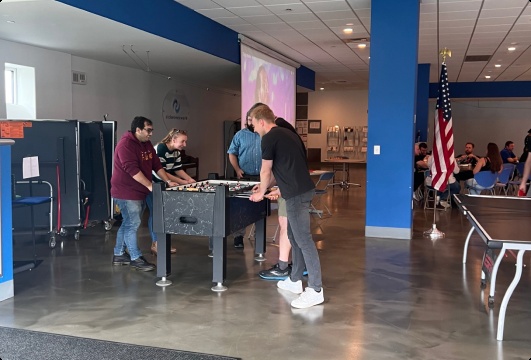
There is an unexpectedly pastoral coda. TicketNetwork’s culture page describes complimentary meals, a game room and a campus animal sanctuary with llamas, goats, geese and chickens. It says a 1.4-megawatt rooftop solar installation was completed in May 2019. These are concrete workplace amenities, rather than proof that every employee enjoys the same experience.
For another business, the transferable idea is simple: help suppliers reach customers without demanding they abandon every tool they already use. Keep inventory synchronized and make the offer intelligible. For a fan, the lesson is smaller and more immediate. Know the seat, the full price and the delivery promise. In this business, all three have to arrive before the curtain goes up.