The show is at eight. The band has brought its own following, the promoter has bought ads, and somebody at the venue is checking whether the guest list still matches the tickets sold online. By seven forty-five, the grand theories of digital commerce have become a short line outside a small room. TicketWeb’s pitch lives in that line. A venue needs the show to be found, the right number of tickets to be sold, and the right people to get through the door.
TicketWeb started selling tickets online in 1995, when putting a club’s inventory on the web was itself an unusual idea. Andrew Dreskin was among its founders; accounts of the early venture also name Dan Teree and technical partner Rick Tyler. Five years later, Ticketmaster Online-CitySearch bought TicketWeb in a stock transaction valued at about $35.4 million. The useful irony has endured: a service built around independent venues became part of the largest ticketing company in their orbit.
- TicketWeb supplies event pages, checkout, box office, scanning, reports and marketing tools for venues and promoters.
- Its selling point is control at venue scale plus distribution through Ticketmaster and partner channels.
- Ticket prices belong to event providers; buyer fees and venue terms vary by event and agreement.
A box office that travels
A club can make a concert available on its own site, on TicketWeb and through Ticketmaster’s discovery network. TicketWeb describes the workflow as building the event once and publishing it across those channels. That matters to a promoter who would otherwise re-enter a title, artist image, date, price and inventory several times, then hope every version stays accurate when a show changes.
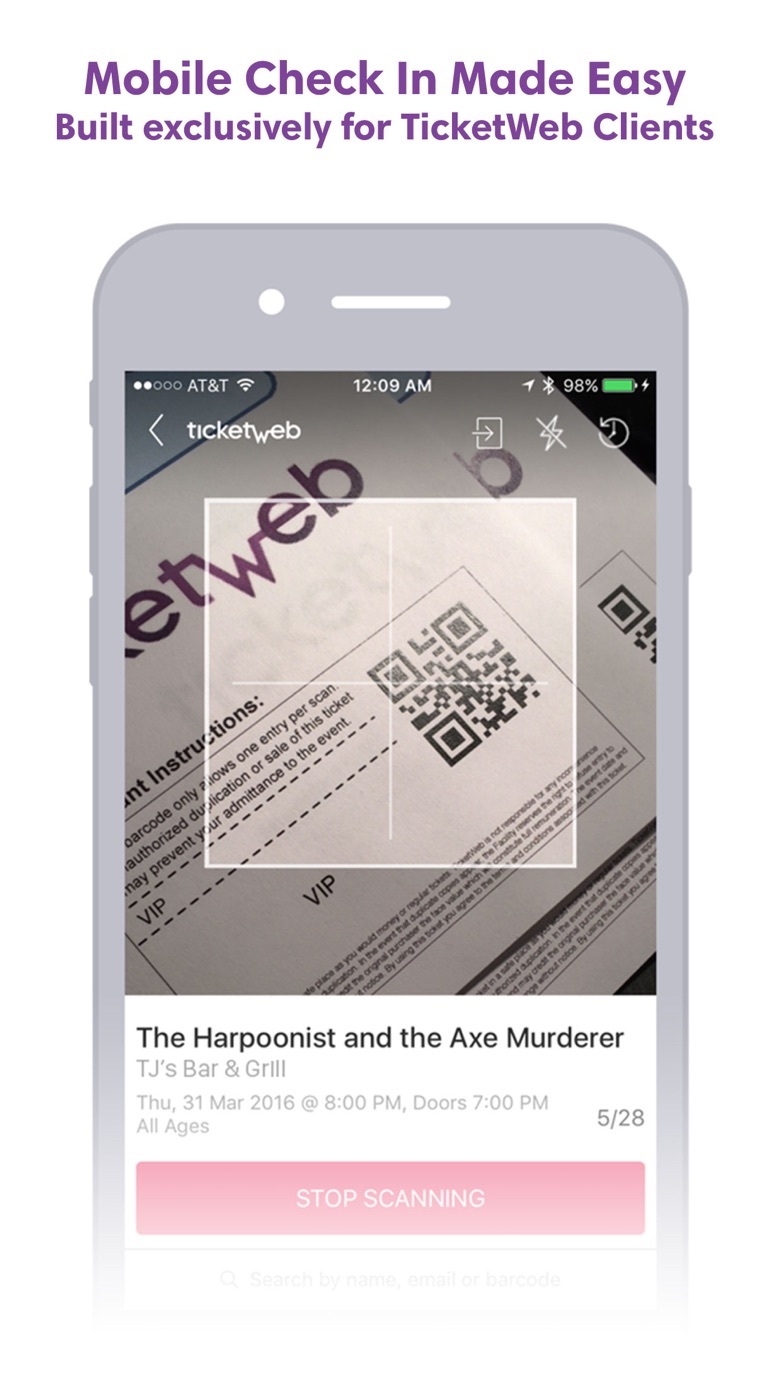
The product reaches further than a checkout page. Its Box Office application shares inventory with online sales. CheckIn, the mobile app for venue staff, scans tickets, looks up buyers and can sell at the door. It can validate tickets while offline and sync when service returns. OnSale puts ticket counts, gross sales and attendance on a phone. Reporting tools show sales by event and partner, promotion codes, referrals and settlement. Email tools help a venue collect subscribers, send campaigns and tie those campaigns to ticket sales.
This is a business-to-business system wearing a consumer website. Fans see a page for a gig or comedy night; the venue sees the inventory, customer record and settlement behind it. The buyer-facing purchase policy says event providers set ticket prices and availability. It also says purchases typically carry a per-ticket service fee and a per-order processing fee. There is no single public price that describes every TicketWeb deal. A venue has to ask for its contract terms; a fan sees the charges for a particular event at checkout.
The giant in the room
Ticketmaster ownership gives TicketWeb something a small independent software vendor struggles to promise: a route to people already looking for shows. TicketWeb lists its own marketplace, Ticketmaster and partners such as Bandsintown among the places where a fan may encounter an event. An individual club could advertise on each channel, but the tedious part is keeping the event, links and inventory coordinated. Distribution is valuable only if a sale in one place does not produce a phantom seat in another.
That 17% figure is unusually concrete for a ticketing sales pitch. It also has a boundary. Knitting Factory was a longtime client with several locations and an established audience. A new comedy room in a quiet town cannot assume the same result. The number tells us that distribution can be material; it does not tell us what every venue will earn, nor what the incremental margin will be after fees and marketing costs.
For the same reason, TicketWeb is not identical to Ticketmaster’s familiar arena-scale consumer brand. Its published client list and product language center the small and midsize operators: independent music venues, clubs, promoters, festivals, theaters and attractions. The company says it serves thousands of venues, events and promoters in the United States, Canada and the United Kingdom. Its role in the market is to make a small operation’s box office behave as though it has a larger back office.
“As soon as we have a show announced and on sale, the week after we double check all of our potential sales sources.”Jeff Mann, then director of marketing, Highline Ballroom
Mann’s remark, from a TicketWeb case study, is revealing because it describes work rather than magic. A venue still checks where a show appears and watches which sources convert. TicketWeb’s referral tracking and partner reports can make that check less anecdotal. If artists drive the sales, as Mann found for his venue, a promoter can spend less energy praising a dashboard and more energy coordinating with the artist.
At the door, the software becomes real
The practical test comes on show night. A door worker needs to scan a code quickly, recognize a duplicate and handle a walk-up buyer. TicketWeb’s CheckIn app was made for that small, busy moment. Its offline validation is especially sensible in a basement room or crowded venue where connectivity can turn unreliable. Once a connection returns, the app syncs its records. The box office and online channel share real-time inventory, while reports give the team a running view of payments and attendance.
TicketWeb also tried to make the audience useful after the transaction. In 2017, it acquired Strobe Labs, a marketing platform for combining purchase history with fan information and targeting campaigns. That acquisition points to a change in the business: the ticket is both admission and evidence about who might return. Email lists, referrals and campaign reports help a venue make another show less of a cold start. The company’s public materials describe these tools, though the value to any particular promoter depends on how carefully the data is collected and used.
What a venue can borrow
TicketWeb’s example offers a fairly unromantic lesson. Start with the operational chain: one event record, consistent inventory, clear sales channels, fast entry and a report someone will actually read the next morning. Then add marketing. A cheap campaign that points to the wrong event page is expensive. A wide distribution network that cannot tell a promoter where buyers came from is less useful than it sounds.
The model fits a venue that runs frequent shows, wants a self-service workflow and can benefit from a larger ticket discovery network. It is a less obvious fit for an organizer whose main need is a one-off private gathering, a different fee structure or complete independence from Ticketmaster. Those are commercial choices, not defects in a barcode scanner. The right comparison is the full cost and control of the relationship with fans, alongside the reach.
There is a tidy paradox in TicketWeb’s history. The small-venue ticket seller was bought by the giant, yet its most durable pitch is still addressed to the small venue. In a business obsessed with the scale of audiences, TicketWeb keeps returning to the scale of the room: the person posting tonight’s event, the promoter reading tomorrow’s report, and the staff member at the door saying, yes, you’re on the list.