Founder / CEO / Operator
Ari Daie
He looked at the loneliest screen in commerce - the checkout page - and decided it should feel like a group chat.
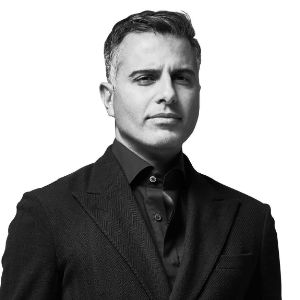
Ari Daie. The pitch is two hours; the idea took longer.
He looked at the loneliest screen in commerce - the checkout page - and decided it should feel like a group chat.
Ari Daie. The pitch is two hours; the idea took longer.
Ask Ari Daie what is wrong with online shopping and he will not start with conversion rates or cart abandonment. He starts with a feeling. You buy alone. You stare at a screen, type in a card number, and nobody is there. That is strange, he argues, because buying has almost never been a solo act. People text a friend before they pick seats. They ask the group chat before they commit. The internet quietly deleted the part of commerce that was always human, and Daie built a company to put it back.
That company is FEVO, a social-commerce platform run out of New York's Meatpacking District. Its job is unglamorous and enormous at the same time: take the checkout page that lives on a sports team's or a brand's own website and make it social. Buy four seats and a friend can grab the fifth. Add a jersey, a parking pass, a round of food and drink, and settle it all in one transaction. FEVO describes this as rehumanizing shopping. Daie describes it, more plainly, as letting people do online what they already do in real life.
For the last 10 years, major brands have forfeited their social graph to walled gardens that own their data, manipulate their data and hoard their data.- Ari Daie, on why brands lost the plot
The conviction underneath FEVO is about ownership. For a decade, Daie says, teams and brands handed their most valuable asset - the web of relationships among their fans - to platforms they do not control. The fan belongs to the league or the artist, but the social connection ends up living inside someone else's walled garden. His fix is blunt: that social graph should sit on the brand's own domain, on pages they operate, with data they keep. FEVO is the machinery that makes that possible without a months-long replatforming project. By his own pitch, it turns on in about two hours, with staff trained in roughly 45 minutes.
Daie did not arrive at social commerce by accident. He is a Chicago native who studied business at Georgetown and went on to a graduate degree at Harvard, then started his career as an investment banker at Goldman Sachs. The banking seat taught him how value gets counted; the next chapters taught him how it gets built. In 1995 he co-founded NRG Studios, an early venture that was acquired in 1998 - the first of two technology startups he launched and sold before most people had heard the phrase "social commerce."
Then came live entertainment. At Ticketmaster, part of Live Nation Entertainment, Daie ran strategic partnerships and mergers and acquisitions, and co-founded two internal ventures - LiveAnalytics and Ticketmaster Nexus. It is hard to imagine a better classroom for the problem he would later attack. He spent years inside the plumbing of how tickets get sold, who owns the buyer, and where the data goes. He also served as President and Head of Strategy and Revenue at Bosch USA, a stretch on the operating side of a very different kind of giant.
This next generation is more socially minded and conscious - they want to build their own clout.- Ari Daie, on who FEVO is really for
Put those chapters together and FEVO stops looking like a leap and starts looking like a logical conclusion. Daie had seen the money, the events, the buyers, and the data leakage from the inside. The thing he had not seen was a tool that let a team keep all of it and make the buying social at the same time. So he built one.
Most enterprise software asks an organization to change to fit it. FEVO's selling point is the opposite. It slots into systems a team already runs and supports the messy reality of what live venues actually sell - suites, season plans, group tickets, single seats, merchandise, food and beverage, premium experiences - and lets a buyer bundle them into one social checkout. That practicality is why the client list reads the way it does: more than 750 partners across sports, music and live entertainment, including the New York Yankees, the LA Dodgers, the Milwaukee Bucks and Formula 1, spanning all five major North American leagues.
The scale followed. FEVO has reported moving past a billion dollars in sales, and has raised tens of millions in venture funding from backers that include Drive by DraftKings and HBSE Ventures - investors who know live sports and gaming well enough to recognize the problem Daie is solving. The newest chapter folds in artificial intelligence. Daie frames it simply: social commerce, bundled with AI. The bet is that the next wave of buyers will not just want to shop together, they will want software smart enough to make those group decisions effortless.
There is a generational argument running through everything Daie says. He believes younger buyers are more socially minded and want to build their own clout rather than borrow an audience from a platform. If he is right, the teams and brands that own their social graph - and make their own checkout the place fans gather - win the next decade. If he is wrong, he has still built a tool that makes buying tickets less lonely, which is not a bad consolation prize. Either way, the through-line of his career is intact: spot the human thing the technology forgot, then build the thing that remembers it.
Relative scale, drawn from reported figures. Illustrative, not audited.
We're enabling social commerce and bundling it with AI.// the next chapter
They should own that social graph and it should live on their owned and operated domains.// on data ownership
For the last 10 years, major brands have forfeited their social graph to walled gardens.// the diagnosis
This next generation is more socially minded and conscious - they want to build their own clout.// who FEVO is for
Live partners on FEVO across sports, music and live entertainment.
Reported sales scaled through the platform.
All major North American leagues - MLB, NBA, NFL, NHL, MLS - plus Formula 1.
Startups built and sold before FEVO, starting with NRG Studios in the 1990s.
Ventures co-founded inside Live Nation: LiveAnalytics and Ticketmaster Nexus.
Series C venture funding raised, backers including Drive by DraftKings and HBSE Ventures.
The platform, the profiles, and the conversations worth your click.