AVOXI
AVOXI delivers unmatched cloud voice coverage that's orchestrated by software. It's the only platform you'll ever need.
There is a specific kind of bad night that only happens to people who run global customer operations. It is 2am somewhere. A support queue in one country has gone quiet, and nobody can tell whether the phones are broken, the carrier is having a bad hour, or the numbers themselves have stopped working. The CRM is fine. The cloud is fine. The dashboard everybody watches is green. The thing that failed is the oldest technology in the building.
AVOXI has been selling to the people who have had that night since 2001. The Atlanta company started as an international voice provider, back when placing a business call across borders meant negotiating rates market by market and hoping. Twenty-five years later it sells something that looks quite different on the surface and is aimed at exactly the same problem: an all-in-one cloud voice platform that gives multinational companies phone numbers, routing, analytics and caller identity across more than 150 countries, on one contract, through one screen.
The company's own line for this is short. International voice, done right.
The mess that nobody puts on a slide
Ask a large enterprise how many CRM systems it runs and you will usually get one answer. Ask how many voice carriers it runs and the answer is often a pause, then a guess, then someone going to check.
This is the gap AVOXI lives in. A company operating in thirty countries has typically accumulated voice contracts the way a house accumulates extension cords: one at a time, each solving a local problem, none of them designed together. Every one comes with its own portal, its own invoice format, its own support queue, its own escalation path, its own local rules about what documentation you need before you are allowed to be issued a phone number at all. Nobody chose this architecture. It just happened, in increments, over years.
The consolidation pitch
AVOXI's core argument is not that its voice is better than any single regional carrier's. It is that one platform sitting on top of direct interconnects with more than 80 local carriers beats twelve separate relationships, because the operational cost of the twelve is invisible until something breaks.
James Young, a senior IT architect at ENGIE Impact, put the appeal plainly in a customer account published by the company: the big thing AVOXI has done, he said, is the consolidation of services. That is a less exciting sentence than most technology marketing produces, and it is probably the most honest description of the product on offer.
covered
carriers
integrations
founded
worldwide
What is actually in the box
The platform breaks into three rough layers, and it helps to hold them apart.
The first is numbers. International toll free service, Universal International Freephone Numbers, local direct-inward-dial numbers in thousands of cities, non-geographic numbers, vanity numbers, and porting of the numbers a company already has. This is the part that sounds like a commodity and is not. Getting a phone number issued in a given market can require local presence, local documentation and patience with a regulator whose rules changed last quarter. AVOXI has spent two decades building that map, and it describes its inventory of international toll free numbers as the most expansive available.
The second layer is control. A visual Flow Builder for routing and IVR, encrypted SIP trunking, programmable voice APIs, and integrations into the applications enterprises already run: Genesys, Amazon Connect, Microsoft Teams, Zoom, Webex, Avaya and roughly forty others. AVOXI is generally not trying to replace a company's contact centre software. It is trying to be the voice underneath it.
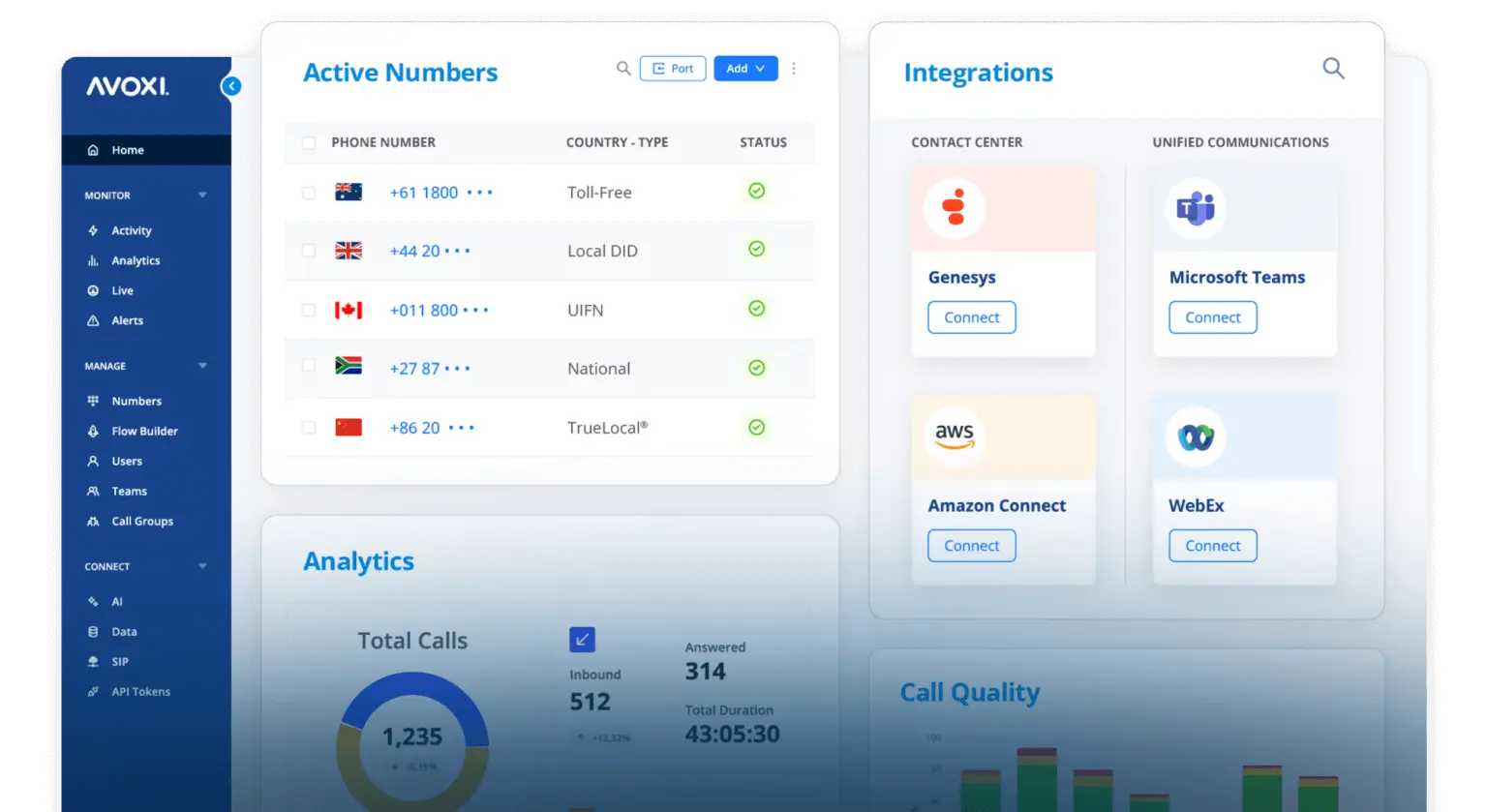
Toll free in Australia, a local DID in the UK, a UIFN, a national number in South Africa, TrueLocal in China. The screenshot's quiet boast is the column on the right: every row is green.
The third layer is where the recent work has gone: intelligence. Call Insights tracks mean opinion score, jitter and packet loss in real time, broken out by geography and SIP trunk. Number Testing checks that a route actually works before a customer discovers it does not. And Proactive Service uses anomaly detection to spot degradation on the voice channel and open the conversation before the client does. AVOXI puts that detection rate at 97 percent, with resolution up to 50 percent faster.
That last product is worth pausing on, because it reveals how the company thinks. Every support ticket a vendor receives is, in a sense, a report card on something the vendor should have noticed first. AVOXI read its own queue and turned the pattern into software.
Platform coverage, by the company's published figures
Three companies wearing the same name
Most corporate history pages flatten twenty years into a single paragraph of inevitability. AVOXI does something unusual: it names its eras, with dates, in public.
The International Voice Era ran from 2001 to 2011, selling cross-border calling to businesses for whom it was expensive and awkward. The Global Cloud Platform Era ran from 2011 to 2020, during which the company rebuilt itself from telecom provider into cloud software while the old revenue paid the bills. The Intelligent SaaS Era began in 2020 and is where it sits now: self-service, integrations, APIs, AI.
Each of those transitions was a chance to die, and most telecom companies from the 2001 cohort did. What stayed constant was not the product. It was the customer. Global businesses that need voice to work, with the same budget and the same 2am problem, for a quarter of a century.
The spam problem, and the pivot to trust
Something changed in enterprise voice over the last few years that has nothing to do with technology and everything to do with behaviour. People stopped answering the phone.
The reason is not mysterious. Carriers and handset makers began scoring numbers algorithmically to protect consumers from fraud, and those filters got aggressive because they had to. The result is that a perfectly legitimate callback from a bank, an airline or a hospital can land on a screen that reads Spam Likely, in red, and be dismissed in half a second.
“With more than 80% of consumers receiving weekly fraud calls, skepticism of unknown callers is at an all-time high.”
Barbara Dondiego, Chief Executive Officer, AVOXIAVOXI's answer, launched in March 2026, is Trusted Outbound Voice. The interesting thing about it is not the name, which is the sort of phrase that usually means nothing. It is that the company decomposed an abstract word into four things you can measure.
TrueLocal supplies an authentic local caller ID, now in more than 110 countries, so a call from your company shows up as a genuine in-market number rather than a foreign string or a spoof. Intelligent Caller ID, which arrived in mid-2025, uses a selection engine that reads communication history, local preference and live performance to pick which of your numbers to dial from. Reputation Management scans global databases to tell you whether your own numbers have already been flagged as spam, which most companies have never checked. Branded Caller ID, still to come, puts a verified brand identity on the recipient's screen.
Each of those has a number attached: answer rate, connection rate, spam-flag count. That is a different exercise from claiming to be trustworthy.
Elka Popova, VP of Connected Work Research at Frost & Sullivan, described the approach when the firm granted AVOXI its 2026 Global Enterprise Voice Trust recognition in August: rather than treating trust as a standalone feature, she said, AVOXI integrates inbound voice stability, outbound caller identity, reputation management and AI-driven analytics into a single platform.
The layer under the AI
There is a second reason voice infrastructure has become interesting again, and it is the obvious one that almost nobody in the current AI conversation talks about.
Voice agents, conversational IVRs and agent-assist tools all depend on audio. If the audio arrives with jitter, packet loss or a few hundred milliseconds of delay on a bot-to-human handoff, a beautifully tuned model transcribes garbage and the customer hangs up. The ceiling on the shiny layer is set by the boring one underneath.
This is precisely the argument AVOXI made in winning the 2026 Voice AI Technology Excellence Award from TMC's CUSTOMER magazine, which went not to an AI agent but to the platform the agents stand on. The company's positioning has become a variant of the shovels-in-a-gold-rush strategy, adjusted one level down. Rather than sell shovels, sell the ground.

JLL, the global real estate firm, is one of AVOXI's named customers. Somewhere behind that glass, someone is waiting for a phone to ring in a country they have never visited.
Who buys it, and how the money works
AVOXI's customer list reads like an index of businesses whose operations cross a lot of borders. Teleperformance and Concentrix on the outsourcing side. JLL and Equinix in real estate and infrastructure. Hyatt, IHG and Hotelbeds in travel. Logitech, Ring, Black+Decker and 3Shape in hardware. Abbott in healthcare. Moncler, Luxottica and Farfetch in luxury and fashion. Flutterwave and ENGIE Impact in payments and energy services. The company has cited a base of more than 5,000 businesses.
The revenue model is a hybrid, and buyers should understand it going in. There is SaaS on top and telecom underneath. Published plans have included a free Launch tier, a Contact plan around $24.99 per user per month and an Engaged Enterprise plan around $49.99 per user per month. Underneath sit per-number rental, roughly $4.49 a month for a virtual number, plus per-minute usage, a platform fee expressed as a small percentage of monthly voice spend, and regulatory and onboarding charges. Large multinational deployments are quoted individually.
The practical implication is that the sticker price on a plan page is not the bill. Total cost tracks numbers, seats and minutes, which is how wholesale voice has always worked and which is worth modelling honestly before signing.
Where it sits on the map
Enterprise voice buyers generally choose between two shapes of vendor. On one side are the programmable communications platforms, Twilio being the archetype, with Vonage, Sinch, Infobip, Telnyx and Plivo nearby. They lead with developer APIs, broad channel coverage and speed of integration. On the other side are the global carriers and the regional telcos, which lead with network ownership and enterprise contracts and are typically slower to change anything.
AVOXI sits in between, and its whole commercial case depends on that position being real rather than a compromise. Compared with a CPaaS platform, it offers deeper international number coverage and in-market regulatory expertise. Compared with a carrier, it offers software, self-service and analytics.
The positioning question
Two axes buyers actually weigh: how much software they get, and how deep the international voice footprint goes.
There is a version of the word global that is close to a lie. Plenty of vendors advertise coverage in 190 countries, which can mean they will route a call there through a partner's partner and wish you luck when it breaks. AVOXI's counter is the direct interconnect count, the teams on five continents, and the people who know which regulator wants which form. Coverage is a claim. Depth is harder to copy.
The quiet part
One more detail is worth noting, because it explains a lot about the company's tempo. AVOXI has raised outside money exactly once: $10.1 million in growth equity led by Ballast Point Ventures in December 2018. Twenty-five years old, roughly 170 people spread across North America, South America, Europe, Africa and Asia, one round.
That is not the usual shape of a technology story, and it has consequences. It bought the company time to spend a decade per act, to rebuild the platform twice without a board demanding the pivot land by quarter's end, and to serve a slow, relationship-heavy enterprise sale on its own clock. The stated values, integrity, customer-obsession, transparency and agility, are the sort of thing every company lists. The distributed structure is less decorative: in-market people are how you handle carrier relationships and telecom regulation in 150 countries, not a perk.
“Voice has long been one of the most important touchpoints in the customer experience, yet many enterprises are just beginning to understand how software can optimize the channel.”
Barbara Dondiego, Chief Executive Officer, AVOXIThe company's mission statement is a single line: keep global businesses connected through the power of communications. Read cynically, that is corporate wallpaper. Read literally, it is a fairly precise description of a business that has done one thing since 2001, changing the delivery mechanism from circuits to cloud to software to intelligence, while the customer and the problem stayed exactly where they were.
Nobody brags about their voice vendor. They only think about it on the night the phones go quiet.
Go deeper
- Website → avoxi.com
- The Cloud Voice Platform
- About & leadership
- Pricing
- Newsroom
- Blog
- Support & contact
- Email → sales@avoxi.com