In 2013, Christopher Hopper and Samuel Adeyemo discovered an absurdity familiar to anyone who has tried to improve a house: the physical work was the quick part. Their solar installation took two weeks. Designing the system took seven months. They were graduate students at Stanford at the time, and the job forced them to stitch together tools for a roof, its shadows, its likely electricity output and the documents that made the project saleable. The panels were waiting; the process was not.
That delay became Aurora Solar. Its premise is simple enough to sound obvious in retrospect: if a solar company can understand a roof accurately from a desk, it can speak to the homeowner sooner and send a more coherent job to the installation crew. Thirteen years later, Aurora says more than 7,000 organizations use its platform and more than 20 million solar projects have been designed in it. Those are software designs, of course, not a count of completed installations.
The short version
- Aurora sells design, sales and delivery software to solar professionals, with HelioScope for commercial projects.
- Its customer starts with a roof model and can leave with a proposal, financing, a contract and plan-set request.
- Public monthly prices begin at $159 per user for Basic and $259 for Premium; enterprise and add-on work vary.
- Its 2026 pitch reaches into batteries, EV charging, HVAC and new markets abroad.
First, draw a roof worth believing
A rooftop proposal is a collection of small claims: where the sun lands, where it does not, how many modules fit, what they might produce, what the household uses, and what the whole proposition might cost. A pretty rendering can make a weak claim look convincing. Aurora’s wager has been that the model behind the rendering matters more than the rendering itself.
Its Design Mode combines aerial imagery, 3D geometry, roof measurements, tree and obstruction modeling, shading analysis, component placement and production simulation. Its AI tools can help form a roof model and lay out panels. The company has also added LIDAR-assisted modeling and on-demand expert models. None of this makes every first sketch a permit-ready truth. Aurora’s own plan-set guidance says AI-generated designs require designer review before final engineering and plan sets. That caveat is sensible: a roof has a life beyond a screen.
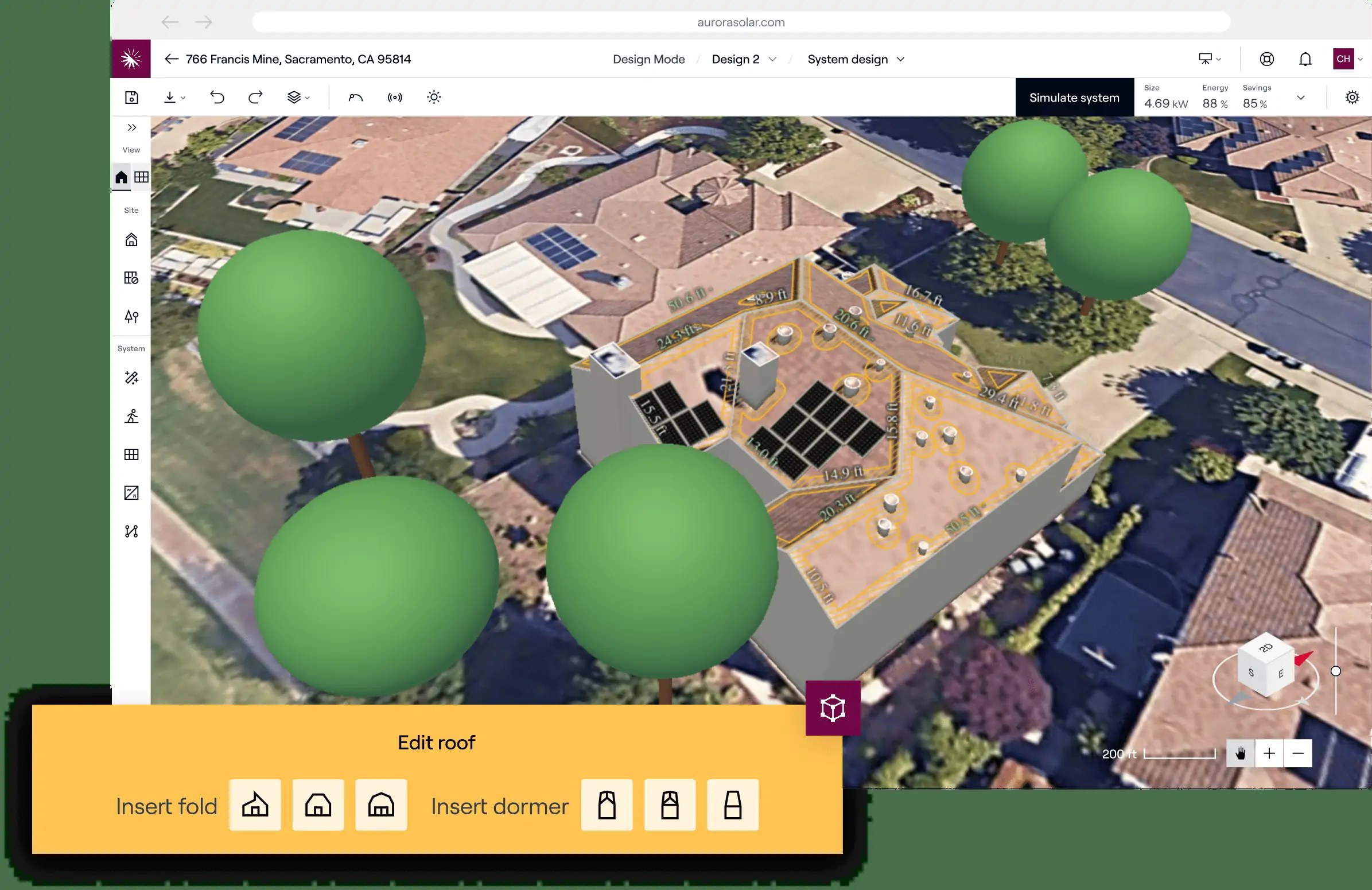
The company sought outside checks early. The National Renewable Energy Laboratory examined Aurora’s performance simulation engine in 2015, and Aurora says the lab also validated its remote shading accuracy that year. In 2020 the California Energy Commission approved it as an assessment tool for the state’s Title 24 solar mandate. The point was not merely to win a badge. Installers need estimates they can defend when a homeowner asks why the eventual system differs from the one shown at the kitchen table.
Founding problem
7 monthsspent designing the founders’ original systemPhysical work
2 weeksspent installing that same systemThe sales pitch has a roof underneath it
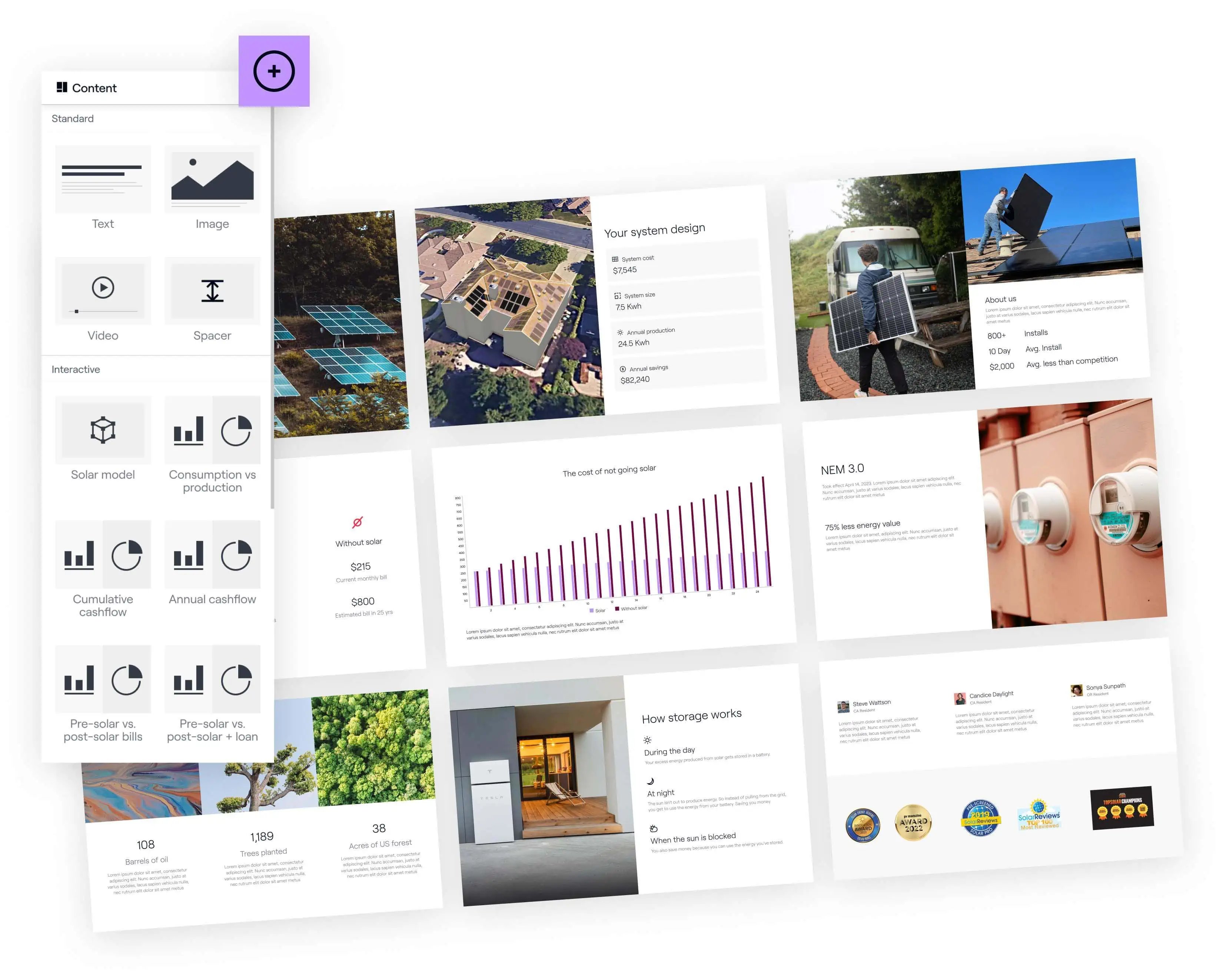
Aurora’s second move was to bring design into the sale. Sales Mode turns a system into an interactive proposal: a representative can show panel placement, production, energy bill comparisons, financing choices and a contract. In a trade where a customer may sign for an expensive roof change after a single conversation, a salesperson who can alter the design in front of them has an advantage. So does a customer who can see what changed.
This is where Aurora competes with OpenSolar, Solo, Solargraf and a collection of spreadsheets, CAD files, finance portals and PDFs. Its distinction is the thread between them. A panel moved during the pitch should still be visible to the designer; the designer’s model should still make sense to the person producing a plan set. Aurora sells that continuity more than any single clever button.
One address, several jobs
The customer stories offer a more grounded measure than a platform slogan. CertainTeed says its solar roofing specialists went from a design process of three to four weeks to a ten-minute customer session using Aurora AI and Sales Mode. Solaris Renewables reports proposals under five minutes and a 5% to 10% increase in close rates after adopting Sales Mode. Kasselman Solar reports 25% fewer change orders with Aurora’s expert design services. These are company-published case studies, so they show what selected customers achieved, not what every installer should expect.
The price of an easier answer
Aurora is a business-to-business software company, and its pricing makes the tradeoff visible. Public rates list Basic at $159 per user per month and Premium at $259 when billed monthly, with annual discounts. Basic covers the design and sales essentials. Premium adds LIDAR-assisted modeling, shade reports and more advanced battery modeling. Enterprise pricing is custom and adds capabilities such as APIs, permissions and premium services. On-demand site models and plan sets carry separate charges. New self-serve plans use credits across products and services without an annual contract.
That is a meaningful cost for a one-person shop. The arithmetic changes for a busy installer if it replaces repeated site visits, rework or scattered subscriptions, though that return depends on volume and the quality of its own process. The software cannot make a bad survey good. It can make the questions that ought to be asked arrive earlier.
Solar became a larger household question
The company widened its map in 2021 by acquiring Folsom Labs, maker of HelioScope, a tool for commercial solar design and simulation. That gave Aurora a product for larger rooftops, carports and ground mounts, where production modeling and finance can look different from a household sale. On the residential side, it added battery modeling, financing integrations, contracts and plan-set services. The product spread followed the way installers’ work spread: selling the panel is only one step in delivering it.
The market also pushed back. In January 2024 Aurora cut about one fifth of a workforce of roughly 500, after a smaller earlier reduction. The company cited higher interest rates and California’s NEM 3.0 policy among the pressures on solar businesses. Its rise had been financed by large rounds - $250 million in 2021 and $200 million in 2022 - but software cannot keep an industry’s loan payments low. The moment exposed a hard limit to workflow gains: faster proposals do not erase the economics of a homeowner’s decision.
Its September 2026 announcements show the response. Aurora now lets U.S. salespeople quote HVAC, EV chargers and storage in a solar proposal, offers more prepaid lease and financing options, and has a homeowner marketplace that can be embedded on installer sites for lead capture. It expanded to the U.K. with local data and proposal requirements; in Germany it added heat-pump modeling. HelioScope gained more storage features for commercial users. The company is following a customer whose questions now include backup power, heating and charging, as well as panels.
There is a lesson in the original seven months. Aurora did not invent the solar panel or the desire to put one on a roof. It found the missing connective tissue between a household’s wish, a salesperson’s promise and an engineer’s drawing. Anyone building tools for a complex service can copy that diagnostic habit: time the whole journey, including the paperwork, and ask which handoff makes the physical job look slow. A clear picture of the roof is useful. A clear account of everything that happens after the picture is worth more.