There is a peculiar indignity in running out of carbon dioxide. The atmosphere has rather too much of it. A brewery, however, cannot place an order with the weather. It needs a concentrated, purified ingredient, delivered when the production schedule says so. Aircapture’s business begins in the gap between those two facts.
The company puts modular direct air capture equipment at the customer’s premises. It extracts atmospheric CO₂ and supplies it to the process that needs it. A technology usually discussed in the language of planetary repair acquires a more immediate job: keep the factory supplied. The purchasing department is invited into the climate conversation, invoice in hand.
- The product: purified atmospheric CO₂, made at the customer’s site.
- The buyer: a business that already needs CO₂, from a brewery to a concrete producer.
- The arrangement: CO₂ as a Service, with gas consumption driving the bill at Almanac.
- The distinction: beer uses carbon temporarily; mineral storage can keep it out of the atmosphere.
01 / THE CUSTOMER’S CLOCKThe ingredient with a delivery problem
Almanac Beer Co. offers a useful test of this idea. In autumn 2025, missed CO₂ deliveries stopped its operations for two days. Canning stalled; catching up required another shift. By March 2026, Aircapture’s equipment was supplying the Alameda brewery. Almanac CEO Damian Fagan reported a 15% saving on the per-pound price, but avoiding another interruption mattered most.
“Fundamentally, this was a business decision.”
Damian Fagan / CEO, Almanac Beer Co.
The resulting beer, Flow - Clean Air Edition, launched in March 2026. The partners said the system supplies beverage-grade liquid CO₂ at 99.999% purity. The intriguing change happens before the glass reaches the customer: an ingredient that once arrived through an industrial distribution network is now produced beside the brewery.
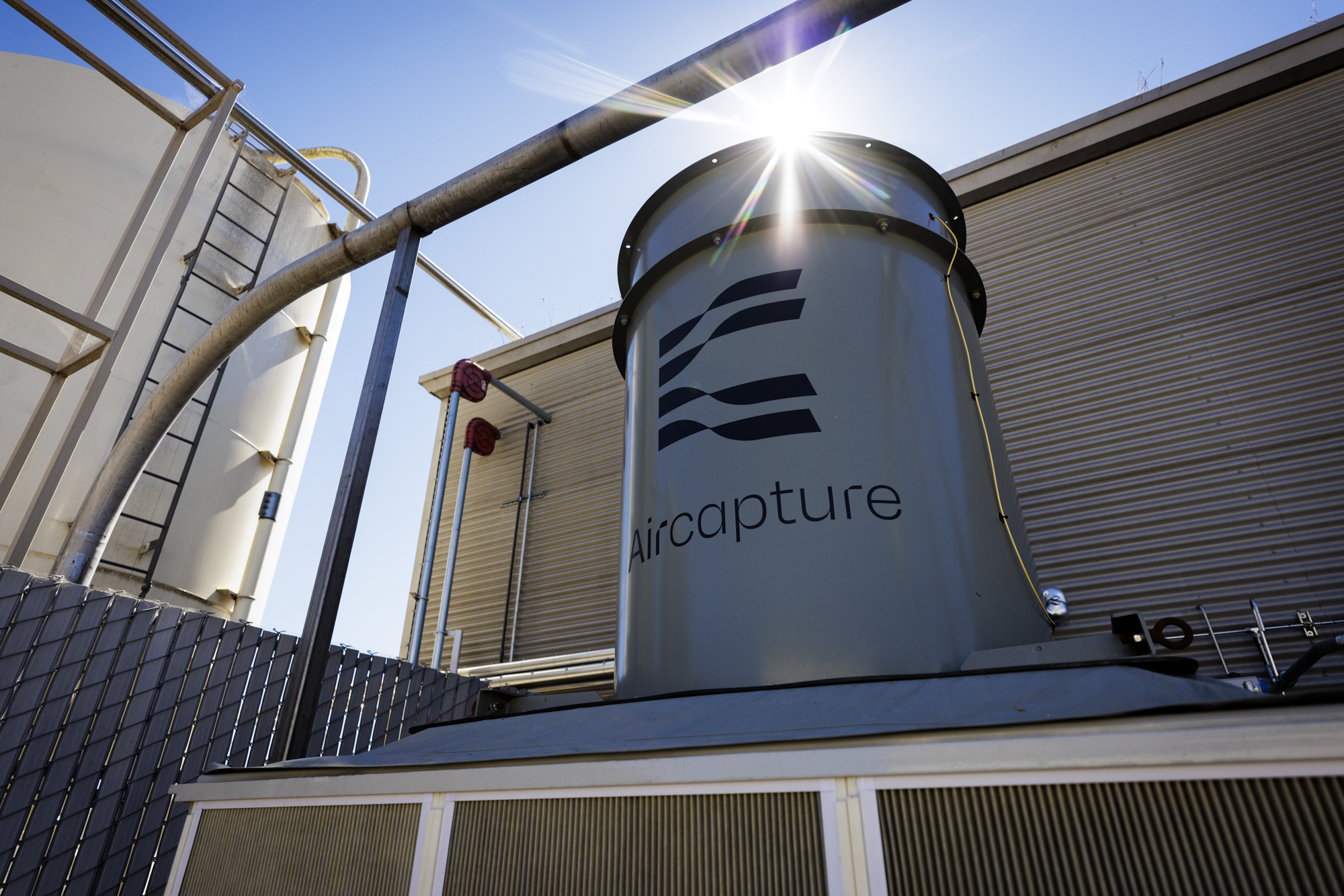
Conventional CO₂ supply often starts at another industry’s plant. Aircapture describes a market fed by hydrogen, ethanol and ammonia production, and petroleum refining. Gas is recovered, processed and transported to users. The brewer buys an essential ingredient whose availability depends partly on businesses making something else. Local atmospheric production changes that dependency.
02 / THE MACHINE’S JOBA fan, a honeycomb, a customer
There is no shortage of air. There is a shortage of CO₂ concentration in air. Corning puts the atmospheric proportion at roughly 0.04%, which means capture equipment must handle a substantial flow to collect a useful amount. This makes the unglamorous details - surface area, airflow and the structure carrying the capture material - consequential.
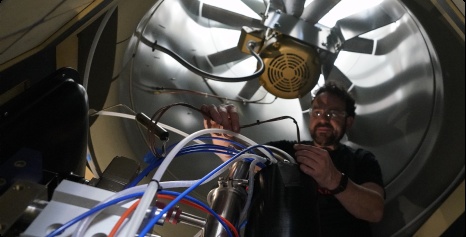
Corning supplies honeycomb ceramic substrates for Aircapture’s systems. Their channels support sorbent material that binds CO₂ as air passes through. Regeneration releases the captured gas so the material can be used again. Corning’s contribution draws on decades of ceramic engineering for vehicle emissions control. The old talent for managing gases has found another assignment.
Move ambient air through a sorbent-bearing structure.
Recover captured CO₂ and condition it for the customer.
Supply the production line in the required form.
Aircapture’s work extends beyond collecting molecules. It designs the platform and integrates production with a customer’s specifications. Liquid or gaseous delivery, purity and the receiving process all matter. A successful demonstration must become a dependable piece of industrial equipment. A brewer cannot schedule its production around an interesting experiment.
03 / FOLLOW THE PURCHASE ORDERPay for the gas. Price the interruption.
Aircapture calls the offering CO₂ as a Service. At Almanac, the brewery pays for the gas it uses rather than directly purchasing the equipment. That makes adoption look familiar to a buyer already paying for CO₂. The physical machinery changes; the bill still corresponds to an ingredient.
The broader comparison must include more than the advertised price of gas. For a prospective buyer, the relevant calculation includes delivery charges, interruptions, energy arrangements, installation and service obligations. On-site production can remove a truck journey, but it introduces equipment that must run reliably. The engineering and the contract have to answer the same question: will the ingredient be there?
This also explains Aircapture’s position in the market. Its immediate alternative is a delivered industrial commodity. Other DAC developers belong in the technical conversation, but a factory choosing a CO₂ supplier has its own comparison to make. The company is competing for an existing purchase while developing equipment that can also serve carbon-removal projects.
04 / WHERE THE CARBON GOESBeer lets go. Rock holds on.
A useful product and permanent carbon removal are different achievements. CO₂ used to carbonate a beverage eventually returns to the atmosphere. Making that ingredient locally can change its supply footprint and help a new technology find paying customers. It does not turn the drink into a permanent carbon store.
A production ingredient. The carbon eventually returns to the atmosphere.
A durable destination. Net removal also depends on emissions across the process.
Project Hajar connects Aircapture’s equipment to a different destination. Partner 44.01 mineralizes captured CO₂ in underground peridotite formations in the United Arab Emirates. The project received the $1 million XFACTOR Air award in the 2025 XPRIZE Carbon Removal competition. That was a specific recognition for the air pathway; the competition’s grand prize went to Mati Carbon.
Corning reports that eight modular units at Hajar reached operational status in 17 days. Atwood described that clock as starting when the machines landed at the UAE port. The distinction matters: rapid installation is an attractive feature, while developing an entire storage project includes more work than placing a machine on site.
Concrete offers another potential destination. In 2025, Aizawa Concrete’s Fukushima work involved testing the combination of atmospheric CO₂ and alkaline process water to produce calcium carbonate. Separately, a 2023 announcement proposed integrating Aircapture with CarbonBuilt’s curing technology at Block-Lite in Flagstaff. A $150,000 coalition grant supported development. The stated carbon reductions were project expectations, not results to borrow for every Aircapture installation.
05 / MAKING THE NEXT MACHINEThe expensive part is letting go
Atwood’s interest in capture grew out of needing carbon, not merely wanting to dispose of it. In a 2025 interview, he recalled searching for CO₂ to grow algae and discovering DAC at a climate conference in 2009. Aircapture was founded in 2019. The origin helps explain the company’s attention to industrial demand: carbon was already an input he had needed to obtain.
In June 2025, Aircapture announced a $50 million Series A led by the Larsen Lam Climate Change Foundation. The stated uses included expanding manufacturing, deployments and engineering. These are the jobs that determine whether modular equipment becomes repeatable infrastructure: building the next unit, installing it, maintaining it and learning from its operation.
The company’s published values emphasize candid feedback and building for scale. Those priorities have a practical application here. Field performance should change the design. A component that behaves beautifully in one setting still has to survive repeated operation at a customer’s facility.
In June 2026, Aircapture announced CarbonX 2.0 support for Lightswing, its microwave-based regeneration process. The company says it directs energy toward releasing bound CO₂ instead of heating the wider system. That targets a costly part of DAC: recovering the carbon after collecting it. The proposed advantage still needs the discipline of operation at scale.
Tonnes of CO₂ per year: the planned Kenya Lightswing pilot’s capture capacity.A design target for a pilot, not reported annual output.
The award supports a planned pilot in Kenya within a shared hub, alongside three other DAC companies. Aircapture says the facility will generate the performance data needed to validate the process. The attractive idea is energy directed more precisely. The useful evidence will be the energy, equipment and carbon accounting of an operating system.
06 / THE IDEA WORTH BORROWINGStart with the invoice
Aircapture offers other industrial innovators a practical starting point: find a purchase a customer already makes, then examine what goes wrong around it. The missed delivery, the transport route and the receiving equipment may reveal an opportunity that a laboratory performance figure does not.
For a CO₂ buyer, the next step is a site-specific comparison. Measure demand and its peaks. Establish the required purity and delivery form. Compare the existing supply bill with an on-site service, including energy, maintenance and backup arrangements. For a permanent-removal project, add storage access, verification and emissions across the full chain.
The proposition becomes less persuasive where delivered supply is dependable and inexpensive, energy is costly, or the site cannot accommodate the equipment and integration. These are constraints to calculate before signing. Atmospheric feedstock may be everywhere; a workable industrial arrangement is local.
That is the charm of the business. Carbon dioxide carries an enormous planetary story, but a customer can encounter it as a missing ingredient on a Tuesday. Aircapture puts a machine beside that problem and offers to supply what the production line needs. The bubbles are small. The purchase order is real.