The machinery of climate repair rarely offers refreshments. It asks for land, power, pipes, patience and, in the case of many direct-air-capture systems, a meaningful quantity of heat and water. Will Kain looked at that bargain and found it ungenerous. The company he founded, Avnos, is built around a reversal: take carbon dioxide from the open air, certainly, but harvest water from that same air as well. A machine charged with repairing one planetary account should not casually overdraw another.
That instinct sounds like the product of a scientist’s long quarrel with a laboratory constraint. Kain’s route was different. He studied economics and government at the University of Virginia, began his career inside UBS Investment Bank in New York, and spent the years after that moving steadily closer to the hardware. His education in climate technology came through balance sheets, ethanol plants, desalination membranes, Chinese manufacturing and the intricate business of persuading industrial equipment to become an industrial business.
This makes him an unusual kind of climate founder. He is not the inventor presented as a commercial afterthought, nor the financier parachuting into science with a suitcase full of vocabulary. His career has unfolded in the narrow, difficult corridor between capital and machinery. Avnos is the most complete expression of that apprenticeship.
“We’ve only got one planet Earth so we better take care of it.”Will Kain, speaking on This Week in Startups
The long road from the spreadsheet to the sorbent
Kain spent roughly five years on the conventional Wall Street track. Then the track bent toward industry. At Altra Biofuels, as vice president of corporate finance, he oversaw more than $300 million in project-level financing for four ethanol facilities. It was an early lesson in the scale of climate-adjacent ambition: a clever process does not become a plant until land, steel, contracts and money agree to cooperate.
At NanoH2O, a Los Angeles company using nanotechnology to improve reverse-osmosis membranes, the subject changed from fuel to water. Kain became vice president of corporate development. His remit included raising capital, strategic planning and launching commercial and manufacturing operations in China. He also led the transaction team when LG Chem bought the company in 2014. Desalination is a useful school for anyone tempted by simple answers. Fresh water can be produced from an abundant source, but energy, membrane performance, manufacturing cost and local conditions decide whether the answer is useful.
Kain next helped launch Rusheen Capital Management, an investment firm concentrating on growth-stage energy, water and industrial sustainability companies. He served in operating and board roles around other industrial technologies, including SonicEnergy and the hydrogen venture C4-MCP. By the time he arrived at direct air capture, he had seen the same plot from several seats: banker, finance executive, corporate strategist, investor and operator.
A personal habit offers a small window into how he works. Kain has said that walking his dog, and allowing his mind to disengage, produces some of his best business ideas. It is delightfully modest technology: four paws, an open route, no slide deck. Yet the habit fits his broader method. Step away from the accepted framing, then return and ask whether the system has been arranged sensibly.
Air contains two prizes
Direct air capture begins with an awkward fact. Carbon dioxide is essential to remove at enormous scale, yet it is dilute in ambient air. Separating it demands energy and material, and many processes need substantial heat to release the captured gas for storage or use. Some also consume water. Those requirements can narrow the places where a plant makes practical sense.
Avnos calls its approach Hybrid Direct Air Capture, or HDAC. The system uses solid adsorbent materials in a cycle that separates water and carbon dioxide from the same air stream. A moisture-responsive material first harvests water; changes in humidity help release concentrated CO2. The company says its design needs no external water and no external high-grade heat. Instead, it can make use of low-grade waste heat and produce water as an output.
The useful-air proposition · simplified
The ambition is not merely technical elegance. Water changes the map. A capture plant that consumes less of it is easier to imagine in a dry place; one that produces it may offer the host site another reason to care. The same logic drives Kain’s interest in data centers. These facilities generate low-grade heat, require cooling, use water and face rising scrutiny over their environmental footprint. Avnos proposes to sit inside that knot of constraints, using otherwise wasted heat while returning water and providing carbon removal.
It is a more worldly sales pitch than virtue. Industrial customers rarely buy a machine because its heart is pure. They buy it because it performs a necessary job, fits the site and makes the arithmetic less hostile. Kain’s language has increasingly shifted toward infrastructure for precisely this reason. Carbon removal, in his telling, becomes more viable when it solves adjacent problems.
A pilot becomes a place
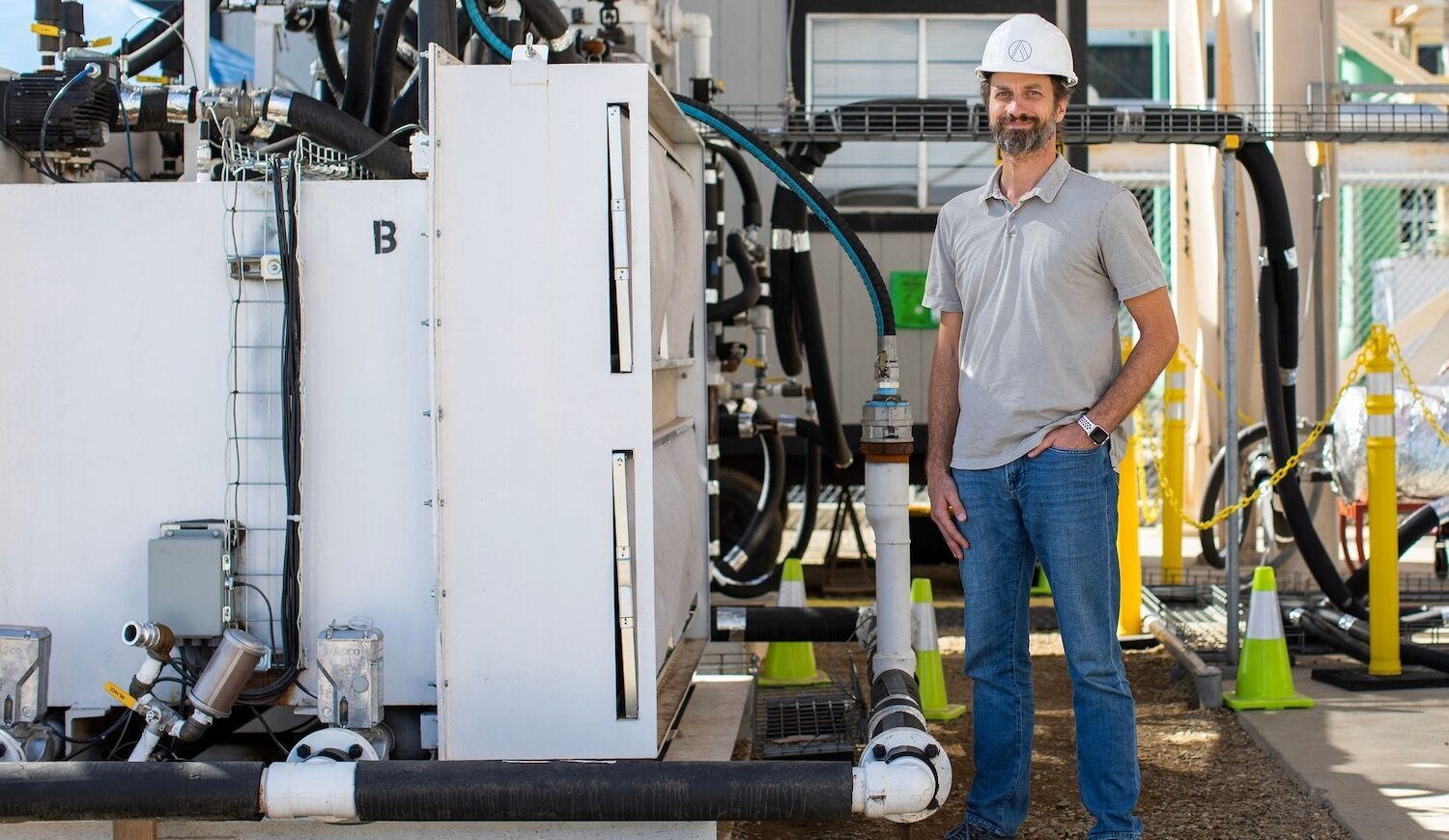
Avnos’s first field deployment, Project Alpine, began operating near Bakersfield, California, in September 2023. Supported by the U.S. Department of Energy and SoCalGas, it was designed to capture about 30 tons of atmospheric CO2 and produce roughly 150 tons of water a year. The quantities were small beside global emissions, but Alpine’s real product was experience. Pipes leak, valves sulk, weather intrudes. A field system answers questions that a handsome rendering cannot hear.
In early 2024, Avnos’s 20,000-square-foot Technology Development Center became operational in Bridgewater, New Jersey. The company placed laboratories, engineering, assembly and full-scale hardware development under one roof. That February it announced a $36 million Series A led by NextEra Energy Resources, joined by investors including Safran Corporate Ventures, Shell Ventures, Envisioning Partners and Rusheen. Existing relationships included ConocoPhillips and JetBlue Ventures, while government support came from the Department of Energy and the Office of Naval Research.
The coalition tells its own story. An airline investor sees a future need for synthetic-fuel feedstock. Energy companies see carbon management and industrial infrastructure. A military research office sees a domestic supply of captured CO2 that could help make fuel. Each arrives through a different door. Kain’s task is to keep them in the same room without confusing interest for a market.
“Brighton is our largest operating deployment to date and demonstrates our ability to deliver infrastructure at increasing scale.”Will Kain, September 2026
Project Brighton supplied the next answer. Built beside the Bridgewater center with Office of Naval Research funding, it entered operation in September 2026. The plant is designed to capture up to 450 tons of atmospheric CO2 each year while producing approximately 475,000 gallons of clean water. Its captured carbon is intended to support work on sustainable aviation fuel. For Avnos, Brighton joins research, construction and operation on one campus - a workshop with consequences.
The unromantic business of becoming repeatable
The next planned step is Cedar, backed by up to $17 million in phased financing from Shell and Mitsubishi Corporation. Four modular HDAC units are intended to capture 3,000 metric tons of CO2 and produce more than 6,000 tons of water annually. Avnos describes the modules as factory-built, an ordinary phrase carrying an enormous burden. Factory-built means fewer bespoke decisions, shorter construction, learnings that survive the trip from one site to the next, and a plausible path from project to product.
The numbers also enforce humility. Thousands of tons remain a rounding error against annual global emissions measured in tens of billions. Kain’s stated destination is gigaton scale, and no press release can bridge that distance. Direct air capture still faces questions about energy, cost, storage, durability and who will consistently pay. The sector has collected graveyards of confident forecasts.
What distinguishes Kain’s approach is not immunity from those questions. It is his attempt to give the machine more than one economic reason to exist. Water is useful. Cooling is useful. Waste heat is available. Captured CO2 can be stored or become an input for synthetic fuel. Stack enough practical relationships together and carbon removal may begin to look less like a costly ornament and more like a piece of working infrastructure.
That thesis now lives beyond Kain’s presentations. It lives in Bakersfield and Bridgewater, among sorbents, ducts, pumps and the data that accumulates when machinery is forced to keep its promises. His Wall Street years are still visible, but so are the desalination factory and the ethanol project. Avnos gathers those earlier chapters into one demand: make the technology financeable, manufacturable and useful where it stands.
There is a pleasant audacity in asking a carbon-removal plant to improve the local water balance while it attends to the atmosphere. There is also shrewdness. The future often arrives wearing moral importance and leaves because it could not find a customer. Kain is trying to make sure this machine has several.