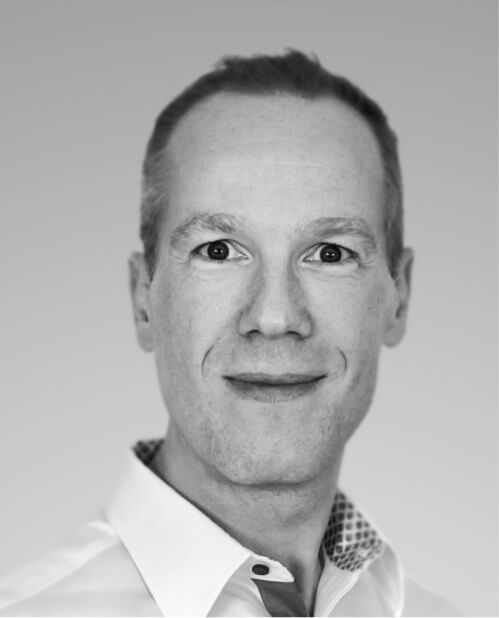
The Lung Architect
There's a moment in every Charles Cadieu company where the science does something the market didn't expect. At IQ Engines, in 2013, it was image recognition fast enough to organize a photo library in real time. At Caption Health, it was an AI that guided a nurse with no ultrasound training through a cardiac scan good enough for clinical use. At Spiritus, the moment is simpler and stranger: a material that sucks carbon dioxide out of the air without fans. No motors. No forced airflow. Just passive contact - the way a lung works.
The PhD Cadieu earned at UC Berkeley's Redwood Center for Theoretical Neuroscience was titled, in the dry language of academia, "Probabilistic Models of Phase Variables for Visual Representation and Neural Dynamics." What it actually studied was how biological systems extract signal from noise - how a brain decides what it's seeing, under uncertainty, using probabilistic inference over incomplete data. That mathematical vocabulary has followed him across every company he's built.
We're seeing soaring demand for data centers and heavy industries, yet we can't ignore the carbon that comes with it. Our DAC technology brings large-scale decarbonization within reach.
- Charles Cadieu, Series A Announcement, March 2025Yahoo, Then GE, Then the Atmosphere
The arc is useful to hold in mind. Cadieu didn't fall into climate tech after some environmental epiphany. He followed the logic of the problem. IQ Engines built computer vision in a world before it was common. Yahoo bought it in 2013 - before the deep learning revolution made image recognition a commodity. He was early.
Caption Health applied that same early-to-market instinct to medical imaging. The company developed AI guidance that could walk a non-specialist through a cardiac ultrasound acquisition - point the probe here, adjust the angle there - and produce images good enough for clinical decision-making. The FDA's landmark 2020 authorization for Caption Guidance was the first time regulators blessed an AI system for guiding image acquisition (not just analyzing the resulting image). GE HealthCare acquired the company in February 2023. TIME Magazine had already called it one of the 100 Best Inventions.
Within months of the GE deal closing, Cadieu was co-founding Spiritus with Matthew Lee, a former staff scientist at Los Alamos National Laboratory where the underlying sorbent technology had been developed. The company came out of stealth in September 2023 with an $11 million seed round led by Khosla Ventures and support from Frontier - the advance market commitment backed by Stripe, Alphabet, McKinsey, Shopify, and Meta. It was not a typical seed story.
The Carbon Orchard
Direct air capture is not a new idea. Strip CO2 from the air, store it underground - simple in concept, ruinously expensive in practice. Current industrial approaches run $600 to $1,000 per metric ton. At those prices, meaningful scale is a budget problem before it's a technology problem. Spiritus's claim - and it's a significant claim - is a path to $100 per ton through passive air contacting and low-temperature desorption.
The "Carbon Orchard" is the physical instantiation of this: an array of passive air contactors filled with sorbent material that binds CO2 from ambient air without powered airflow. Once the sorbent is saturated, low-energy heat regenerates it, releasing concentrated CO2 for geological sequestration. No fans means dramatically lower operating energy. The structure is modular and can be deployed at scale in open terrain - Wyoming rangeland, New Mexico desert, eventually anywhere with the right geology for underground storage.
In March 2024, Spiritus announced "Orchard One" in Wyoming - a facility designed to sequester 2 megatons of CO2 annually, among the largest planned DAC projects in the United States. A 1,000-ton pilot facility is under development on Nambé Pueblo tribal land in New Mexico, expected to begin operations in early 2026. TIME Magazine named the technology one of its 200 Best Inventions of 2024.
Series A and Strategic Alignment
March 2025 brought a $30 million Series A led by Aramco Ventures. The co-investors - Khosla Ventures, Mitsubishi Heavy Industries America, TDK Ventures - are not passive financial bets. Aramco comes with Middle East deployment potential. Mitsubishi brings heavy industrial infrastructure and Japanese market access. The round gave Spiritus $41 million in total funding and validated a strategy of pairing American carbon removal innovation with global industrial partners who have the physical footprint to deploy it.
Around the same funding announcement, Spiritus expanded its leadership team with executives from Tesla, Meta, and ExxonMobil - a mix that signals the company is past the research phase and into the build-and-deploy phase. Dorian West and Kip Hensley joined to lead commercial scale-up. The talent profile of a company often tells you more about its current problems than its press releases do.
Cadieu has been direct about the policy and industrial context: the same AI infrastructure build-out and industrial expansion that's driving energy demand is also driving carbon emissions. His bet is that the economics of DAC, with the right technology, can reach a point where removing carbon becomes a viable industrial service - not charity, not government program, but a market.
America can - and must - grow its industrial base, but we can't let carbon emissions run unchecked. Our technology ensures large-scale progress does not mean large-scale emissions, preserving both economic opportunity and environmental responsibility.
- Charles Cadieu, Spiritus CEOThe Through-Line
What connects image recognition (2013), AI-guided cardiac ultrasound (2023), and passive direct air capture (2025)? Cadieu's answer, implicit in the pattern if not always stated explicitly, is that they're all problems of sensing and inference at scale. How do you extract useful signal from an overwhelming environment? IQ Engines did it with pixels. Caption Health did it with ultrasound waveforms. Spiritus does it with molecules in the atmosphere.
His academic work studied how the brain resolves ambiguity under uncertainty - specifically how "phase variables" in neural representation encode the relationships between visual features, not just the features themselves. It's a subtle point, but the insight is about structure: the patterns in patterns. The Carbon Orchard's passive architecture is, in a different register, the same kind of insight. Instead of forcing air through a system (imposing structure from outside), you let the environment do the work. The sorbent material is structured to capture what's already there.
Whether Cadieu would frame it that way is another matter. Founders rarely narrate their own arcs in the way observers do. What's clear is the empirical record: he has consistently identified technologies that were technically plausible but economically premature, built companies around them before the market was ready, and exited when the market caught up. At Spiritus, he's making the same bet with higher stakes and a longer time horizon than anything he's attempted before.
What Comes Next
The Nambé Pueblo pilot facility in New Mexico is the near-term proof point. If 1,000 tons of CO2 can be removed at a cost trajectory consistent with the $100/ton target, the Wyoming Orchard One project becomes fundable at the scale required. The Saudi Arabia partnership with Aramco opens a separate deployment pathway in a region with abundant sun (heat for desorption) and specific geology favorable for sequestration.
Cadieu has said he expects "a handful" of Carbon Orchard projects before the end of the decade. In direct air capture terms, that would be a significant milestone. The industry has been promising scale for years; few have delivered it. The question is whether Spiritus's technology advantage - specifically the energy cost of passive contacting versus fan-driven systems - holds up at operational scale. The pilot will answer that question. The Series A says investors think the odds are favorable.