In the beginning, Noya wanted to borrow a fan. Cooling towers already moved enormous amounts of air through industrial buildings, and air is the costly part of direct air capture: to find a little CO₂, a machine must encounter a great deal of everything else. Josh Santos and Daniel Cavero, friends and future cofounders, saw ready-made infrastructure. Their early apparatus was less polished. A 55-gallon drum and a refrigeration tank in a backyard drew visits from the local bomb squad, according to Santos. It also helped them prove they could catch carbon.
- Noya developed direct air capture hardware to pull CO₂ from ordinary air, then planned to store it underground and sell verified removal credits.
- The founders moved from cooling tower retrofits to modular, all-electric units after a 2022 US tax credit improved the economics of projects near storage wells.
- Shopify and Watershed made advance purchases. Noya raised an $11 million Series A in 2023.
- In August 2025, Santos said he and Cavero had decided to wind down operations.
The first idea was nearly irresistible: use equipment someone else had already installed. The second idea required building Noya's own fan and putting the machines where captured carbon could be injected into rock. In most startup stories, a pivot is treated as a confession. Here it was an address change, forced by the economics of the entire chain from air to underground storage.
The cooling tower looked like a shortcut
Founded in 2020, Noya began with cooling towers because they had already paid for the hardest physical chore: moving air. The team proposed adding its capture chemistry to the water circuit and recovering the CO₂ afterward. That plan took the company into Y Combinator's Winter 2021 batch and helped it attract $1.2 million from Fifty Years and Lowercarbon Capital. It also supplied a good story: America had a great many cooling towers, so perhaps a large removal network was hiding in plain sight.
A site that is good at moving air is not automatically good at storing carbon. When Congress passed the Inflation Reduction Act in 2022, the federal incentive for direct air capture paired capture with permanent underground storage and rewarded projects meeting a minimum annual scale. The credit rose from $50 to $180 per metric ton for qualifying projects, as Noya's founders described the calculation at the time. Cooling towers, scattered across ordinary commercial and industrial sites, were rarely beside injection wells. The apparent shortcut had left out the destination.
“We did some math to confirm, of course, but it was really exciting for us. And it was a pretty easy decision.”Josh Santos on the 2022 pivot, speaking to TechCrunch
Late that year, the founders switched plans. They kept the filter, sorbent and electrical regeneration concept, added their own air-moving hardware, and aimed to deploy beside suitable geologic storage. It was a small revision in the diagram and a large one in the business. Noya would now have to manufacture and operate more of the machine itself, but it could locate the whole project where capture, transport and storage lined up.
Carbon, catching carbon
Noya's newer design used an activated-carbon monolith: a conductive honeycomb coated with a chemical sorbent. A fan pushed ambient air through its small channels. CO₂ stuck to the sorbent. When the material filled, the unit closed and electricity passed through the carbon support, warming the sorbent directly and releasing a concentrated stream of CO₂. The module could then reopen and repeat the cycle. The company argued that direct electrical heating could avoid some heat losses of systems that warm the entire box with steam or other external heat.
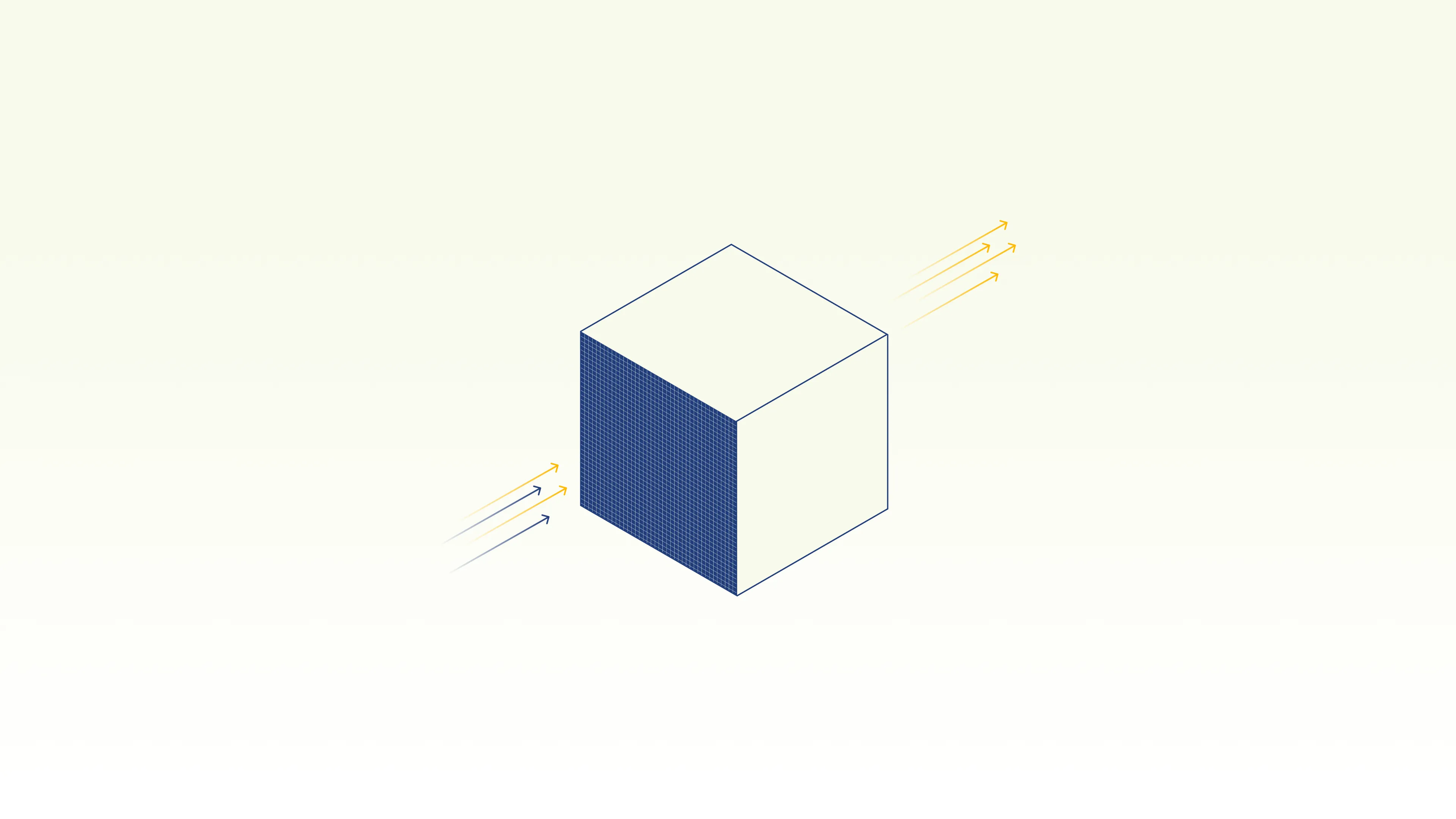
A simplified account of Noya's proposed modular process.
The important word was modular. Each unit worked independently, so Noya could imagine making many copies and assembling them into larger facilities. Santos compared the units to solar panels; MIT News reported that one was roughly six feet wide, four and a half feet high, and a foot thick. Noya also described its system as all-electric, able to pause when renewable power was unavailable, and water-positive. Its XPRIZE team profile claimed roughly four parts water produced for each part CO₂ captured. Those were design claims and targets, not evidence that a megaton-scale facility existed.
There was a charmingly obsessive side to the engineering. In a company explainer, Noya said its team had a custom Slack emoji for the monolith. The object deserved the attention. Carbon monoliths had uses in other industries and an established supply chain; electrical conductivity made them useful in this particular capture cycle. The less glamorous work was keeping the sorbent effective through thousands of cycles while driving energy use and cost down.
Buyers could pay before the air was cleaned
Noya did not intend to sell a household appliance. Its proposed customers were companies seeking durable carbon removal. Shopify, Watershed and an unnamed university endowment bought future credits in advance, helping finance development before large facilities were operating. The business model depended on capturing CO₂, storing it permanently and having independent auditors verify the removal. A prepurchase is meaningful demand; it is not the same thing as a delivered ton.
Series A announced in April 2023, led by Union Square Ventures and Collaborative Fund. The money was intended for hiring, testing, manufacturing and a first commercial pilot.
That Series A brought total disclosed equity financing to about $12.2 million, adding to the earlier $1.2 million. Investors included Lowercarbon Capital, Fifty Years, MCJ Collective and others. The funding made Noya a credible contender in a market that also included Climeworks, Heirloom and CarbonCapture. Its particular wager was that familiar materials, direct electrical regeneration and repeatable units could lower the cost of capture. Other companies had their own routes to scale; the contest was about delivered, stored, net tons at a price buyers would keep paying.
There were reasons to scrutinize every link. A module running on fossil-heavy electricity could erase part of its climate benefit. Low utilization could make a supposedly cheap machine expensive per ton. A perfect filter beside a poor storage site would still be a poor project. Noya's proposal answered these constraints with siting near injection wells and operation that could follow intermittent renewable power, but the public material did not establish a commercial cost per delivered ton.
The grant and the goodbye
The last public technical chapter came in California. In April 2025, the California Energy Commission approved a $996,822 grant for Noya to improve amine sorbents in its electric system. A June environmental filing named Lawrence Livermore National Laboratory as a collaborator and described a bench-scale experiment in Oakland. The stated goals were to reduce sorbent degradation and capture cost. A research grant says what a project plans to test; it does not report the test's outcome.
Then, on August 7, Santos wrote that he and Cavero had decided to wind down Noya's operations. He thanked the staff and turned his attention to helping former colleagues find work. He said he might later explain the decision, but the announcement itself offered no cause. It would be tempting to turn the ending into a verdict on the machine, on policy, or on carbon markets. The available account supports none of those tidy conclusions.
Noya starts with cooling tower retrofits.
A federal credit favors larger capture projects with geologic storage.
Noya raises $11 million and names advance removal buyers.
A California sorbent grant is approved; the founders later end operations.
What can a reader copy from this story? Begin with the full chain, not the clever component. Noya's original cooling tower insight attacked the air contactor cost. Its pivot recognized that storage location and policy eligibility might matter more. For any climate hardware project, the practical questions follow: Where is the resource? Where does the output go? What proof turns it into something a customer can buy? What happens to the arithmetic when one rule changes?
Noya's answer changed over five years. The company built a distinctive capture concept, found respected buyers and backers, and still stopped. That is the least theatrical and most useful ending: the machine's address was part of the machine all along.