The shirt had been sold. Somewhere, a customer had paid Ledbury for it. Yet the advertising system that helped bring that customer to the checkout could miss the purchase entirely. A business can know its revenue and still misunderstand how it earned it. That small discrepancy is a useful place to begin the story of Audiense.
- Audiense connects social audience research, location intelligence and ecommerce tracking.
- Its customers use those signals to choose audiences, plan stores and improve campaign measurement.
- The practical test: can the insight change the next decision?
The customer who disappeared
In Audiense’s account of Ledbury’s experience, Apple’s iOS 17 restrictions disrupted browser-based conversion tracking. The clothing brand’s customers favored Apple devices, making the missing signals particularly troublesome. Orders continued; campaign attribution became less dependable. The dashboard did not announce that its view had narrowed.
Ledbury moved its Meta tracking to Elevar’s server-side system. It could then reconcile individual transactions across platforms. Within twelve months, the published customer story reports 13.8% more attributable Meta revenue and 19.5% more purchases. Those figures describe that customer’s experience, with measurement recovery part of the story. They should not be read as a universal sales forecast.
“It helped us reach decisions faster.”
Paul Watson, co-founder, Ledbury
What changed the spending conversation was the ability to trace reported revenue back to orders. Reliable evidence made a larger budget easier to defend. For anyone reviewing a disappointing campaign, there is a useful preliminary question here: does the measurement capture the transaction?
Before the shopping cart, a Twitter crowd
The original Audiense started with a different visibility problem. Its founders had built Followfriday, an application around Twitter recommendations, and wanted to understand the people using it. SocialBro launched in 2011. Javier Burón, Alfredo Artiles and Luis Pablo Pardo appear in contemporary reporting on its beginnings in Córdoba, Spain.
The early question was wonderfully concrete: who are these followers? Counting them offered little explanation. SocialBro organized communities into something a marketer could examine. It joined Seedcamp, built a paid business and, in 2016, became Audiense. “Bro” had meant “Browser”; the original name no longer described the expanding product particularly well.
The current company has another family tree. Buxton, founded in 1994, specialized in understanding customers and where businesses should locate. It acquired ecommerce analytics company Elevar in January 2024 and Audiense in March 2025. A July 2025 announcement adopted the Audiense name; the broader brand and website rollout followed in 2026. Jim Swift leads the combined business, backed by PSG Equity.

Five doors into the same question
That history explains a product lineup that can otherwise look like several companies sharing a website. Discover handles detailed audience research: interests, communities, affinities, influencers and segmentation. Legacy names including Insights, Soprism, Affinio and Connect now sit within that offering. Researchers can compare groups and turn the differences into targeting guidance or a more defensible creative brief.
Action puts an AI conversation in front of consumer data. Marketers can investigate an audience, explore personas and seek feedback on messaging or creative. Its usefulness depends on the quality of the underlying signals and the judgment applied afterward. An AI persona’s response is a planning input; a live campaign remains the test of whether people actually respond.
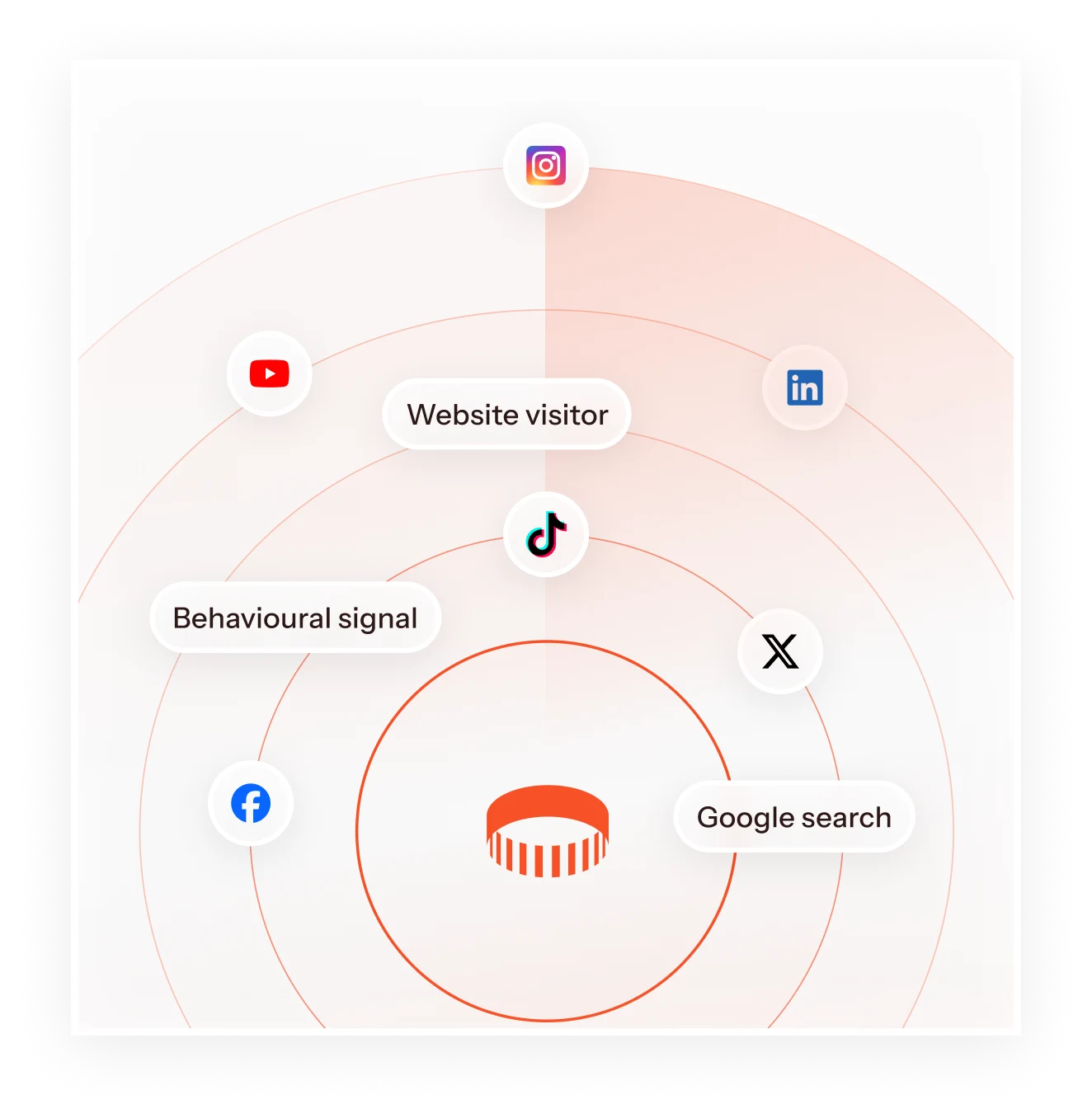
In-Person carries Buxton’s location expertise, including SCOUT, its mapping and market-planning platform. A retailer can evaluate trade areas, compare potential sites and examine locations performing below expectations. Online carries Elevar’s conversion tracking and session enrichment. Data Services supplies enrichment, APIs and MCP connections for teams that want the intelligence inside their own systems.
A persona needs somewhere to go
CALM, the Campaign Against Living Miserably, illustrates a second kind of missing connection. It already had audience segmentation, but its teams struggled to translate the research into confident advertising targets. Using Soprism, they adapted segments for Meta campaigns. The customer story reports a 746.49% increase in conversions and a 203.16% increase in site users from Meta ads.
Those are reported campaign outcomes, rather than evidence about clinical impact. The transferable idea is the workflow: give each segment a usable route into campaign execution, then test it. CALM also raised questions about methodology and accuracy. Understanding that the tools work with proxies and indicators helped the team assess their practical value.
Other customers ask different questions. Audiochuck, the podcast company behind Crime Junkie, used audience segmentation to examine listener interests and motivations for content and partnerships. Agencies need research they can explain to clients. Real estate planners need geographic evidence. Audiense’s position spans these jobs, while individual alternatives may focus on survey research, social listening, location analytics or tracking.
The distinction matters when choosing software. Listening starts with what is being said; audience research asks who is connected to the conversation and what else connects them. Tracking asks whether an event reached the system that needs it. Location analysis asks whether a place fits the customer. Buying every capability makes little sense without a decision that benefits from it.
Audiense’s partner list reflects that division of labor. It includes listening providers Meltwater and Talkwalker alongside Meta, Google, Shopify and Klaviyo. The company can supply context to an existing marketing workflow rather than requiring every team to begin again.
The price of a usable signal
Audiense sells subscriptions, data access and implementation services. At the time of writing, Online’s free Base plan covers 100 orders monthly. Core costs $225 per month for up to 2,000 orders; Advanced is $650 and Premium $1,250. Elite starts at $3,000. Order allowances and connected destinations differ, so a plan’s fit depends on both volume and workflow.
Optional expert installation is listed at $1,000, with more complex options at $4,500; promotions can affect the bill. The research and location products take a sales-led route. Buyers should match the quote to a specific decision, the data available in their market and the channels they can actually activate.
A narrowly observed social community may say little about customers absent from that platform. A targeting recommendation still needs an available advertising option. A beautifully segmented report still needs an owner. Audiense is most interesting at those handoffs: where a description of the customer becomes a choice somebody can make, measure and revise.