Atsushi Tsukigata’s name appears near the end of Honda’s 2023 integrated report, in the production secretariat. It is a modest credit in a document concerned with the future of a very large company. Two years later, he was running Honda’s Silicon Valley innovation operation. By October 2026, he had become Chief Operating Officer of Honda Innovations Co., Ltd. The sequence invites a question: how much of innovation depends on understanding the organization that must eventually use it?
Technology stories tend to give the invention the good chair. The people who arrange the meeting, find the appropriate business unit and keep a collaboration moving get whatever seating remains. Tsukigata’s career puts that quieter work nearer the center. His route runs through human resources and corporate planning, then out toward startups and venture capital firms, and now across Honda’s own internal organizations.
He goes by Ash in Honda’s team biography. It is a short name for a job with several constituencies. A founder, an investor and a manufacturer may agree that a technology is interesting while meaning quite different things by “next.” Getting them to build something together involves a second kind of engineering: arranging the work between people.
The company before the capital
Tsukigata joined Honda Motor Co., Ltd. in 2004. His career took him through leadership roles in human resources in Japan and North America, with work on HR strategy and organizational development. He later served in corporate planning. In 2025, he was appointed CEO of Honda Innovations Silicon Valley, where his responsibilities brought startups, venture capital firms and Honda business units into the same working picture.
There is an appealing continuity here. Human resources asks how an organization can do its work. Corporate planning asks where that organization is going. Corporate innovation adds outsiders who might help it get there. The vocabulary changes, and so does the audience. The practical question of how people cooperate survives the move.
Consider the familiar corporate encounter with an unfamiliar idea. Somebody must decide which team should look at it, what a useful trial would establish and who will take responsibility afterward. These are questions about organizational arrangements as much as technical merit. They help explain why a career spent inside a manufacturer can be relevant when the next conversation begins outside it.
In Honda’s 2023 report, Tsukigata was identified as a manager in the Corporate Strategy Division and a member of the production secretariat. The 2024 report placed him on the editorial committee as manager in the Corporate Strategy Planning Department. Those credits locate him in the work of making corporate strategy legible: the effort to explain where a company’s activities fit and why they matter.
A report committee is unlikely to inspire a dramatic film adaptation. Yet it provides a useful detail in this story. Before taking on a job connecting young companies with Honda, Tsukigata had worked within the machinery through which Honda described its own direction. The later move into Silicon Valley was a change in setting with an organizational thread running through it.
A Thursday afternoon in Sunnyvale
The work becomes easier to picture in June 2025. Honda Xcelerator Ventures was a platinum sponsor of Plug and Play’s Silicon Valley June Summit. Tsukigata, Raymond Zheng, Eric Blumbergs and Austin Hwang were announced as hosts of a corporate networking session on June 12, from 3:30 to 5:30 in the afternoon. The invitation reached toward mobility, sustainability and other areas of startup collaboration.
It is a small calendar entry with a large implied cast. There are founders looking for partners, corporate teams looking for technologies, and investors considering where a company might go. For a visitor, the immediate benefit of such a session is wonderfully ordinary: a chance to meet the people attached to the company name. A logo is impressive company, but notoriously poor at answering follow-up questions.
The scheduled session also gives Tsukigata’s role a human scale. “Collaboration” can seem abstract until it occupies two hours on a Thursday and names the people hosting it. The starting point is conversation. What follows has to become sufficiently specific for both parties to know whether they should continue.
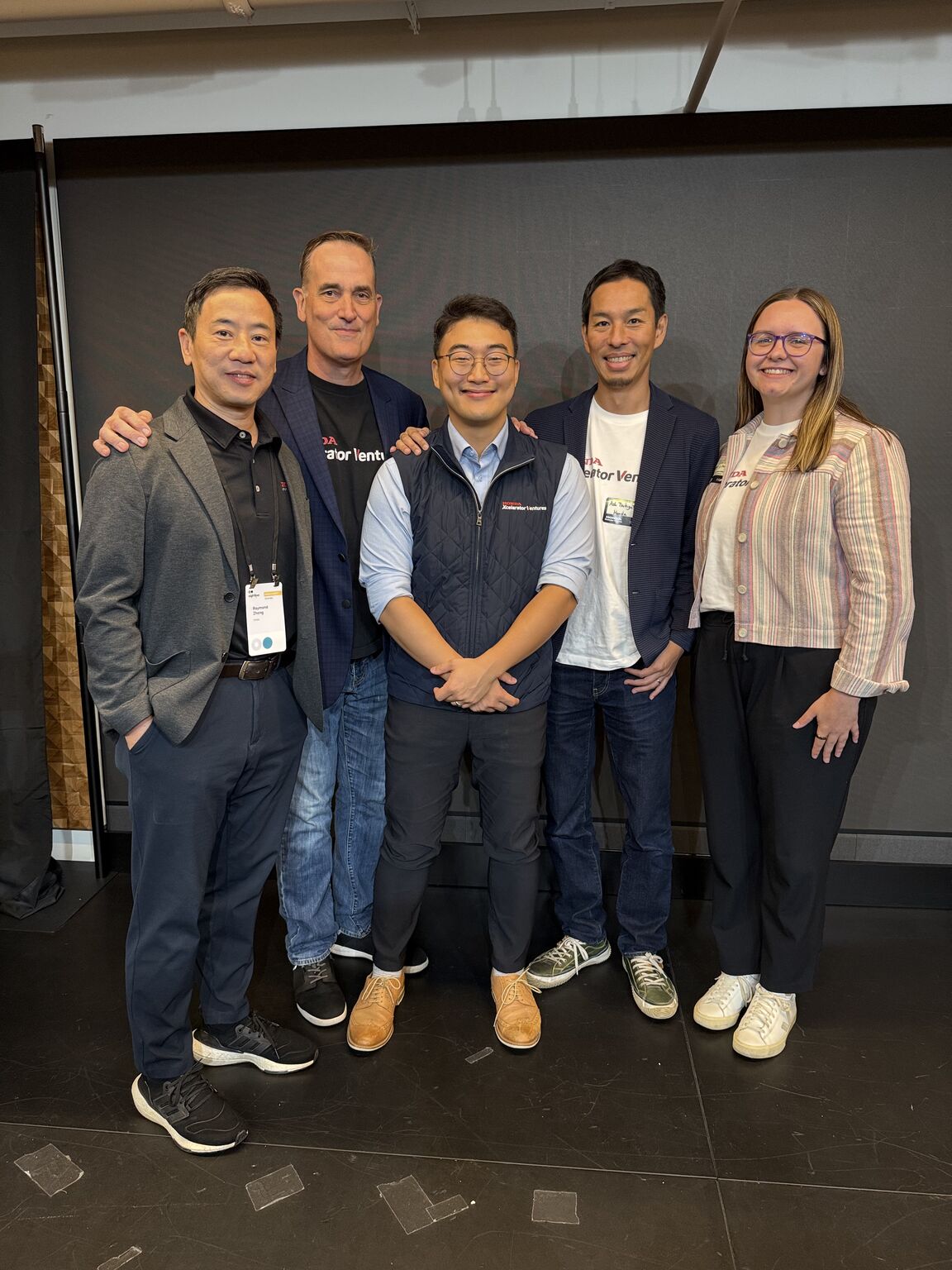
A separate photograph shared by Zheng shows Tsukigata with colleagues, standing together rather than arranged behind a podium. Zheng thanked the team for its work and reported compliments from the audience about the discussion. The photograph is a useful companion to the networking invitation: the people who represent a corporate venture program are a working group, with different contributions gathered under the same name.
Another public exchange supplies a smaller detail. After Masakazu Kobayashi visited the Silicon Valley office and posted his thanks, Tsukigata thanked him for the visit, adding: “Looking forward to joining the party next week!” It is a brief glimpse of professional acquaintance continuing beyond the office. Even an innovation operation has a next-week social calendar.
What a partnership has to survive
The clearest recent example of the organization’s patient technical work is Honda’s collaboration with Princeton NuEnergy. The companies had been conducting joint validation of battery recycling technology since 2022. In January 2026, they announced a memorandum of understanding to advance discussions about further collaboration, including additional validation and possible future commercial applications.
That progression matters because each stage asks for a different kind of evidence. A technical result must first be established. A subsequent agreement can create room for more work. Commercial use remains another question. The sequence leaves space for learning, rather than treating the first promising test as the final answer.
Princeton NuEnergy’s plasma-based approach addresses lithium-ion battery manufacturing scrap and material at the end of its useful life. The collaboration produced rejuvenated cathode materials with performance comparable to virgin materials. For a manufacturer considering resource circulation, that makes the idea concrete: the material that comes out must be useful, and the process must have somewhere to go.
This is organizational context for Tsukigata’s work. His biography describes connecting Honda business units with startups and venture firms; the battery collaboration shows the kind of continuing technical relationship such a program can contain. It also supplies an antidote to the breezy language of innovation. A promising recycling process still requires validation, agreed responsibilities and a credible route toward use.
Honda’s stated partnership approach. A sequence of work, rather than a promise of success.
Magnets, mathematics and useful patience
The breadth of the program is visible in two more 2026 investments. In August, Honda Xcelerator Ventures announced an investment in Quemix, whose work includes quantum computing algorithms and software. The relationship already involved joint research with Honda. The investment was intended to strengthen that collaboration, particularly around materials development.
Materials computation can sound distant from a finished vehicle. Yet it belongs to the work of deciding what a future product can be made from. Quemix’s collaboration with Honda included a quantum state readout development in 2025 and an algorithm in 2026 intended to accelerate calculations used in computational materials science. The ambition is to move research toward practical application.
In September, the program announced an investment in Niron Magnetics, supporting permanent magnets made without rare-earth materials. Its iron nitride technology has potential uses in automotive systems, robotics and industrial automation. The stated work includes advancing motor designs suited to those materials, alongside commercialization and manufacturing scale.
Both examples involve a familiar difficulty: a capability needs an application, and an application needs a workable relationship. A new material affects the designs around it. A computational method must be useful to the people developing materials. This helps give substance to the internal coordination in Tsukigata’s new role. The organization has to connect specialized work with the teams that can carry it forward.
The door opens in both directions
Honda’s UK expansion in April 2026 offered another view of the partnership problem. Events in London and Manchester brought together founders, investors and operators. The discussions included aligned incentives, access to decision-makers and clearly defined pilot pathways. Roberta Franchi was named to lead the UK activity.
Those themes describe the practical concerns surrounding a promising introduction. Access matters because someone must be able to make a decision. A defined pilot matters because the parties need a common understanding of what they are testing. Incentives matter because two organizations can attend the same meeting while pursuing different outcomes. Hospitality gets people into a room; agreement gives them a reason to return.
Since October 2026, Tsukigata’s title has been Chief Operating Officer of Honda Innovations Co., Ltd. His remit includes overall business operations and strengthening collaboration across Honda’s internal organizations. After a Silicon Valley chapter oriented toward startups and venture firms, the new description puts the company’s own connections plainly in view.
A good introduction still needs a place to go.
An editorial observation on the work of partnership
His career gives that responsibility a particular shape: years in HR, a corporate planning chapter, leadership of the Silicon Valley operation, and now an operating role. Each brings a different part of the relationship into focus. The people who must cooperate inside Honda belong in the story alongside the people arriving with an idea.
There is no need to turn this into a tale of solitary invention. Tsukigata’s documented work is populated by colleagues, business units, startup teams and investors. The team photograph is an apt image to end on. The future may arrive as a proposal from outside the company. For it to become a working partnership, somebody inside has to know who should stand beside whom.