More than fifty entrepreneurs came to the Bluebox office for a gathering about Posible México’s 2026 call. Juan Pablo Sánchez Gnecchi described a room full of ideas, questions, and people eager to move their businesses forward. His account returned to the pleasure of being among people who wanted to build. For an executive whose work often involves large companies, investment structures, and innovation strategy, the scene offers a useful place to begin: people turning up, hoping a conversation might lead somewhere.
The office gathering sits neatly beside the rest of his public career. Sánchez Gnecchi is CEO and co-founder of Bluebox, a Mexican firm working on corporate venturing. That means helping young companies and established organizations find useful ways to work together. The phrase has the polished sound of a conference badge. The underlying problem is wonderfully ordinary. Someone has something another person needs. They must first discover that fact, then agree on what to do about it.
The people already in the room
Bluebox’s beginnings involved precisely that kind of discovery. Gustavo Huerta Vargas met Sánchez Gnecchi and Alejandro Cortés Meza at an entrepreneurship event where Huerta was an organizer and the other two were participants. They continued meeting afterward. The company grew out of those connections, rather than a single cinematic moment of collective inspiration. Its early story also includes Cinépolis, which became an important corporate collaborator, and the gradual development of a business serving the relationship between startups and larger organizations.
There is a pleasing modesty to an origin involving people who kept talking. A meeting can be memorable without producing an immediate business plan. The participants need time to discover what each can contribute. In this case, a company devoted to collaboration emerged from collaboration itself.
“La innovación abierta debe ser una directriz en las estrategias corporativas.”
Juan Pablo Sánchez GnecchiOpen innovation should guide corporate strategy. Translation from Spanish.

A hometown with outward connections
Morelia matters to the story. In March 2020, Sánchez Gnecchi described Bluebox as entirely Morelian while discussing the company’s work supporting entrepreneurs. By then, its activities extended into other Mexican cities and Latin American countries. The local origin and the international ambition occupied the same sentence. Morelia was a starting point for relationships that could travel.
A particularly concrete local connection dates to September 2016. Sánchez Gnecchi signed an agreement between Bluebox and the Instituto Tecnológico de Morelia alongside the institute’s director, Paulino Rivas Martínez. The planned work included advising students with entrepreneurial potential and organizing events where young founders could exchange ideas, learn about opportunities, meet contacts, and find possible partners.
That list sounds like the practical contents of a useful afternoon. It also shows how much entrepreneurship depends on access to other people. A student may have a promising proposal and still need someone who understands an unfamiliar customer, a technical problem, or the next administrative step. The agreement placed those encounters inside the institution’s plans.
In 2017, Forbes México included Bluebox in its thirty business promises, naming Huerta, Sánchez Gnecchi, and Cortés together. The shared credit is fitting. A firm working on connections had a founding story with several people in it. The recognition made the company more visible while preserving that collective frame.
A smaller experiment, a larger possibility
In a 2020 business conversation, Sánchez Gnecchi explained how he and his partners came to see corporate collaboration as a way to help companies grow. A startup could bring technology to a problem inside an established business. A small proof of concept could test whether the technology and the need fitted together. A larger investment might follow. He also emphasized the value of becoming a corporate supplier, which could bring revenue, credibility, and experience with demanding processes.
His account gives the pilot an important role. It provides a manageable piece of work around which two very different organizations can learn about each other. The young company has to show what its technology can accomplish. The larger one has to identify a problem clearly enough to make that demonstration useful.
There is room here for an unfashionable business virtue: specificity. “We should collaborate” can mean almost anything. A test gives the conversation an object. It also gives the people involved something to discuss after the enthusiasm of the first meeting has subsided.
- 01A business problemAn established company identifies a need.
- 02A technology to testA startup brings a potential solution.
- 03A working relationshipA pilot can inform supply or investment.
The investment chapter
The financial side of his career has a documented chapter in InnovaCamp Ventures. In January 2017, the firm announced a MXN125 million fund for Mexican food-industry businesses. Sánchez Gnecchi was named among its investment leaders alongside Huerta and Félix Cárdenas del Castillo. The announcement described a public and private capital mix and an active role supporting the growth of businesses receiving investment.
Food-sector fund with Sánchez Gnecchi among its investment leaders. Fund size, not personal wealth.
He has also written about the purpose of corporate venture capital. An ISTMO article co-authored with Héctor Ramírez Sánchez and Luis Antonio Paredes Izaguirre examines corporate investment as a way of strengthening strategic objectives. Its subject is the established company’s interest in learning and developing capabilities alongside financial considerations.
That distinction helps explain why his work crosses several settings. An investment decision, a pilot, and a training program ask different immediate questions. Each can involve an organization deciding how to encounter something unfamiliar without losing sight of what it needs to accomplish.
David, Goliath, and the org chart
On CNN Chile’s Nación Innova podcast, Sánchez Gnecchi used David and Goliath to discuss the relationship between startups and corporations. The larger organization has scale and experience, along with structures that can make change difficult. The startup brings agility and technology. In his telling, those differences give the two reasons to collaborate.
The metaphor improves considerably when the slingshot can stay at home. Business leaves room for an ending in which both participants benefit. The giant can gain access to a different way of doing things. The smaller company can gain a relationship that helps its solution reach further.
His 2021 column in El Diario de Antofagasta put cultural change at the center of that relationship. He urged large companies to learn from the entrepreneurial ecosystem and argued for collaboration measured beyond financial results alone. The challenge, as he framed it, included changing traditional organizational culture.
By August 2023, his public discussion of investment also carried a note of caution. Ahead of InnovaSummit in Santiago, he described investors making more careful decisions after a period of high valuations. He pointed to mobility and sustainability as areas of opportunity, while acknowledging the patience that developing corporate interest could require. The resulting portrait is of an advocate for innovation who still pays attention to the timetable.
Forty people learning to change a university
In April 2024, the Universidad Autónoma de Guadalajara launched Mindset 40 with Bluebox. Sánchez Gnecchi and Huerta participated in presenting a program for forty senior university leaders. Its purpose was to develop people who could sustain innovation within the institution, with the university’s 2035 centenary in view. Methods of work, innovation portfolios, and teamwork formed part of the discussion.
A university gives his recurring interest in organizational learning a literal setting. The people being asked to learn are also responsible for an institution that teaches. Change therefore has to travel through leaders, colleagues, and everyday working habits. The launch photograph gathers those people around a central statue: an institution’s established identity sharing the frame with an initiative concerned with its future.
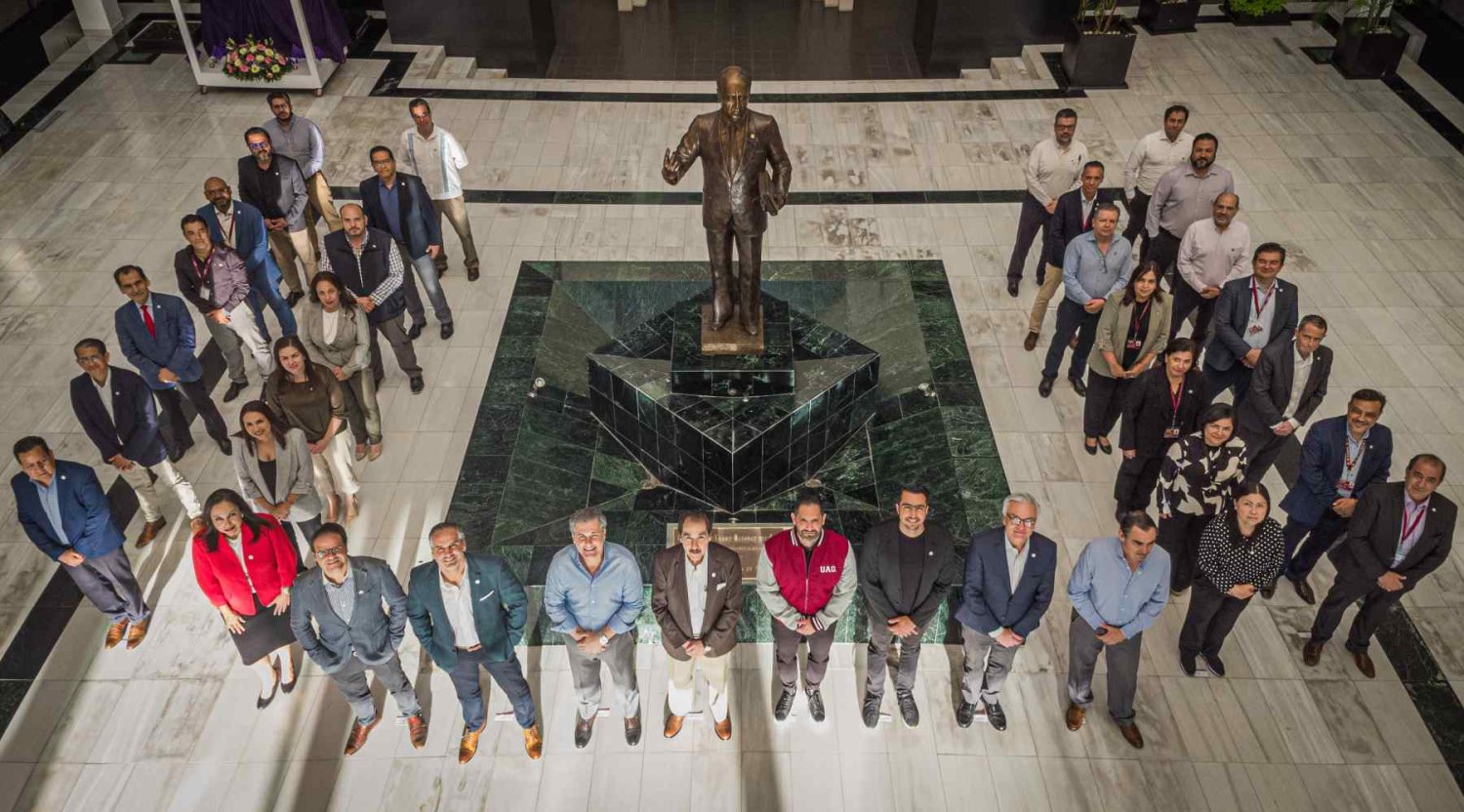
In May 2026, Sánchez Gnecchi joined the launch of the program’s third generation. He spoke about more than five years of Bluebox collaboration with UAG and described innovation as a survival strategy. The return matters. A launch offers an announcement; another cohort gives the work a continuing place in the institution’s calendar.
A regional network with local rooms
The same attention to where people meet appears in his regional work. In a post about presenting a Chilean corporate network’s 2024 agenda, Sánchez Gnecchi highlighted artificial intelligence and acknowledged Bluebox’s startup-scouting team in Argentina. The picture is of work distributed across countries, with different groups contributing to the same conversation.
A letter bearing his name for Bluebox Ventures formalizes collaboration with Corporación Innova Viña in Viña del Mar. It sets out shared use of the HUB Tecnocreativo’s spaces and participation in projects and programs within the organization’s network. The language is administrative, but the subject is familiar: giving collaboration somewhere to happen and a set of activities to happen around.
He has also described Bluebox’s work with Flecha Amarilla on YellowHubMX Connections and the presentation of Mobility Grid. Here the participants gather around mobility, an industry whose problems bring companies, technologies, and cities into the same discussion. The industry focus gives the network a reason to exist beyond the pleasure of collecting contacts.
The question behind the blocks
One of Sánchez Gnecchi’s public posts poses a smaller, more playful problem. How would readers arrange 112 orange blocks to create a productive residential development? The blocks could serve as apartments, offices, or other uses. The question invites people to take the same pieces and imagine different arrangements.
It is an apt final image for this career. His work repeatedly concerns the pieces already available: a technology, an institution, a company with customers, a founder with a proposal. Their usefulness depends partly on how they are brought together. Rearranging blocks is easy to picture. Rearranging relationships takes longer, involves more people, and rarely comes with a tidy diagram.
The Bluebox office full of entrepreneurs brings the story back to human scale. Before there is a fund, a pilot, or another university cohort, there are people with questions. Sánchez Gnecchi’s public work keeps returning to the next practical matter: finding an arrangement that gives those people something useful to do together.