An airline dispatcher can see a storm on a screen and still have a difficult question to answer: where will it be when the airplane gets there? Add other aircraft, airport restrictions and a pilot’s report of turbulence, and the map becomes a negotiation with the future. Air Space Intelligence, or ASI, has built a business around making that negotiation less improvised.
- Flyways supports flight monitoring and routing.
- PRESCIENCE models, simulates and compares options.
- The FAA assignment expands the work to national traffic flow.
Its proposition sounds modest: give the person making a consequential decision a better idea of what happens next. In aviation, however, modest improvements repeat thousands of times. A few minutes, multiplied across a network, become a fuel bill. They also become the difference between a connection made and a connection missed.
01 / The map needed a clock
Before ASI became an infrastructure contractor, co-founder Phillip Buckendorf visited an airline dispatch center. Reporting in 2021 described his surprise at its paper-heavy workflows. He and his fellow founders then spent months alongside Alaska Airlines dispatchers. The useful discovery was practical: the people planning routes needed forecasts they could act on inside their existing responsibilities.
Buckendorf founded ASI with Kris Dorosz, its chief technology officer, and Lucas Kukielka, who leads product engineering. Their backgrounds help explain the approach. Dorosz brings computer-science research and autonomous-driving experience; Kukielka specializes in geospatial interfaces. ASI also recruits people who have worked inside the operations it serves. Air Force veteran Mark Lepczyk leads its federal business, while deployment specialists work with customers on workflows. The expertise must cover both the mathematics of a prediction and the job awaiting the person who receives it.
That experience matters because a flight is not an isolated line between two airports. Its route intersects other plans, weather and limited capacity. A perfectly attractive shortcut can become unattractive when everyone else discovers it. Software must understand the environment around the aircraft, including how that environment changes.
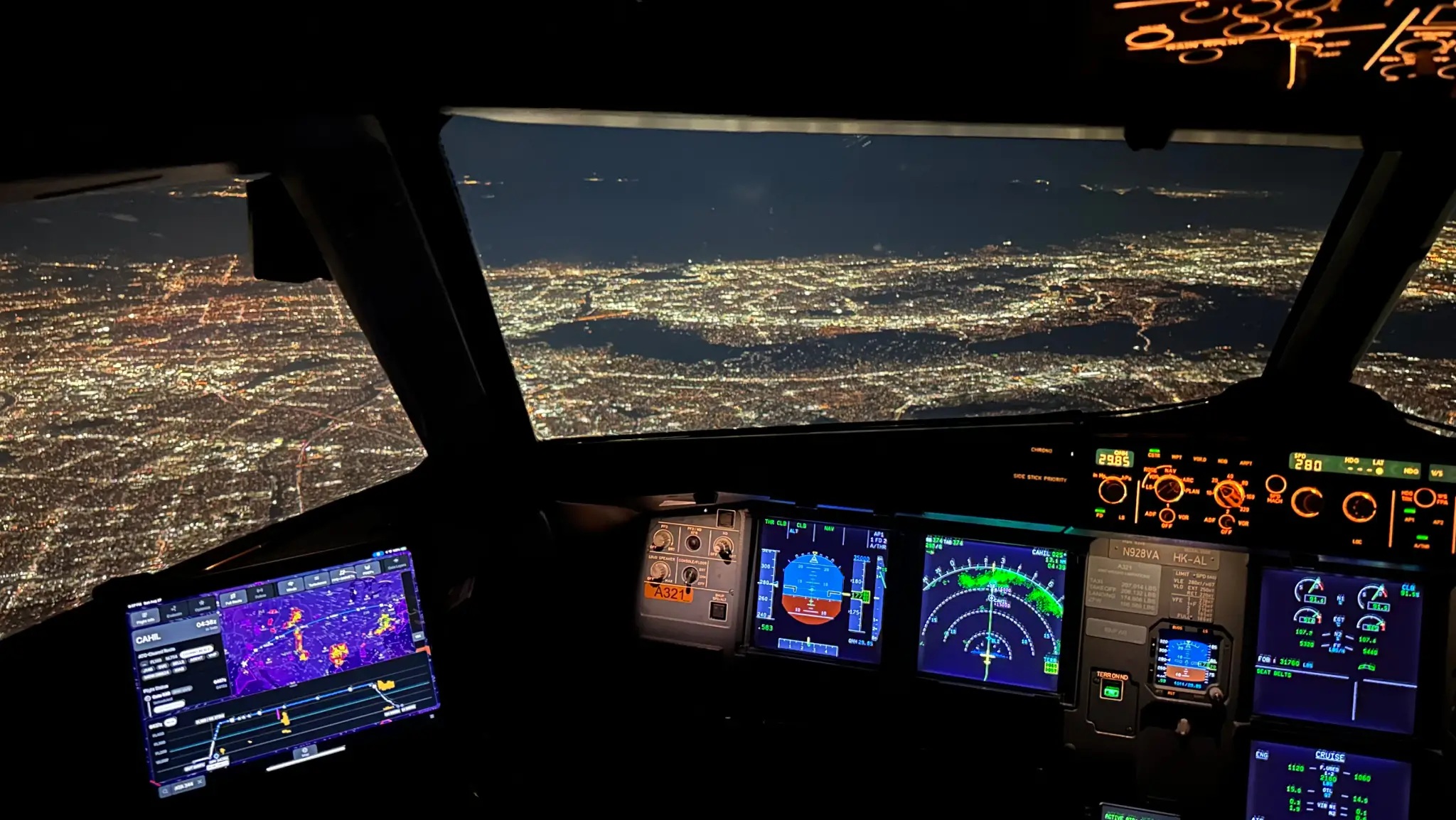
Flyways is ASI’s aviation answer. It combines operational information into a shared picture, monitors planned and active flights, and offers routing alternatives. The company’s wider platform, PRESCIENCE, adds time to geospatial modeling: a four-dimensional representation of an operating domain. Operators can compare possible actions, collaborate and replay earlier events.

02 / A recommendation is an invitation
Alaska’s early trial offers a revealing wrinkle. Dispatchers accepted 32% of Flyways recommendations. That figure is not a failure rate. It is evidence that suggesting a route and authorizing it are different jobs. A recommendation has to survive professional judgment, safety requirements and the particulars of a flight.
“Dispatchers always make the final call.”Alaska Airlines, announcing Flyways adoption in 2021
The airline nevertheless moved from a six-month trial to a multi-year agreement. The persuasion was operational. Software could search for possibilities while dispatchers decided which possibilities deserved to become plans. The distinction remains central to understanding what customers buy: support for consequential work, with people still accountable for the outcome.
By its August 2024 renewal, Alaska had a longer record to discuss. It reported optimization opportunities on 55% of flights, and fuel savings of three to five percent on flights longer than four hours. For 2023, it credited optimized routes with saving more than 1.2 million gallons. The denominator deserves attention: the percentage applies to longer flights, not every departure.
03 / Selling into the room where it happens
ASI’s customers are institutions rather than travelers downloading an app. Its announced deployments include Alaska, United and Delta. Users include dispatchers, pilots and operations teams. This is an enterprise software business, sold through commercial agreements and government contracts, with the work of connecting data and fitting software to operational practice.
Bloomberg reported an eight-figure, multi-year Alaska deal in 2023. That gives a sense of the commercial scale, although it cannot serve as a price list. In December that year, ASI announced a $34 million Series B led by Andreessen Horowitz, alongside Bloomberg Beta, Renegade Partners and Spark Capital, to support expansion into government.
The competition includes established aviation software suppliers and organizations’ own accumulated tools. In the FAA contest, Bloomberg identified Palantir and Thales alongside ASI. The company’s argument is built around predictive, coordinated operations already used in demanding settings. That is a positioning claim; a procurement win is not a universal comparison of product quality.
- 01ConnectWeather, traffic, operational data
- 02ModelLocation, movement, time
- 03CompareForecasts and alternative actions
- 04DecideOperators assess and coordinate
04 / The sky becomes the customer
In June 2026, the FAA selected ASI for two related programs. FMDS is intended to replace aging traffic-flow infrastructure; SMART adds predictive coordination of schedules and trajectories before departure. The FAA described an initial operational start planned for fall 2026. Selection and nationwide delivery are separate milestones.
ASI described the award as $875 million over 12 years. That is a contract value, not revenue already collected. It also said it had invested nearly $100 million of its own resources in developing the platform. At this scale, the product must help multiple organizations coordinate, rather than merely find one airline a convenient way around a storm.
05 / What travels beyond aviation
The adjacent markets share a problem: assets move, constraints change and decisions have consequences later. ASI announced a production expansion for the Air Force’s NITMRE-Geo mobility application in October 2025. A February 2026 Defense Innovation Unit prototype award extended its logistics decision-support work. In May, National Grid and ASI announced grid planning and operations collaboration.
The National Grid work makes the expansion tangible. Its announced focus includes locating distributed energy resources, planning for extreme weather and mapping outages. A Massachusetts Clean Energy Center grant supports the collaboration. Those are decisions about physical assets, geography and future demand, familiar ingredients for ASI. But the announcement establishes a collaboration and intended applications, not a measured reduction in electricity bills. The aviation results give the idea a precedent, while the grid work still needs its own evidence.
These are different domains, not interchangeable maps. A utility model must understand a grid; a military model must account for contested supply. ASI’s team reflects that requirement, combining engineers with experienced operators. Its deployment staff describe embedding with users, and its hiring material emphasizes autonomy and fast execution.

The transferable lesson is to begin beside the decision-maker, measure something concrete and make advice usable. The limits follow naturally. Stale inputs, a poor model of the domain or recommendations nobody can execute will weaken the result. ASI’s next test is whether the habits that earned a place in dispatch can hold up when the whole network needs to agree.