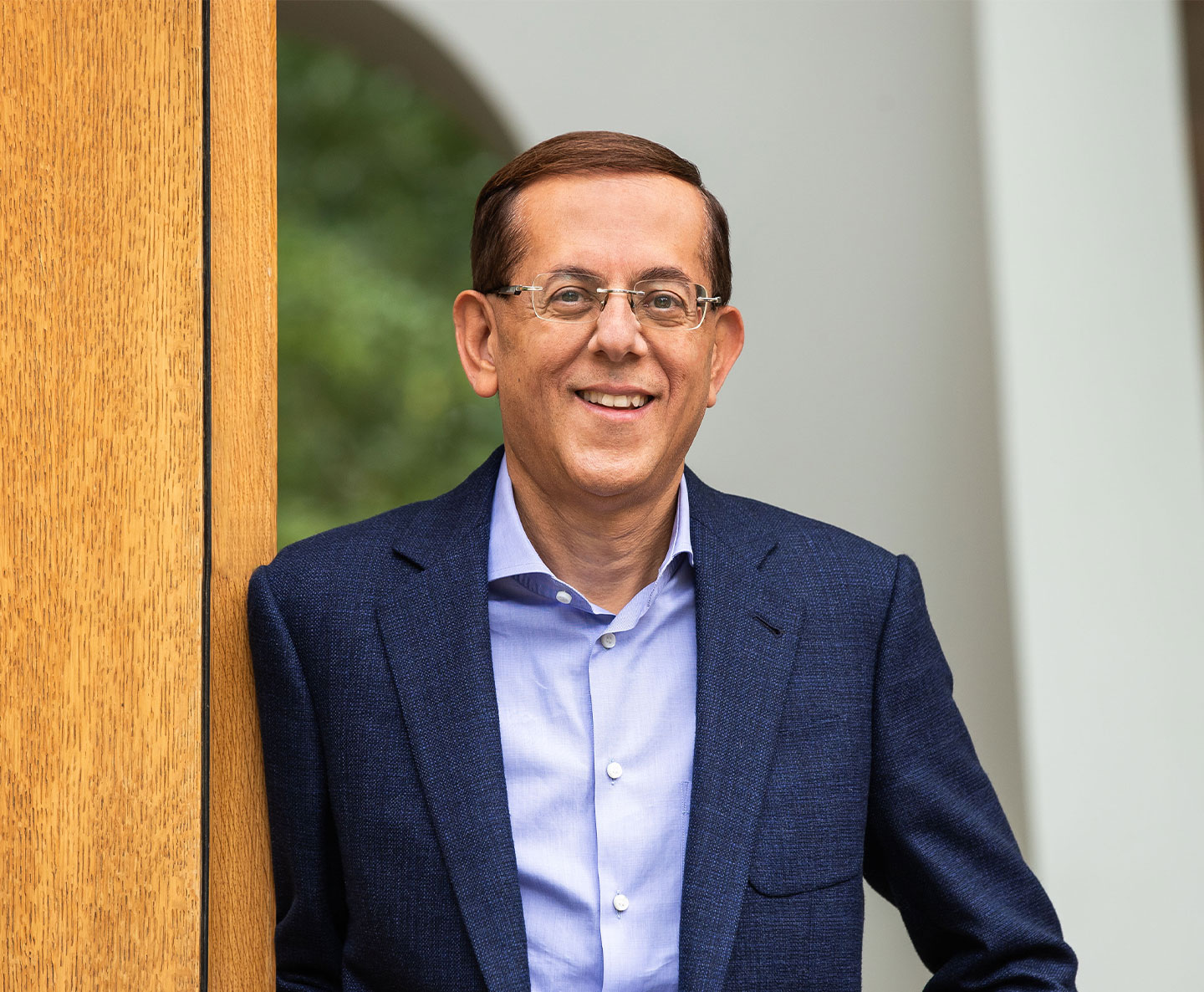
The Investor Who Never Lost
There is a specific kind of silence that follows when you tell a founder their email was not precise enough. Asheem Chandna creates that silence often. Not out of cruelty - out of conviction that the inability to be precise about a problem is the inability to solve it. He has been testing that theory at Greylock Partners since 2003, and the record is clean.
Twenty-two years. Not a single investment he led has lost capital. That is not luck - it is a methodology so deeply internalized it reads like instinct. He backs founders before slides exist, sometimes before product exists. He is writing checks on the quality of thinking in a room.
"If you email me wanting a meeting, I'll ask for documents. If it's not highly precise, it's unlikely we'll fund you."- Asheem Chandna, General Partner, Greylock
The portfolio reads like a syllabus for enterprise security. Palo Alto Networks (IPO, 2012, now worth over $100 billion). AppDynamics (sold to Cisco for $3.85 billion, just before its own IPO). Rubrik (IPO, 2024). Wiz ($12B+ valuation). Abnormal Security ($5.1B+ valuation). Anthropic, the AI safety company behind Claude. Skyhigh Networks, acquired by McAfee. Innovium, acquired by Marvell for $1.1B.
Pick any category - cloud security, AI-native email defense, network monitoring, application performance, next-gen firewall - and Chandna's fingerprints are on the category-defining company. That is not accidental. It is a deliberate focus on founders who are not just building products, but naming and framing entirely new markets.
In early 2013, Chandna was working closely with Rajiv Gupta, the founder of Skyhigh Networks. At RSA Conference that year, the two of them worked on messaging strategy and came up with a name for the type of solution Skyhigh was building: "Cloud Access Security Broker." CASB. The acronym is now standard terminology in enterprise security, used by Gartner, by IT teams worldwide, by every vendor in the space. Chandna did not just invest in the company - he helped invent the vocabulary.
What makes this unusual is the path that led here. Chandna grew up in Mumbai, moved to Canada, and enrolled at Case Western Reserve University in Ohio - not Stanford, not MIT, not the obvious feeder schools for Silicon Valley. He earned a BS and MS in electrical and computer engineering in 1988 and then did something that would prove crucial: he went to Bell Labs.
At AT&T Bell Labs he worked in product architecture and represented AT&T at IETF standards committees for TCP/IP management protocols. The early internet's plumbing, being written in real time, and Chandna was in the room where the standards were set. He later described Bell Labs as giving him "a thirst for knowledge and the ability to think with rigor and humility" - two qualities that are not usually packaged together, and even less commonly packaged with a track record like his.
Engineer. Operator. Investor.
TCP/IP standards at IETF. The internet's management protocols, written with Chandna in the room. Rigorous. Foundational. Unglamorous.
$175M to $900M at SynOptics. Then $10M to $550M at Check Point. He learned that big numbers are just many small precise decisions compounded.
Zero losses. Nine Midas List appearances. A portfolio that defines the modern enterprise security stack. He is still early-stage, still first-check.
After Bell Labs came SynOptics, the Silicon Valley networking pioneer. Chandna joined in 1991 as a product management executive and watched the company grow from $175 million to over $900 million in revenues. From there he joined Check Point Software - the Israeli firewall company that was quietly becoming indispensable - as part of the core management team. Check Point went from $10 million to $550 million in revenue during his 6.5 years there.
Somewhere in there, while still at Check Point, he started making angel investments. He was good at it. Noticeably good. Venture capital firms started asking: who's that guy in our deals? That question eventually became a job offer from Greylock, one of the oldest VC firms in America, founded in 1965. He joined in 2003 and has not left. Why would he?
"We're fundamentally investing in founders. Sometimes there's no slides."- Asheem Chandna on early-stage investing
His investment philosophy leans heavily on pattern recognition of a specific kind: not sector trends or market maps, but founder quality under pressure. When he meets a founder three times over two weeks, he is watching how fast they learn. His standard is direct: "If we meet three times over two weeks, you should be getting better. It's about the pace of learning." A founder who shows up to the third meeting with the same pitch as the first has already lost.
At Greylock, over 80% of investments happen at the pre-seed or Series A stage. Chandna is a first-check investor. He is writing the check before the machine is built - based on the quality of the person proposing to build it. The operator background matters enormously here. He knows what it costs to take a product from $0 to $10M in revenue. He has done it. He knows what "precise" actually means in a pitch because he spent years translating complex ideas into simple, actionable marketing for products that did not yet have names.
Where He's Putting Money Now
The current focus is squarely at the intersection of agentic AI and cybersecurity. In November 2025, Chandna led Tenzai's $75 million seed round - a record for a seed-stage raise - to build an AI-native penetration testing platform. His thesis: "AI-generated code is creating new cybersecurity risks and challenges for enterprises." The code being generated by AI models needs to be tested by AI. That is the bet.
He also sits on the board of Cylake alongside Palo Alto Networks veterans Mark McLaughlin and Nir Zuk - a reunion of sorts for the cybersecurity network he has spent two decades building. The Anthropic investment shows the breadth: he is not just backing security companies, but the AI infrastructure layer beneath them.
The Chandna Doctrine
"If we meet three times over two weeks, you should be getting better. It's about the pace of learning."On evaluating founders
"I want to be a beacon for talented founders at the earliest stage of company building."On Greylock's mission
"Marketing is about taking complex ideas and distilling them into simple nuggets of truth."On his time at SynOptics
"Bell Labs gave me a thirst for knowledge and the ability to think with rigor and humility."On early career foundations
"AI-generated code is creating new cybersecurity risks and challenges that enterprises are not ready for."On the next wave, 2025
"We're fundamentally investing in founders. Sometimes there's no slides."On early-stage conviction