Before a John Deere sales representative gets near a tractor, there is the problem of knowing what to do with it. A machine has features, controls and consequences. A slide can name them. A rehearsal can ask the learner to use them. That distinction explains much of Articulate’s appeal, and rather more about workplace training than another photograph of smiling employees could.
- Rise builds responsive courses; Storyline builds more custom interactions.
- Review, translation and distribution sit alongside the authoring tools.
- Customers use it for onboarding, safety, product knowledge and practice.
- Frontline now invites teams outside learning departments to create training.
John Deere’s online training specialist, Sheldon Cole, describes a familiar starting point: PowerPoint courses with limited interactivity. Participation suffered. The company already valued physical training, but bringing dealership representatives to a training centre consumed time and money. The opportunity was to prepare them better before they arrived.
The tractor comes later
Using Articulate’s Rise and Storyline tools, Cole’s team built equipment walkthroughs, job aids and interactive preparation. Rise could explain a warranty programme or label the parts of a combine. Storyline could take learners through more involved operations, including starting a tractor and engaging its power take-off.
The physical machine remained essential. Online preparation let instructors spend their time on more advanced material. The reader’s version is straightforward: put the repeatable groundwork online, then reserve scarce hands-on time for what needs hands, judgement and supervision. A browser lesson is a poor place to acquire the feel of a tractor.
“Articulate allows us to keep our sales reps better informed.”Sheldon Cole / John Deere
Two builders, one cupboard
Articulate occupies the space between workplace expertise and its delivery. Its buyers include instructional designers, learning departments and organisations training employees or customers. They bring the knowledge; Articulate supplies the means to shape it into something another person can use.
The division between its two familiar authoring tools matters. Rise works in a browser, assembling text, media and interactions from blocks that adapt to different screens. Storyline gives authors more control over custom scenarios and simulations. One favours quick assembly; the other makes room for elaborate decisions. Neither chooses the right lesson for you.
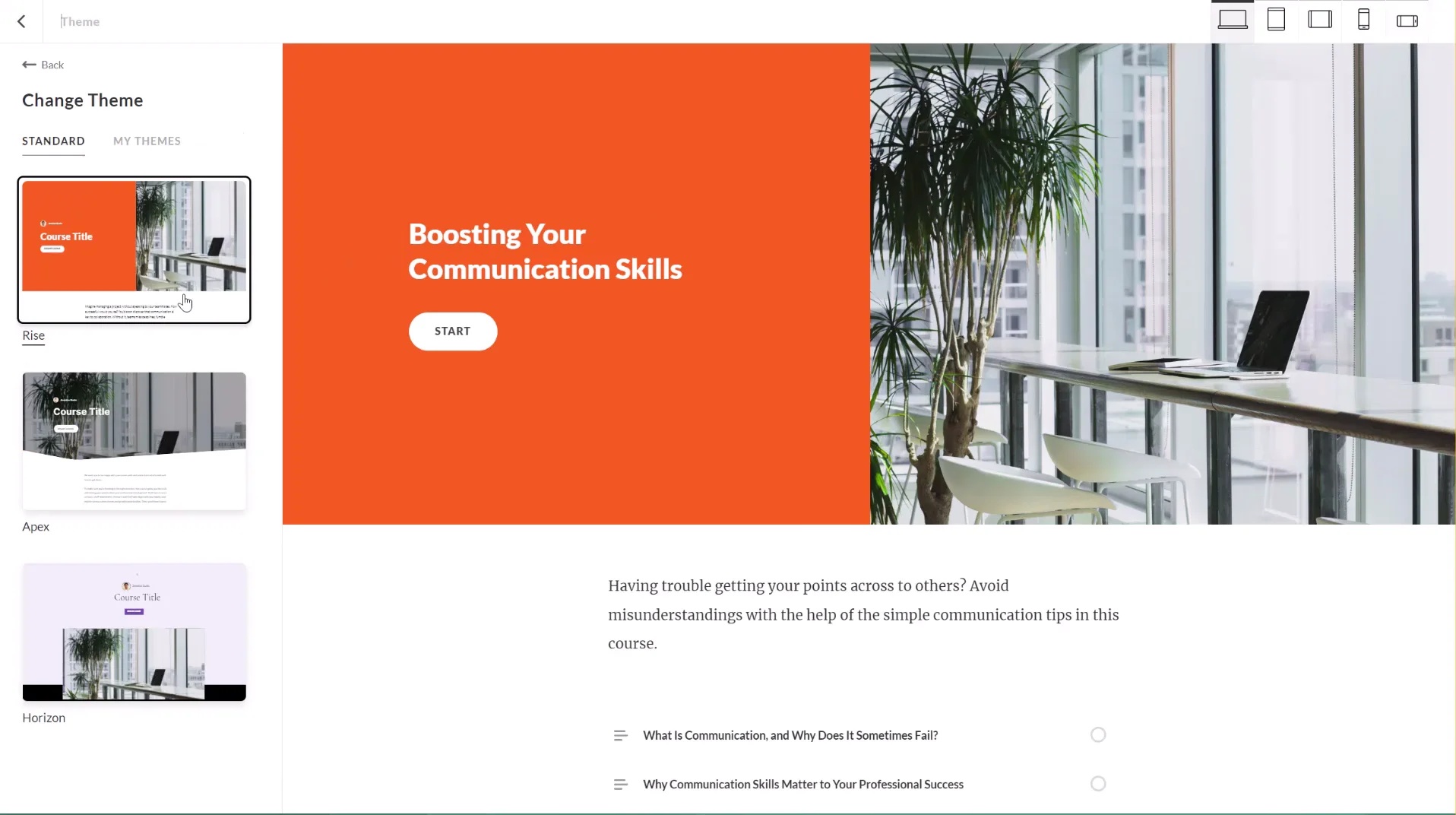
The cupboard holds more than builders. Review collects stakeholder feedback. Localization handles translation and validation. Reach provides integrated delivery, while standard exports let customers use an existing learning management system. Adobe Captivate offers responsive authoring and review too; Articulate’s distinction is the particular combination of two authoring approaches, supporting workflows and a practitioner community.
There are practical qualifications. Storyline authoring needs a Windows environment, including supported virtualisation on a Mac. Responsive layouts also do not absolve an author from checking accessibility or testing a course with its actual audience. The software can arrange the room; someone must still notice who cannot get through the door.
The community is part of the purchase proposition. E-Learning Heroes offers discussions, examples and help, while Articulate provides video tutorials and webinars. An author trying to build a branching conversation needs more than a blank canvas. Seeing how another practitioner solved a similar problem can shorten the distance between owning the software and producing something useful.
The expensive part was the language
At Forbes Travel Guide, the obstacle came after the courses existed. Its hospitality curriculum needed to reach workers in other languages. External translation cost roughly $10,000 for a learning plan of three or four courses. Translating the full hotel curriculum would have cost about $50,000 and taken up to five months per programme.
When Articulate launched Localization, the team explored bringing the work in-house. It reports more than 75% cost savings and 90% time savings. Those are customer-reported results from one programme, rather than a promise attached to every licence.
A specific customer comparison with its previous external-vendor workflow.
The more revealing choice concerned which language came first. A hotel in Dubai might employ workers who need Filipino or Hindi before Arabic. Forbes Travel Guide used workforce demographics and engagement data, choosing Spanish as its first priority. Geography was an inadequate proxy for the person taking the course.
That is a procedure worth copying: establish the audience, choose a complete programme, translate it, and validate it with people who understand the language and the work. Savings depend on having that capability. Faster machine translation cannot settle whether a safety instruction or service standard means the right thing locally.
Nineteen years before the cheque
Adam Schwartz founded Articulate in 2002 and bootstrapped it until its first institutional investment in July 2021. The Series A raised $1.5 billion from General Atlantic, Blackstone Growth and ICONIQ Growth, at a $3.75 billion valuation. The stated purpose was to accelerate growth and international expansion.
The company’s own working arrangements are unusually consistent with its product: it has always been fully remote. Its published benefits include student-loan assistance and mental-health support. A business selling ways to transfer knowledge across distance has spent years organising its own work across distance.
Now the manager can make the lesson
United Rentals illustrates the next question. It once relied on two people to create company-wide training. With Articulate, more departments began authoring courses, and creators met to exchange practices. Removing the bottleneck meant changing who could contribute, as well as changing the tool.
September 2026 brought Frontline, an AI-guided product for business teams, and Nova, an embedded agent for advanced workflows. Frontline creates connected training kits; Nova powers functions such as translation and avatar videos. The market proposition is broader: the person closest to changing knowledge can help turn it into training.
The bill has several parts. At the October 2026 US list price, Articulate 360 AI Teams costs $1,749 per author annually. Frontline starts at $500 a year with unlimited seats and a credit allowance. Advanced workflows consume credits, so buyers must estimate production volume alongside headcount.
The sensible first project is small: one recurring task, one consequential decision, one chance to practise. Ask an expert to check it, then see whether learners perform better. Articulate makes creating and distributing that experiment easier. Its value arrives when the employee leaves the course and handles the real situation with fewer surprises.