Arthur Lozinski had a business that paid the bills and another that barely made a dent. The first sold services. The second sold software. He and his colleagues closed the one bringing in the larger sum. For a founder, this is a particularly awkward form of arithmetic: the column that looks reassuring is the column you cross out.
It was a choice about the company they intended to build. Oomnitza’s young product business offered a way to sell something repeatable. Consulting had financed the search, but continuing to do both would have meant continuing to divide their attention. The smaller operation got the future. The larger one had already done its job.
There is something appealingly inconvenient about Lozinski’s story. The milestones sound familiar: a software company, enterprise customers, venture funding. The route between them contains revisions. A product conceived for factory equipment found customers in IT. An inventory tool became a conversation about security. Years later, the founding CEO stepped down and began asking other founders how their own routes had worked.
A future that arrived unevenly
Oomnitza’s work began in 2011, followed by incorporation in 2012 and a market launch in 2014. The early ambition concerned connected capital equipment. Lozinski described working with Tesla Motors and Flextronics on the possibilities of managing enterprise assets in the cloud. The machines on a factory floor seemed ready to join the networked world.
Potential customers supplied a timing problem. Much of their equipment still needed the expensive, lengthy work of getting connected. Software designed to manage those connections would have to wait. A convincing picture of the future can be a poor appointment calendar.
Office computers offered a nearer opportunity. They already had operating systems, software, components and updates to manage. Location mattered. So did protection. The similarities between those devices and connected industrial equipment gave the team a practical way forward.
In Lozinski’s recollection, the decisive invitation came through Twitter. A prospective customer saw the capital-equipment product and asked whether it could manage IT assets. The founders initially found the request surprising. The customer bought; introductions followed. Within about six months, the team had roughly ten customers. Someone else had supplied a use case their original plan had overlooked.
Connected equipment was the starting point. IT devices supplied the earlier opening.
The whiteboard had no small print
The setting for the original ambition was modest: a small office belonging to Lozinski’s father, a whiteboard and Trent Seed. Lozinski remembers the pair writing down their intention to build a great software company. A whiteboard is obliging that way. It never asks about procurement.
Seed had been his neighbor during high school. Lozinski’s early working life included building longboards for money and interning at SAP. He completed his high-school diploma through Foothill College so he could work full time. A short spell at an unnamed university ended when he decided to start a business.
His childhood had crossed borders before his career crossed business models. Born in Latvia in 1989, he grew up in Germany, then moved with his family to Silicon Valley before high school. His father had a doctorate in robotics. Education mattered in the household, and technology became the son’s chosen work.
At SAP, his responsibilities included technical project management and proof-of-concept work for prospective customers. That put him near the junction where software has to demonstrate usefulness. Enterprise buyers have particular requirements; a demonstration has to answer them. It is a useful place to encounter the distance between a working product and a purchase.
In a later public reflection on his father, Victor Lozinski, he described watching a founder build a global systems integrator. He praised the sustained effort, adaptation and example that the work required. His account places family influence in the daily conduct of building a business, alongside the technical background.
Closing the business that paid
The early Oomnitza operation financed development through consulting and what Lozinski called co-innovation. The team worked on customers’ problems while retaining the intellectual property. Some projects went nowhere. Others helped expose what a usable product might become. Each engagement bought time and supplied another encounter with a real requirement.
By the time the IT product had its first group of customers, the revenue contrast was stark. Lozinski recalled roughly $100,000 a year on the product side and a few million on the services side. The services operation was viable. Choosing to close it made the preference for a product company concrete.
“We shut down the services completely.”
Arthur Lozinski, recalling Oomnitza’s early product decision
The subsequent seed round was a milestone, but his memory of it included the doubts that had preceded it. There had been suggestions that he could still return to college. Funding gave the team room to continue. It also brought the ordinary requirement to make that room useful.
A consulting engagement can accommodate a particular customer’s needs. A repeatable product must find enough needs in common. The decision put that requirement at the center of Oomnitza’s working life. The founders had chosen the business whose economics they still needed to improve.
Follow the question upstairs
Finding buyers did not settle what Oomnitza should charge or how it should explain itself. Lozinski described an early sale framed as an IT manager’s need to keep track of assets. The team began asking why. Answers led them upward through the organization, eventually to concerns at board level.
The inventory had implications for security, compliance, financial management and employees’ experience of technology. A device record could be part of an audit or a much larger operational question. Oomnitza needed to understand those consequences and make them legible to the people paying for the work.
Lozinski has acknowledged that the team initially lacked the enterprise sales experience to do this well. Repositioning required new conversations with existing customers and changes to pricing. Some customers left. Some returned. Others accepted the transition. This part of the story contains the uncomfortable work behind a cleaner business model.
Where are our devices?
Why does the organization need to know?
Security · Compliance · Financial oversight
A schematic of the sales conversations Lozinski described, from the IT task to its business consequences.
His account of financing was similarly practical. Capital became useful when the team believed it could put the money to work in a more developed business. Oomnitza raised $12.5 million in 2020. In August 2021, it announced another $20 million in growth funding, bringing its reported total to $35 million. Those are company financing figures; they describe resources for the business.
The inventory acquires a voice
By December 2018, Lozinski was discussing an Oomnitza bot that connected Slack with Zendesk. An employee could report an issue from Slack; a support ticket could then carry details about the relevant asset. The practical appeal lay in connecting an employee’s request with the information a service desk needed to act.
The product’s broader enterprise technology management approach brought together data about devices, applications, networks and cloud infrastructure. Its purpose was to support business processes across systems an organization already used. The inventory became useful through what people could do with it.
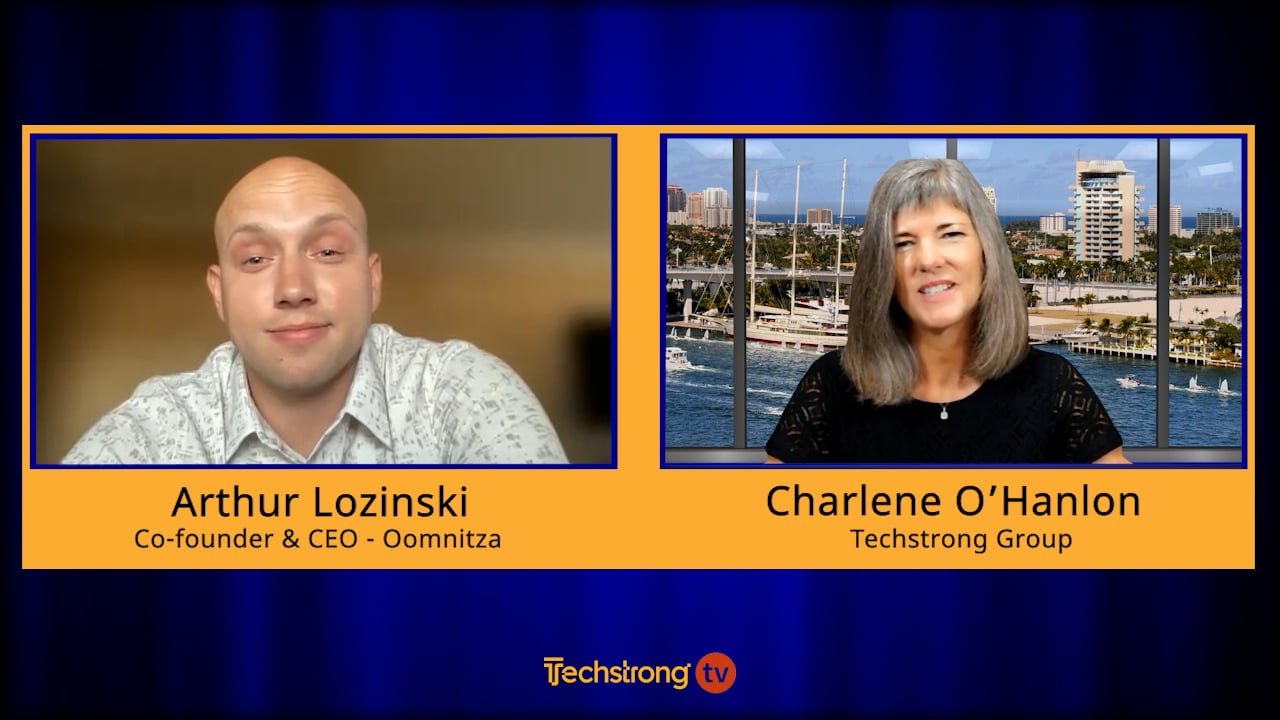
In June 2022, he discussed enterprise technology blind spots with Charlene O’Hanlon. The subject had moved well beyond whether someone could locate a laptop. It concerned how companies understood the technology they possessed and the risks associated with incomplete knowledge.
He also wrote about generative AI and low-code or no-code development in 2023. The topic extended his interest in making software behavior accessible to people without requiring them to manage every technical detail. A founder selling business-process software has good reason to care about how people specify the work they want done.
A chair, a walk, a microphone
On September 4, 2024, Oomnitza announced Robert Potter as its new CEO. Lozinski would continue as a board member. His own announcement emphasized family, friendships and new adventures. In the company’s announcement, he thanked colleagues and customers and expressed confidence in the incoming leadership.
Relationships occupy a substantial place in his public recollections. In 2025, he described a walk with Yousuf Khan and a friendship stretching back a decade. He remembered Khan inviting him and Eric Yuan to address CIO peers in 2015, when the audience still questioned the need for another video-conferencing application. Khan’s conviction stayed with him.
In February 2025, Lozinski launched Founders in Focus. The first conversation featured Nick Carter of INGENIOUS.BUILD. Later guests included Brian Geisel, Alastair Paterson, Lior Yaari and Ben Lilienthal. The subjects ranged from robotics to data security, hiring and the experience of building successive companies.
The launch carried a small, welcome admission: the first episode took a few minutes to find its rhythm. Lozinski asked for feedback. A new project was getting its first encounter with an audience, and the audience was invited to help improve it. There is a familiar shape to that exchange.
He began Oomnitza with a view of how connected machines would change business. Customers helped determine where that view could become useful sooner. His next public project gives other founders time to describe their own adjustments. The microphone suits a career in which a well-timed question has repeatedly changed what happened next.