Before remote work had a dress code, Dave Apsey had a modem and a useful annoyance. He had written a DOS program that could control a computer somewhere else. Al Kingsley, then an accountant who found the machines more interesting than the accounts, saw what the program removed: the drive. A support technician no longer had to spend an afternoon on the motorway to touch a keyboard 200 miles away. Kingsley joined Apsey, helped sell the idea, and the first version of NetSupport Manager became the practical centre of a company incorporated in 1989.
That origin is almost comically modest next to the present catalogue. NetSupport now makes tools for remote access, classroom management, IT inventory, helpdesk workflow, desktop lockdown, mass notification and student safeguarding. It sells to schools, hospitals, government offices and corporate IT departments. The company says its software has more than 22 million users in over 120 countries. Yet the line from then to now is straight: somebody responsible for a fleet of computers needs to see what is happening and do something about it.
The distance collapsed from 200 miles to two metres
The clever turn arrived in 1995. If one technician could control a faraway PC, one teacher could also manage 30 nearby ones. The distance changed; the mechanism did not. NetSupport School let a teacher demonstrate an application, view student screens, launch or block programs, distribute files, ask questions and reclaim a distracted class without walking a circuit of the room. It was remote support miniaturised into classroom choreography.
One technical primitive, repeatedly repackaged around the person who is accountable when the screen misbehaves.
The modern portfolio follows that logic into adjacent chores. NetSupport DNA inventories hardware and software, meters applications, distributes software and manages power. NetSupport Notify pushes conspicuous, one-way alerts to staff or students when email is too easy to miss. ServiceDesk organises incidents, problems and changes. Protect freezes the configuration of shared machines against accidental or deliberate meddling. None is designed to be the most thrilling tab open on a computer. That is rather the point.
A product cabinet, not a single pane of glass
Many rivals begin with a category and keep digging. TeamViewer, AnyDesk and Splashtop concentrate on remote support. GoGuardian, Lightspeed, Securly, LanSchool and Impero chase the school screen. Lansweeper, ManageEngine, NinjaOne and Intune organise devices. NetSupport sits awkwardly, and usefully, across the shelves. A school can buy classroom control, safeguarding, asset management and urgent alerts from the same maker; a hospital can use remote access for a scattered campus, inventory patient kiosks and send an outage notice to thousands of staff.
The breadth is an advantage only when a buyer actually has overlapping jobs. A small team that wants elegant, browser-only support may prefer a focused cloud rival. An organisation already standardised on a large endpoint-management suite may not need another inventory. And a school that has not agreed who may monitor what, during which hours and with which escalation process should not mistake surveillance software for a safeguarding policy. NetSupport works best where responsibility is clear, devices are numerous and administrators value control over fashion.
The cloud arrived as an option, not a conversion experience
NetSupport's most distinctive commercial decision may be its refusal to declare one deployment model morally superior. Manager and School remain on-premise products. They are generally licensed per installed device rather than concurrent user, with perpetual licences and optional maintenance available in many markets. That suits public bodies, labs and regulated organisations that want predictable ownership or cannot casually send management traffic beyond their perimeter.
Alongside them sit classroom.cloud and 247connect. The former combines teaching controls, IT management and optional safeguarding in a browser-accessed service. It integrates with Google Classroom, Microsoft School Data Sync and ClassLink so classes need not be typed twice. The latter is NetSupport's newer cloud remote-access tool, covering attended and unattended machines with zero-trust access, AES-256 encryption and two-factor authentication. NetSupport says a session can connect in as little as eight seconds.
The cost reveals the split. Most of the catalogue is quote-led, with volume and regional partner pricing. One public UK government listing puts classroom.cloud at £2.50 to £4.50 per device per year, including education pricing and a 30-day trial. On-premise School is a machine licence, even when the software is served centrally. In plain English: customers pay for the endpoints under management, then decide whether they want to own the licence or rent the service.
“We accelerated its pre-launch to give access to a limited number of school districts that had the greatest need.”Al Kingsley, on classroom.cloud in 2020
The pandemic changed the timetable, not the thesis. classroom.cloud was already in development when school buildings closed. NetSupport pushed it into a limited 2020 pre-launch, letting districts use it through remote and hybrid learning before a wider North American release in 2021. That is a copyable move: expose a new product to the customers with the sharpest version of the problem, watch what breaks under real pressure, then widen distribution. It is not a universal recipe. It fails when early users are unrepresentative, when support cannot absorb the feedback, or when urgency becomes an excuse to weaken privacy and security review.
Control gets morally complicated in a classroom
A remote-control company eventually meets the uncomfortable question: who watches the watcher? In education, a thumbnail of a screen can reveal distraction, confusion or distress. NetSupport DNA and classroom.cloud can monitor words and phrases associated with self-harm, bullying, exploitation and radicalisation. The database contains more than 20,000 safeguarding terms. Role-based permissions, monitoring-hour limits, contextual risk signals and integrations with school concern-management systems are meant to keep an alert from becoming a verdict.
The company's decade-long relationship with the Internet Watch Foundation matters here. Membership gives its product teams another channel for emerging child-safety intelligence. ISO/IEC 27001 certification, first effective in 2024 for its UK development, operations and customer-service scope, supplies a more prosaic reassurance about how information security is managed. Neither badge decides whether a school has chosen proportionate settings. The software can surface a concern; a trained adult still has to understand it.
The useful boundary: NetSupport can provide visibility, permissions and an audit trail. It cannot provide judgment, consent or a safeguarding culture. Buyers have to bring those themselves.
A global company with Market Deeping manners
NetSupport is privately held and headquartered in a purpose-built property it owns in Market Deeping, near Peterborough. LinkedIn places the staff between 51 and 200; supplied company data puts the figure around 200. Regional operations in the United States, Canada, Germany and Japan work with a larger distributor network. This is how software born in a small English market town reaches 120-plus countries without pretending that a download page counts as local service.
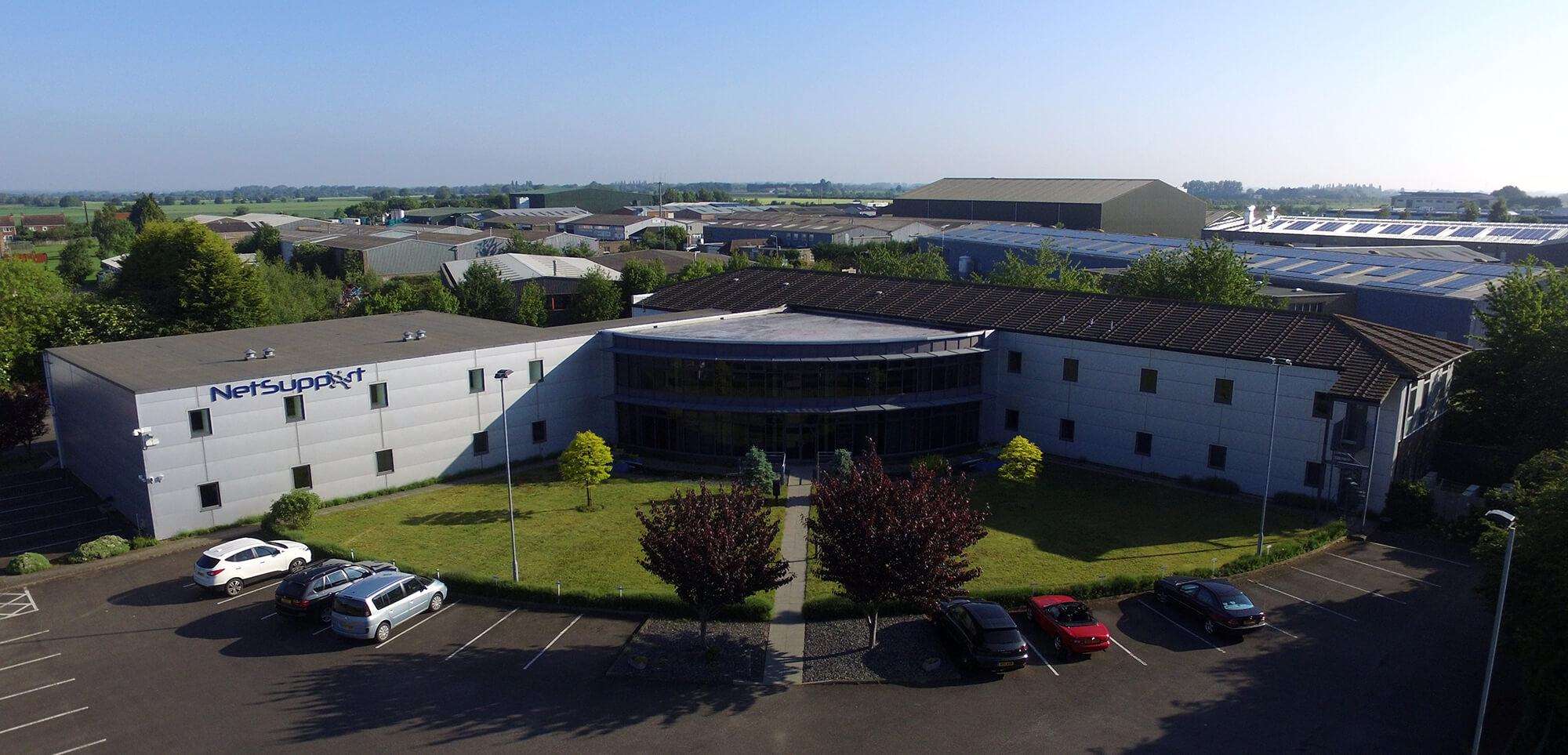
The culture advertised from that building is steady rather than breathless. NetSupport talks about co-production, evidence of impact, apprenticeships, community work and long customer relationships. It publicly celebrates staff anniversaries. Kingsley's management maxim is “listen more and speak less,” a sentence with particular value at a company selling tools that can literally observe other people's computers. Even the customer case-study programme has a peculiarly British incentive: submit a review and the thank-you may include retro sweets.
That listening also explains the route to market. Local partners translate, price and support the products; Widetec, for example, handles Japanese localisation and technical service. In the United States, TIPS awarded-vendor status gives eligible schools, municipalities and nonprofits a pre-competed path through procurement. The product is only half the sale. The other half is getting through a public institution's purchasing rules and being present after installation.
The lesson worth stealing is gloriously unromantic
NetSupport did not discard its first useful idea. It varied the distance, the responsible operator and the consequence of inaction. Two hundred miles became two metres. One PC became a classroom, then an estate. A support call became a safeguarding signal or an emergency alert. When customers moved toward cloud delivery, the company added cloud products without evicting the buyers who still needed local control.
That playbook is available to copy. Start with the costly human motion your product removes. Look for adjacent situations where the same mechanism serves a different accountable person. Pilot under real conditions. Keep deployment and pricing choices aligned with customers' constraints. Build distribution that can survive language, regulation and procurement. Then maintain the old, dull thing long enough for trust to compound.
It will not work if the common mechanism is imaginary, if the adjacent products share branding but no operational logic, or if maintenance starves invention. NetSupport has to manage that last risk now: a broad cabinet can become a crowded cupboard. Yet 37 years after a modem saved somebody a drive, the original proposition remains legible. Computers multiply. Distance changes. Someone still needs to take control.
Open tabs, responsibly