Philippe Trounev was working on a billing system when the instructions became a problem worth building a business around. His team needed a better way to document what it was making. The software intended to explain the software acquired a life of its own. There is something pleasingly awkward about that beginning: the supporting material stepped forward and took the lead.
By late 2023, he described Docsie's path as a change in audience. Developers were the original target. Product managers turned out to offer more commercial opportunity. A tool made for one group's needs was being pulled toward another group's responsibilities, and eventually toward larger deployments involving multiple products, partners and territories. Trounev's business followed the people who had to make the information useful.
That distinction gives his story its shape. Writing a feature and helping somebody use it are different jobs. Documentation occupies the uncomfortable space between them. It must keep pace with the product, survive revisions and reach the appropriate reader. A beautifully finished application can still leave its customer asking a very ordinary question: where are the instructions?
Trounev's answer became Docsie. The company he co-founded treats those instructions as something to create, organize and deliver. His career offers a view of the work required to make that apparently modest proposition into a business. The appeal lies in the modesty itself. No customer has ever complained that an instruction manual was insufficiently glamorous. They tend to have other concerns.
A law student with other tabs open
Before documentation, there was law. Trounev has described studying it in Canada before moving into technology. Computers already occupied his spare time: chat rooms, scripts, robots and trading bots were part of his early interests. A friend's invitation to join a startup helped turn that interest into a career. The change followed work he was already doing for pleasure.
The temptation is to give such a turn a grand retrospective explanation. His own account is less ceremonial. He moved toward software because it interested him. That is a useful detail in a profession so fond of biographies in which every childhood hobby becomes a prophecy. Sometimes a computer is simply where someone wants to spend the afternoon.
Later, running Docsie required a further move, from writing code toward executive responsibilities. In 2023, he spoke about changing priorities as the company grew, and about the difficult adjustment between enterprise work and a broader software subscription business. The technical part of founding had given him somewhere to begin. It could not do every subsequent job for him.
The public recommendations on his LinkedIn profile add another part of the picture. Former colleagues describe consulting work in program and vendor management at Rogers, and application lifecycle management and business intelligence at POST. One points to clearer reporting and the resolution of escalations; another describes his ability to connect data with business needs. These are useful skills for someone whose later product depends on translating complexity into something other people can act on.
The booth, the coffee, the change of plan
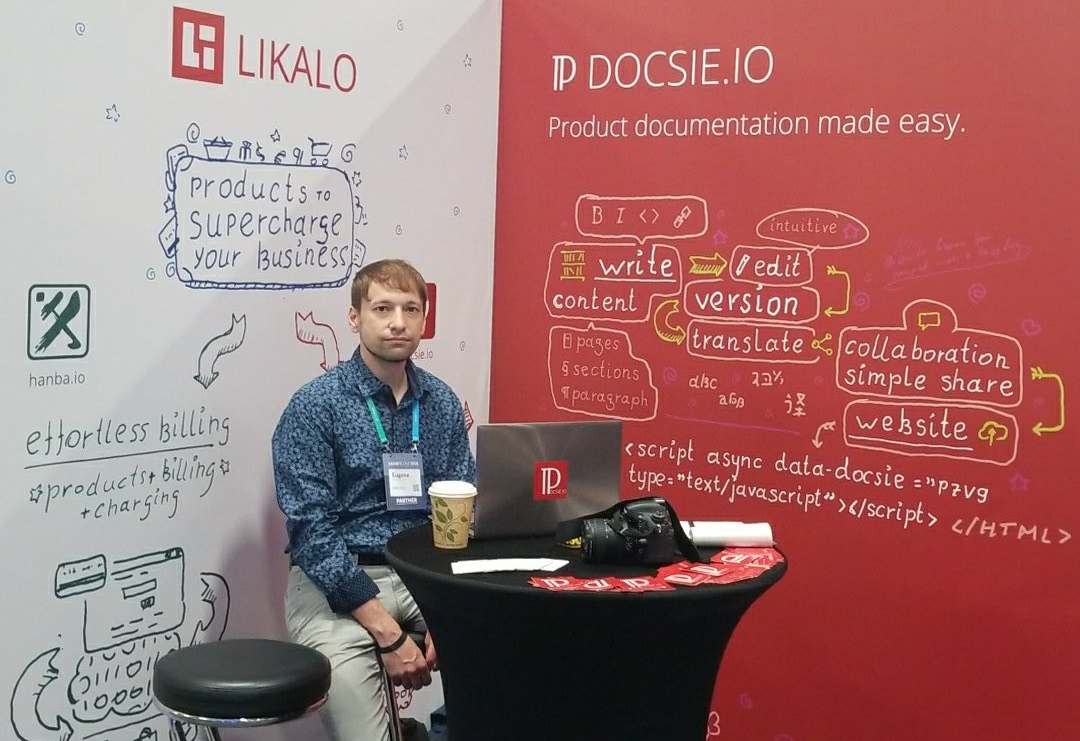
In a photograph published with a 2018 interview, Trounev sits at a small exhibition table. There is a laptop, a camera, a paper coffee cup and a fan of red leaflets. Behind him, a Docsie display maps a route from writing and editing to versions, translation and a website. Beside it, another display promises billing tools under the hanba.io name.
The photograph has the practical charm of a working booth. The coffee appears to be doing as much useful work as the branding. Two product pitches share the same patch of floor; the founder sits between them. It is a better illustration of an early software company than any stock photograph of people pointing at a glass wall.
Trounev said the idea for Docsie emerged while he and his co-founder were at Web Summit presenting hanba.io. They had also built an earlier product, metrics.im, without launching it. Rather than proceed with funding for hanba.io, they chose a different direction and bootstrapped Docsie. In 2018, he associated that choice with retaining control and equity.
His ambition then was a collection of more than 100 profitable microservices serving businesses around the world. It was an aspiration, rather than a count of products delivered. The distinction matters. An early ambition can explain a founder's appetite without becoming a scorecard imposed on everything he does afterward. The booth contains several possible futures. The documentation business is the one this story follows.
A customer is allowed to change the plot
The interesting customer in a founder's story is often the one who uses the product differently. Docsie's move toward product managers and enterprise deployments gives Trounev's career that kind of interruption. The buyer changes the conversation. The product's intended audience does not get the final vote simply because it arrived first.
Think of the difference between explaining one application and maintaining instructions for a family of products sold through several partners. The first task might end with publication. The second includes permissions, revisions, language choices and responsibility for what readers actually see. The article is only one part of the operation. Its surroundings become part of the product.
Docsie's present platform brings editing, versioning, translation, review and publishing into a shared workspace. It also converts material such as videos and documents into structured documentation and training content. Those capabilities describe the business Trounev is building now. They also make clear why its direction extends beyond a convenient place to type paragraphs.
There is a human question inside this software arrangement: who inherits the explanation? The person who wrote the code may move to another project. A product manager must still explain the change. A partner needs an answer that matches the right version. Good instructions allow work to continue without repeatedly summoning the original author. For a business built around documentation, that everyday handoff is consequential.
- Explain itMake the product understandable.
- Deliver itPut the right version in the right hands.
- Check itConnect a finding to its evidence.
The founder takes the other microphone
Trounev also hosts So What About AI Agents. The podcast identifies him as the founder of Docsie and Video Dokuta, with Svitlana Kovalska as producer and COO. It gives him a second public role: asking people how automated systems work outside a product demonstration. The founder who has been interviewed about his own company now conducts the conversation.
A September 2025 episode with Bobbie Chen of Stytch explored agent authentication, security and fraud prevention. These are practical questions with awkward edges. A system taking action must be recognizable to the systems it encounters. A service must distinguish useful automated activity from abuse. The discussion sits close to the operational questions that documentation and permissions already raise.
His guest list reaches beyond his own company. In 2026, he spoke with Cloudera's Shayde Christian about enterprise AI, governance and changes to IT work. A September episode featured SambaNova's Vasanth Mohan on speed and the delays that accumulate as AI agents perform sequences of tasks. The subjects move from what a system can produce to what happens when people rely on it.
There is an appealing fit between the two occupations. A product founder has to discover which question customers really need answered. An interviewer has to keep asking until an explanation becomes usable. Both roles reward attention to the part of a conversation where an impressive phrase needs a concrete example. A microphone can be another instrument for doing that work.
When the recording can answer back
In June 2026, Docsie announced AI Avatar Presenter, a workflow that connects recorded knowledge to interactive training. The company described a sequence in which video becomes documentation, documentation becomes a presentation, and an AI presenter answers questions using that underlying material. Trounev's emphasis was on making existing expertise accessible without requiring teams to recreate it.
The product announcement is a statement of direction and capability. It is also a useful clue to the continuity in his work. A recording preserves a person explaining something, but preservation alone does not make the explanation easy to retrieve. A question asked later needs an answer, rather than another invitation to watch the entire recording.
The charm of the idea is less about the avatar's appearance than the work behind it. Which material supplies an answer? Which reader may see it? Can the explanation be updated? The company described permission-aware access controls as part of the workflow. The old documentation questions remain present even when the interface acquires a face.
October 2026: show the working
By August 2026, Docsie had announced expanded availability of Content Comparison, designed to examine documents, videos and knowledge bases. Its output includes separate findings, severity, verdicts and evidence. Users choose the question they want investigated, such as differences between revisions or gaps in coverage. A comparison becomes something a reviewer can inspect, rather than a single summary to accept.
On October 2, the company introduced its Compare hub. The announcement brought together source comparison, checks against approved baselines and requirements review. It described evidence-linked findings, follow-up questions and repeatable review workflows. For Trounev, the stated goal was a comparison that helps someone decide and verify the reasoning behind the decision.
“A useful comparison helps someone make a decision and verify the reasoning behind it.”
Philippe Trounev · October 2026
That sentence is a fitting place to arrive. A founder who began with the difficulty of explaining software is now selling ways to investigate explanations themselves. The useful thing must be readable, but it must also be checkable. The claim and the material behind it need a path between them.
Return to the exhibition photograph and its cheerful diagram. Write, edit, version, translate, share. The nouns have multiplied since then, and AI has entered the workflow. The underlying job is still recognizable: help somebody understand enough to proceed. Trounev's business grew around that small, persistent demand. The instructions keep earning a place at the table.