A search result arrives with the manners of a magician. The query goes in, the answer appears, and all the backstage labor politely vanishes. Arnab Bhattacharjee spent the early part of his career backstage. At Inktomi and then Yahoo, he worked on web maps, crawlers, graphing and the architecture that allowed an engine to collect a sprawling internet and return something useful in a fraction of a second. The disappearing act mattered. It trained him to see apparent simplicity as an engineering achievement.
Today the object being searched is different. Consider, the company Bhattacharjee co-founded and leads, helps venture firms, employers and staffing agencies organize jobs, candidates and professional connections. A hiring team may have past applicants in one system, current openings in another and the useful connection hiding in a colleague's network. Consider pulls those fragments toward one interface. The result might be a candidate match, a shared contact, a portfolio-wide job board or a timely introduction.
The career makes sense when read as a long argument about relevance. Web pages, restaurants, films, books, jobs and people are very different things. Yet each presents the same impolite abundance: too many possibilities, too little context and a user who would prefer one good answer to a warehouse of options.
Learning the geography of the web
Bhattacharjee studied computer science engineering at IIT Roorkee from 1994 to 1998, then completed a master's in computer science at the University of Pennsylvania in 1999. He joined Inktomi that year. The company was one of the engines beneath the early commercial web, supplying search technology to other portals. Bhattacharjee led its search webmap team, work concerned with the links and structures that make the web legible to a machine.
Yahoo acquired Inktomi in 2003. Bhattacharjee moved with the technology and stayed, eventually running Yahoo's Search Technology organization. His remit covered the algorithmic backend from crawling through indexing and serving. A 2008 conference biography described him leading engineers who built crawling, web graphing and structured-information extraction systems. These are not glamorous nouns, but they are the verbs behind the product. Before an engine can rank an answer, it has to know that the answer exists.
One paper from that period offers a revealing glimpse of scale. Bhattacharjee and three Yahoo colleagues studied robots.txt behavior by regularly retrieving roughly 2.2 million non-empty files from a sample of six million sites. The humble robots file tells a crawler where it may go. Studying millions of them meant observing the customs, permissions and biases of the web in aggregate. The paper found that the leading crawlers appeared to receive broadly similar access, contrary to an earlier claim.
The interface can be a box. The thinking behind it is a map.What a career in search makes visible
Colleagues later described Bhattacharjee in terms that fit this kind of work. Ken MacInnis called him a conscientious and thorough manager, while Eric Baldeschwieler emphasized his optimism, fresh perspective and ability to recruit, coach and empower engineers. Search systems punish carelessness and reward teams that can reason about invisible interactions. Thoroughness here is not a charming accessory. It is part of the uptime.
Leaving Yahoo, then returning through the side door
In 2011, Bhattacharjee left Yahoo and co-founded Jybe with other former Yahoo engineers. Jybe was a consumer recommendation service built around an ordinary but slippery problem: deciding what to eat, watch or read. Its iPhone app mixed a user's interests with signals from social circles. Recommendations gained reviews, recipes or trailers, because a suggestion is more useful when it arrives with a reason.
When Jybe updated the app in 2012, Bhattacharjee spoke about adding context around recommendations and improving the algorithms with several months of behavioral data. That combination is a small manifesto for his work: learn from use, expose the explanation and refine the match. Jybe also let active users become influential on particular topics. It treated taste as social and specific, not as a generic popularity contest.
The startup's independent life was short. Yahoo acquired Jybe in March 2013, closed the consumer service and brought its five employees into the company. Every member of the small team had worked at Yahoo before. The acquisition was widely read as part of Yahoo's push to strengthen mobile products and personalization. Bhattacharjee returned to senior leadership, working across mobile search, knowledge, personalization and advertising technology until 2015.
There is a tidy circularity to the episode. He left a large search company to build a recommendation product, then carried the team and its instincts back into the large search company. The route was unconventional; the intellectual destination was familiar. Search had widened into recommendation, where the challenge is not merely retrieving what somebody requested but understanding what might fit before they know how to ask.
The durable founder trick
- Keep a technical question long enough to develop taste around it.
- Move it into markets where the consequences become more personal.
- Hide the complexity, but preserve enough context for a human to judge.
A search engine for professional possibility
Bhattacharjee became Consider's CEO and co-founder in 2017. The company began from a truth recruiting teams know too well: the candidate they need may already be somewhere they possess, but not somewhere they can see. An old applicant can disappear inside an applicant-tracking system. A strong passive candidate can sit outside the usual job boards. The warm introduction can remain locked inside a colleague's contacts.
Consider's platform approaches these as connected information problems. Its search and matching can identify candidates against a full job description. Its Talent Connections product aggregates colleague networks and shows introduction paths. Its talent networks give people a lighter way to express interest before a particular job is right. Its job boards gather openings across venture portfolios into a branded, searchable destination.
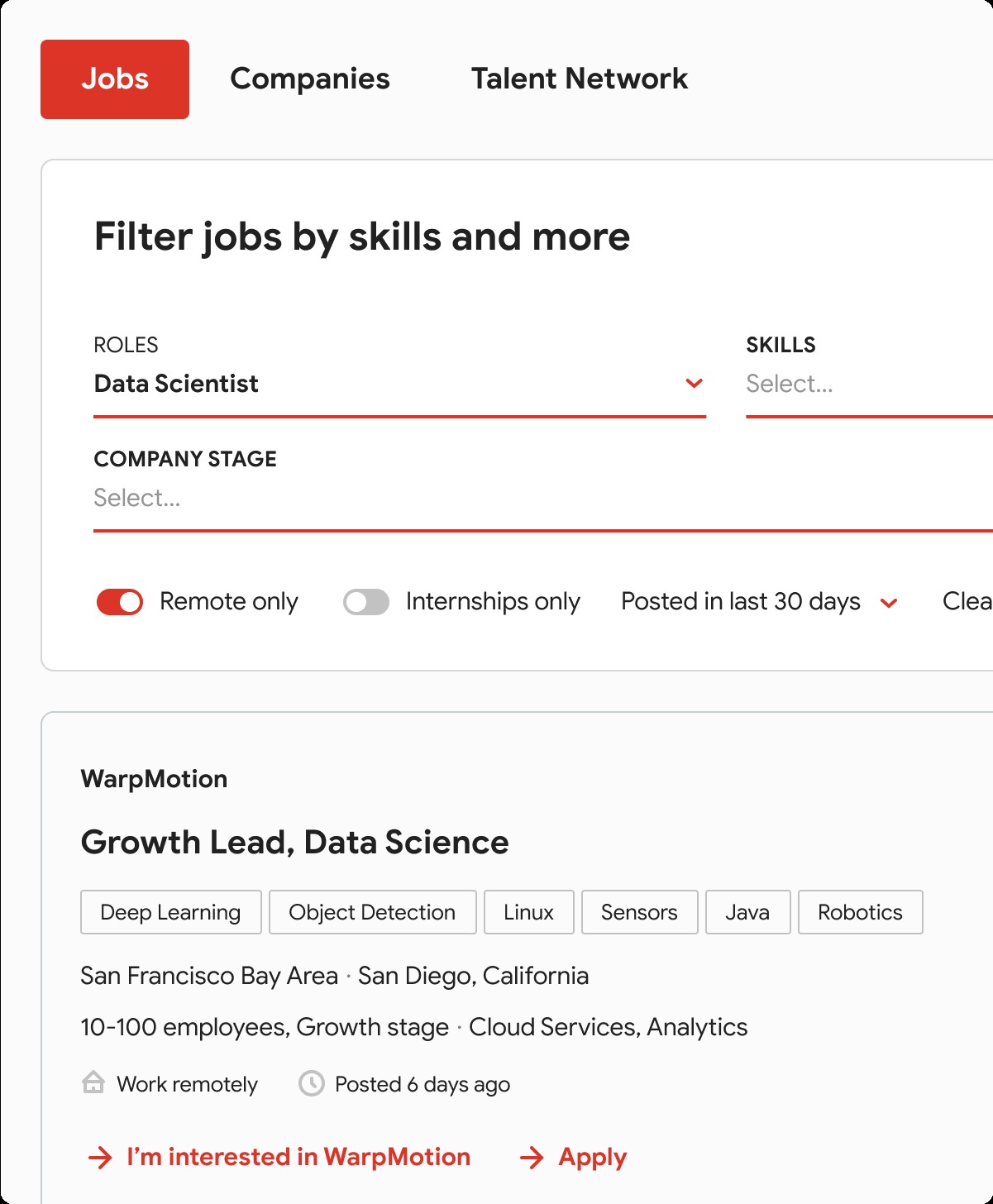
That last product reveals how Bhattacharjee's search background has traveled. A venture firm's portfolio may include dozens or hundreds of companies, each with its own careers page and applicant system. A candidate experiences the collection as noise. Aggregation creates the corpus; analysis makes it searchable; matching makes it personal. The old search sequence has simply changed clothes.
The company has continued to widen the places where that sequence operates. It offers integrations with Greenhouse, Lever, Salesforce, HubSpot, Gmail and Outlook, along with a Slack app, APIs and single sign-on. In 2025 it opened branded job boards and talent networks to individual companies, not only investment portfolios. A case study published that July described European investor XAnge using a Consider board across more than 90 active portfolio companies and reporting 20 filled roles per year through it.
The interesting metric in that account is not volume alone. XAnge's operator said the board required almost no attention once installed. Search infrastructure is successful when it becomes calm. The user gets the right opening; the portfolio team avoids a spreadsheet ritual; the system keeps watching the changing web of companies and jobs.
Automation creates motion. Relevance decides whether the motion is worth making.The product principle beneath Consider
Software can surface the path. Someone still has to walk it.
Recruiting technology now arrives wrapped in grand claims about artificial intelligence. Consider uses AI for matching, enrichment and outreach, but Bhattacharjee's longer record suggests a less theatrical frame. The core problem is judgment under abundance. Which person fits? Which role is timely? Which colleague can make the introduction credible? More activity can make those questions harder by producing more noise.
A professional introduction also differs from a web result in one crucial way. The result has agency. People can decline, change direction, care about a mission or choose a colleague they trust. A knowledge graph may reveal an edge between two nodes; a career can turn on how thoughtfully somebody uses it. Consider's attention to shared connections and personalized context acknowledges that limit. The machine can arrange the room. The conversation remains human.
Bhattacharjee's public persona is quieter than the products' data exhaust. He does not maintain a broad creator apparatus or sell a mythology around his work. What is visible is the continuity: computer science education, search infrastructure, a recommendation startup, a return to Yahoo and a second company that treats hiring as discovery. His colleague recommendations add a useful shade - conscientious, optimistic, technically capable, generous with engineers.
Careers are often narrated as reinvention. This one is more interesting as refinement. Bhattacharjee keeps moving the same set of tools closer to consequential choices. First the page. Then the film or restaurant. Now the job, colleague and possible next chapter. The signal has become harder to rank because it belongs to a person. It has also become more worth finding.