A customer opens Facebook Messenger, types a question and waits. The company replies with a request: could you send an email? It is a small administrative instruction, polite enough to sound harmless. To Gerardo Salandra, it was a way of losing someone who had already made the effort to arrive. The customer wanted a conversation. The business wanted the customer to move.
Salandra encountered that mismatch while working at Runtastic. He remembers people dropping away when inquiries on Messenger were redirected to email. Hiring a person for every messaging app would have been an awkward answer, and an expensive one. The tools he wanted were missing. Eventually, he helped build a company around the gap.
Today he is the co-founder and CEO of respond.io, based in Kuala Lumpur. The name is unusually close to an instruction. Answer the person. Keep the conversation moving. Behind that modest verb sits a career crossing continents, a startup that came close to stopping, and a persistent interest in how people actually behave when software would prefer they behaved differently.
Four languages before the first business plan
Salandra was born in El Salvador to an Italian family and attended a German school. Spanish, Italian, German and English became part of his upbringing. In his own telling, the multilingual education was something he acquired somewhat unwillingly. Parents have a talent for arranging opportunities that children initially experience as extra homework.
A scholarship took him to Germany, where he studied international business. His degree came from Reutlingen University, but technology drew his professional attention. His working life included Google, IBM and Runtastic, and time living in Germany, Ireland and Austria before Hong Kong. He had reasons to notice that a business habit in one country might feel thoroughly unnatural in another.
The family example mattered too. His father built a company in a traditional industry and put Salandra and his six siblings through college. That is a rather crowded audience for an entrepreneur's cash flow. Salandra has described watching the effort behind it. His interest in building a business had a familiar, domestic precedent long before it had a software product.
The seven-minute education
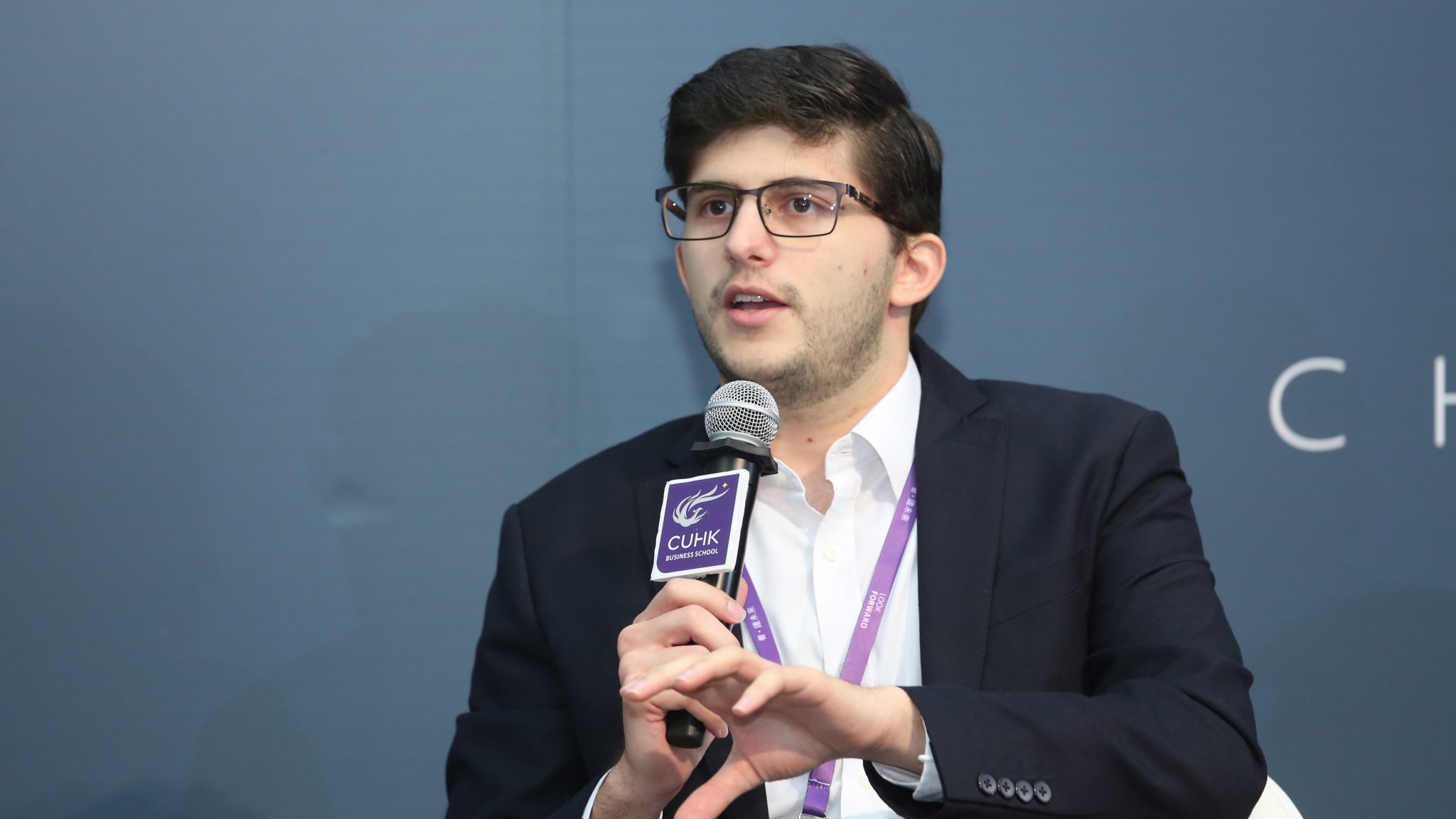
He arrived in Hong Kong in 2015 for an MBA at the Chinese University of Hong Kong, graduating in 2016. One course gave entrepreneurship an unusually immediate set of consequences. Students worked with struggling startups connected to local incubators, learned their businesses, proposed changes and pitched to investors. There was a month to prepare.
Salandra remembers the pressure of knowing that the outcome mattered to the entrepreneur on the other side of the assignment. His pitch helped secure investment for the business he worked with. Later, raising money for his own startup, he recognized the exercise. Seven minutes in a room can be a brief presentation and a very long examination.
“By far the most useful course I ever had was applied entrepreneurship.”
Gerardo Salandra
The university also supplied introductions. An alumnus saw his CV and contacted him about working together; Salandra took on part-time work during the MBA. He subsequently drew on the network for employees, shareholders and investors. CUHK itself became an early customer after he presented the idea to the MBA program director. Education was becoming a practical relationship with the people who could help him start.
Rocketbots meets the real world
In 2017, Salandra, Hassan Ahmed and Iaroslav Kudritskiy founded Rocketbots in Hong Kong. Ahmed became CTO and Kudritskiy COO. The division of responsibilities matters: this story belongs to a founding team, even when the CEO is the person holding the microphone.
Ahmed's route to Hong Kong began in Pakistan, where he taught himself programming as a teenager. A scholarship internship brought him to the city, and he and Salandra connected over business communication and AI. Kudritskiy also came through CUHK's MBA program. Their backgrounds put technical development, operations and commercial questions in the same company.
The early name announced a belief in bots. The practical problem was broader: customers were speaking through separate apps while businesses were trying to organize those conversations. A reply needed to reach the right person, retain the history and lead somewhere useful. A customer does not spend much time admiring the architecture of an inbox. A customer notices when the answer disappears.
By 2019, Salandra was running short of conviction about the existing direction. He later recalled feeling like a hamster on a wheel. He told investors about a final attempt to pivot, prepared to shut down if it failed. The change brought the product-market fit he had previously heard other founders describe. That year the headquarters moved to Kuala Lumpur. In 2020, Rocketbots became respond.io.
Hong Kong
Kuala Lumpur move
respond.io
Expansion capital
A thousand customers before a sales hire
Salandra's preference for product-led growth can sound provocative when compressed into a social post. The concrete version is easier to understand. He says respond.io acquired its first 1,000 customers before hiring its first salesperson. He has named Grab, HP, Decathlon and Pizza Hut among the customers in that account.
The approach linked useful software with useful explanations. People searching for a particular messaging problem could find content about it, then try the product. Salandra describes building from customer feedback and looking at engagement data to decide which markets and channels deserved attention. That process gave search questions a role in commercial strategy. The person asking how to manage a messaging app might also be the person ready to pay for the answer.
There is no need to turn the story into a prohibition on selling. Salandra himself acknowledges that some customers benefit from an extra push from a sales team. His argument concerns what has to carry the business as it grows. A salesperson can explain a product's value; customers still have to experience it when the presentation is over.
“We have a very agile, creative, and goofy team!”
Gerardo Salandra
The teacher who acquired a society
Alongside the company, Salandra became involved in explaining AI to a wider audience. He describes founding the Artificial Intelligence Society of Hong Kong almost by accident. People asked him to share what he knew, seminars and meetings followed, and other industry figures joined. He has served as its co-chairman.
The impulse was educational. He found a lack of understanding about AI and wanted to make it less obscure. There is a recognizable connection with the entrepreneur writing answers to customers' software questions: explain something useful, and see who gathers around it. A formal organization followed the activity rather than arriving first as a grand declaration.
His TEDxCUHK talk, published in September 2019, took a similarly practical angle on AI's future. It emphasized applications and innovation over the fantasy of a single machine capable of everything. In 2020, Forbes included him in its Asia 30 Under 30 Enterprise Technology category. Recognition attached to the work while he was still changing the shape and name of the business.
WATCH / TEDxCUHK / 2019Salandra on the breadth of AI's futureThe bot needs an exit door
By January 2026, Salandra was candid about the limits of the early chatbot premise. He said customers become frustrated when they are stuck with a bot indefinitely. Automation needs a route to a human. That observation brings his career back to the original problem: a business should make it easier to continue a conversation.
His present approach gives AI repetitive work while retaining escalation for cases that need a person. He has also publicly committed that employees at respond.io will not lose their jobs merely because AI can perform their work. His stated aim is to let people move into roles where they contribute more value. It is a leadership commitment, with the responsibilities that accompany one.
He identifies curiosity, resilience and strategic focus as qualities behind his progress. The examples are less glamorous than the vocabulary: funding rejections, technical roadblocks and narrowing the audience to businesses with substantial incoming conversations. His insistence on customer problems also supplies a rule for the product roadmap. A feature has to justify the attention it consumes.
- Customer message
- Shared context
- AI or human reply
- Human handoff when needed
A conceptual illustration of the approach Salandra describes, not a product performance measure.
More capital, the same unanswered question
On June 16, 2026, respond.io announced a $62.5 million Series B led by Camber Partners, with Endeavor Catalyst and existing investors participating. At the announcement, the company reported $35 million in annual recurring revenue and 169 percent year-over-year growth. It said more than 10,000 businesses in over 180 countries used the platform.
Those figures belong to a particular moment, rather than serving as permanent labels. The expansion plan was specific: build a stronger presence in North America and Europe, including local acquisitions. For a founder whose working life has crossed several regions, the geographical ambition is familiar. The business now has to carry its service and organization across those boundaries too.
Salandra's June announcement stressed the infrastructure surrounding AI: routing, conversation history, CRM context and a handoff to a person. These are unromantic nouns for an industry fond of spectacle. They are also the details a customer feels when someone remembers what was said five minutes ago.

There is a satisfying continuity in Salandra's story. A childhood spent moving between languages, an MBA built partly around introductions, a company changed by listening to customers: each involves making contact across a boundary. The software version adds its own difficulties, but the test remains intelligible. Someone has asked a question. Will the business answer while that person still wants to talk?
The first frustrated Messenger customer would probably have little interest in a funding round. A helpful reply, delivered where the question was asked, would do nicely.