The Inbox That Treats Every DM Like a Sale
An AI-powered omnichannel inbox that turns messaging apps into a storefront - letting small teams sell, support and retain customers from a single screen.
Open the phone of anyone running a small online shop and you'll find the same quiet chaos: a Messenger thread from a customer asking about sizing, an Instagram DM about a return, a WhatsApp message that just says "still available?", a website chat widget blinking, and an email that arrived overnight. Five apps, one person, and a sale hiding in each one. Chative.IO was built to pull all of that into a single screen - and then to help close the sale before the customer drifts off.
Chative.IO is an omnichannel messaging platform aimed squarely at e-commerce and small-to-medium teams. It consolidates conversations from Facebook Messenger, Instagram, WhatsApp, website live chat and email into one shared inbox, connects that inbox to stores on Shopify and WooCommerce, and layers an AI assistant on top to handle the repetitive parts. The company was founded in 2021 by two Australian-Vietnamese friends, registered in Singapore, and built by an engineering team in Da Nang, Vietnam. It now reports serving more than 10,000 businesses.
// The problemFive inboxes, one very tired person
The pitch is easy to grasp because the pain is universal. Customers no longer email a support address and wait. They message wherever they already are - and they expect the shop to remember them. For a small team, that means jumping between tabs, losing context, and asking a returning buyer to repeat an order number for the third time. Every switch is a small tax, and every dropped thread is a sale that quietly evaporates.
Chative's answer is a unified inbox with memory. Its own framing is blunt: "No matter what channel a customer reaches out on, you'll build forward from each interaction - instead of starting from square one." A lightweight CRM sits underneath, tying each conversation to a 360-degree view of the customer: purchase history, past chats, activity logs. The person answering doesn't have to be the person who spoke to that buyer last week.
The cost of fragmentation is easy to underestimate until you add it up. A support agent switching between apps loses the thread of who said what, which return was already approved, which discount was already promised. Multiply that across a day and the failure mode isn't dramatic - it's a slow leak of small frustrations that end with a customer buying elsewhere. Chative's wager is that fixing the plumbing, boring as it sounds, is worth more to a small shop than any single flashy feature.
How the inbox unifies channels
The best customer support is invisible - it makes the shop feel like it never forgot you.The design philosophy, in one line
// The productAn inbox that also happens to sell
Where Chative diverges from a generic help desk is the e-commerce wiring. Because the inbox talks to Shopify and WooCommerce, a conversation can carry a product, an order status, or a checkout nudge without the agent leaving the chat. This is what the company means by "shoppable messaging" - the conversation and the transaction live in the same place. For businesses whose customers already buy through DMs, that closes an awkward gap where the chat happened in one tool and the sale in another.
The automation layer is where the AI shows up. The AI Copilot works inside the inbox: it translates a customer's message on the fly, summarizes a long thread so an agent can catch up in seconds, and suggests quick replies. Separately, an AI Agent can run 24/7 - answering FAQs, tracking orders, and firing automated workflows like abandoned-cart reminders and promotions. The split matters: Copilot speeds up humans, the Agent covers the hours when no human is online.
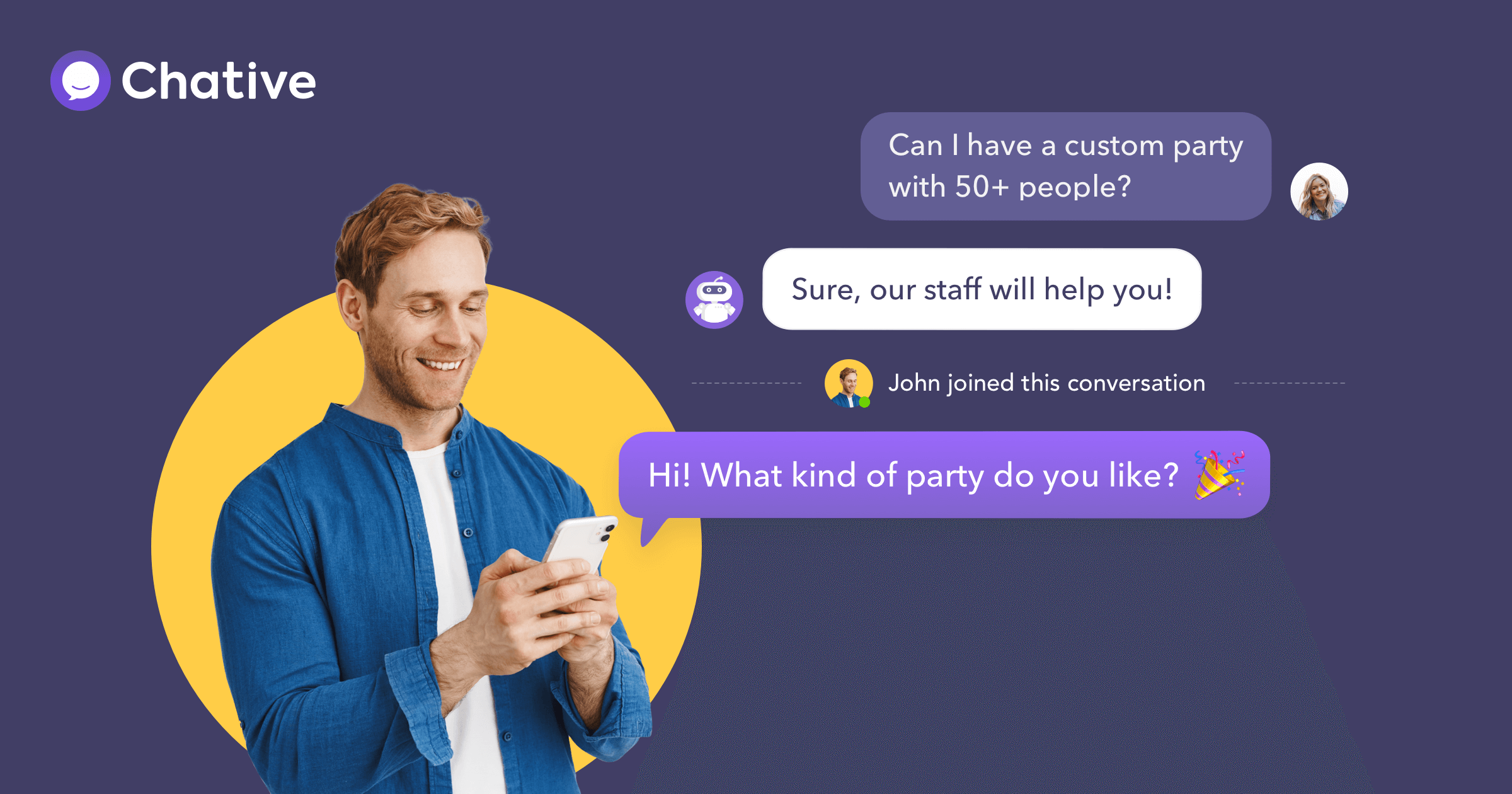
For teams that want to build their own logic, there's a no-code visual chatbot editor, designed - in the company's words - to be friendly to people "who have or have not had any experience with chatbot building." It's a small detail that reveals the target user: not an enterprise automation team, but the shop owner who wants a bot that answers the three questions they get fifty times a day. Mobile apps for iOS and Android round it out for people who run their business from a phone.
// The business modelFree until it isn't
Chative runs a freemium SaaS model, and the free tier is unusually generous where it counts. The Starter plan is free for up to three members with unlimited messages and unlimited channels - the cap is on seats, not on volume. That's a deliberate growth strategy: let a small shop connect every channel and feel the value before a single dollar changes hands. Paid tiers scale by seat as the team grows.
Figure: published per-seat pricing. Starter is free for up to 3 members with unlimited messages and channels.
The logic is clean. A tool that unifies channels only gets more valuable as a team adds more of them, and switching costs rise once every conversation and customer record lives inside it. Start free, get embedded, expand by seat. It's the same motion that carried other bottoms-up SaaS products, applied to a market - conversational commerce - that has grown as more buying moves into chat.
The cap is on seats, not on messages. Chative bet that if small businesses could try omnichannel without a sales call, they wouldn't go back.On the freemium math
// The expertiseA distributed team, built on friendship
The company's shape tells you something about how it works. Chative was started by two Australian-Vietnamese friends, incorporated in Singapore for the reach and the market access, and staffed by engineers in Da Nang - a coastal city that has grown into one of Vietnam's more active startup hubs. Huy Dinh, born and raised in Da Nang and a Swinburne University graduate, leads it as CEO. It is a distributed operation by design, not by pandemic accident, and the product reflects a team that has spent years close to the specific problem of business messaging in Southeast Asia.
That regional grounding shows up in the small choices. Instant translation isn't a checkbox feature when your users routinely sell across languages; a no-code chatbot editor matters when your customer is a shop owner, not a developer. The footer's line - "Empower Business Messaging Since 2017" - hints at a longer runway in the category than the 2021 founding date suggests, the kind of accumulated familiarity that's hard to fake in a product.
// The customersFrom corner shops to L'Oreal
The user base spans the range you'd expect from a freemium product with an enterprise ceiling. On one end are thousands of independent online retailers running their store from a phone. On the other are names like L'Oreal, PwC, GS25, CSAGA and the University of Michigan cited among its users. That spread - the solo seller and the global brand on the same platform - is the tell of a product that started narrow and useful, then grew upmarket without losing the small-team ergonomics.
| What it is | AI-powered omnichannel messaging platform for e-commerce and SMB teams |
| Core product | Unified inbox + e-commerce integrations + AI Copilot and AI Agent |
| Channels | Messenger, Instagram, WhatsApp, website live chat, email |
| Integrations | Shopify, WooCommerce, Meta, WhatsApp |
| Founded / HQ | 2021 · Singapore (team in Da Nang, Vietnam) |
| Model | Freemium SaaS - free for 3 seats, then $10 and $25 per seat/mo |
// The competitionA crowded room, a specific seat
Customer messaging is not an empty market. Chative sits among Omnichat, Respond.io, Tidio, Gorgias, Manychat and the larger incumbents Zendesk, Intercom and Freshchat. What distinguishes it is less a single unmatched feature than a specific posture: e-commerce-first, priced for small teams, generous on the free tier, and built around the idea that a message is a sale in progress rather than a ticket to close. The bigger platforms can do more; Chative aims to be the one a three-person shop can actually turn on this afternoon.
There's also the geography. Building in Da Nang and registering in Singapore gives the company a foothold in Southeast Asia, where conversational commerce over Messenger, Zalo and WhatsApp is a default rather than an experiment. It's a market where the "sell through chat" thesis needs no convincing.
// Where it fitsBuilding the register for the conversation
Step back and the position is coherent. As buying migrates into messaging, someone has to build the equivalent of a cash register for the conversation - a place where support, sales and customer memory sit together. Chative is making that bet for the businesses least served by heavyweight enterprise suites: the ones with a handful of people, a growing pile of DMs, and no time to babysit five apps. It starts free, it remembers the customer, and it tries to turn the next message into the next order.
None of this is guaranteed to win. The category is crowded, the incumbents have deeper pockets, and AI features that feel novel today become table stakes fast. But the shape of Chative's bet is legible, and it lines up with where commerce is actually heading: toward conversations that don't end at a support ticket but carry through to a sale, and toward tools small enough that the person running the shop can set them up between customers. If the next decade of buying happens in the chat window, the companies building the register for that window are worth watching. Chative is one of them.