The first version of the plan was perfectly reasonable. XAnge, a European venture firm with more than 90 active portfolio companies, wanted to help its founders hire. So it gave those companies access to its applicant-tracking system. Then reality arrived carrying a password reset and a spreadsheet. “It quickly became a nightmare - for them and for us,” Pauline Paquet, XAnge’s director of operations, later recalled.
That little failure explains Consider better than a parade of AI adjectives ever could. Consider, a Redwood City recruiting-software company founded in 2017, sells the opposite of a shared administrative burden. It collects open jobs across a portfolio, presents them on a branded career site, lets candidates signal interest, searches for talent across networks and applicant records, finds the colleague who can make an introduction, and helps send the follow-up. The pitch is not another place to do recruiting chores. It is a system that quietly assembles the pieces.
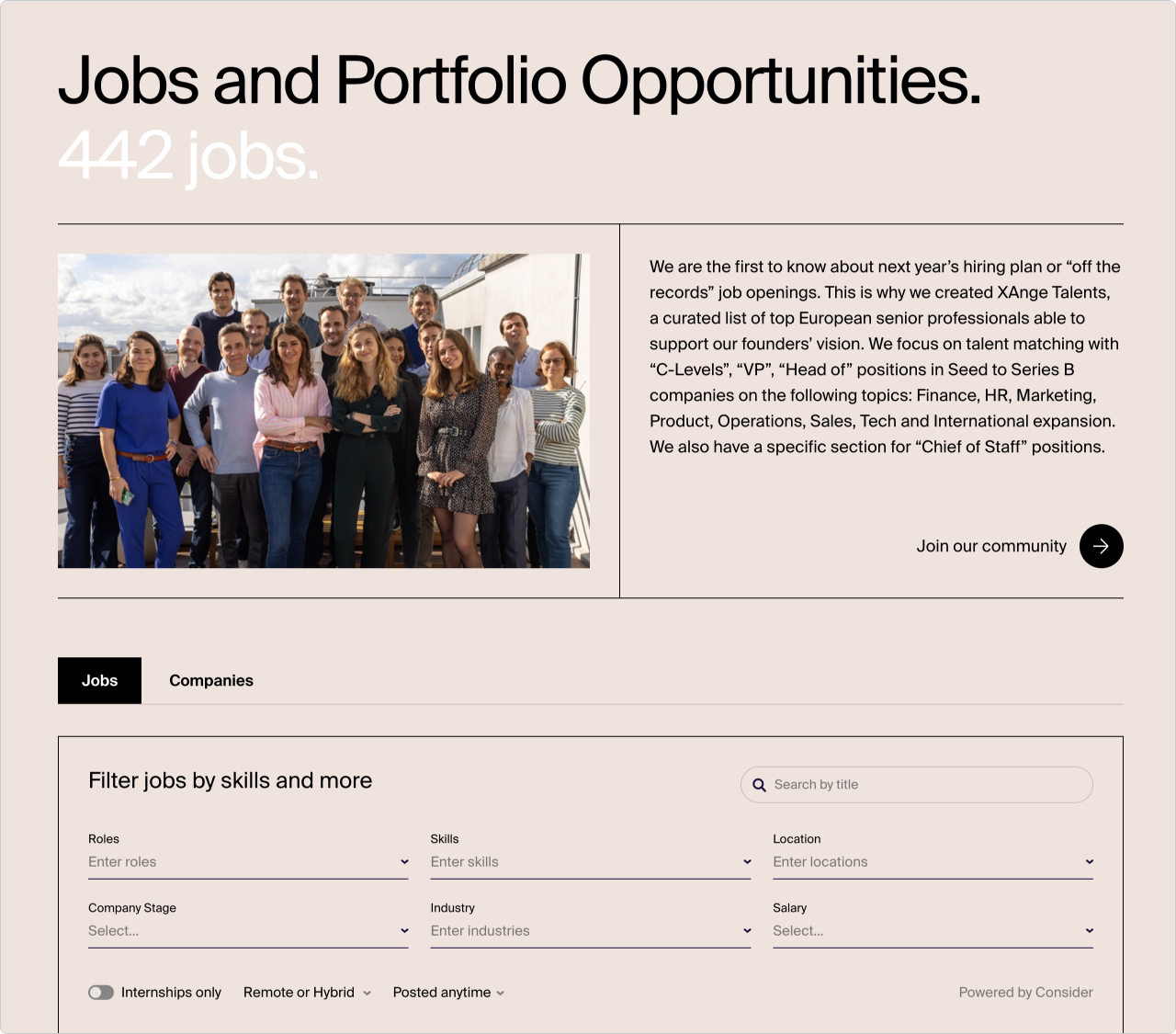
For XAnge, the switch became unusually measurable. The firm says up to 40 percent of requests from portfolio companies concern recruiting, especially leadership and technical roles. Its Consider-powered board now contributes to about 20 filled roles a year, according to the case study. XAnge renewed for another three years in 2025. The customer’s most flattering sentence sounds almost rude to software: “I don’t have to connect to make it work.”
01 / The thing itself
A job board with connective tissue
Calling Consider a job-board company is accurate in the way that calling a Swiss Army knife a small pair of scissors is accurate. The board is the visible edge: it automatically gathers openings from portfolio companies, keeps them current and lets candidates filter by role, skill, location, company size, funding stage and salary. A fund can promote priority roles without asking every founder to email over a fresh CSV.
Behind it sits a Talent Network. A visitor can create a profile and express interest in a company or opening without submitting a formal application. That matters because the person a startup wants is often employed, curious and not ready for the ceremony of a cover letter. Consider keeps the signal alive and can match the person when a relevant role appears later.
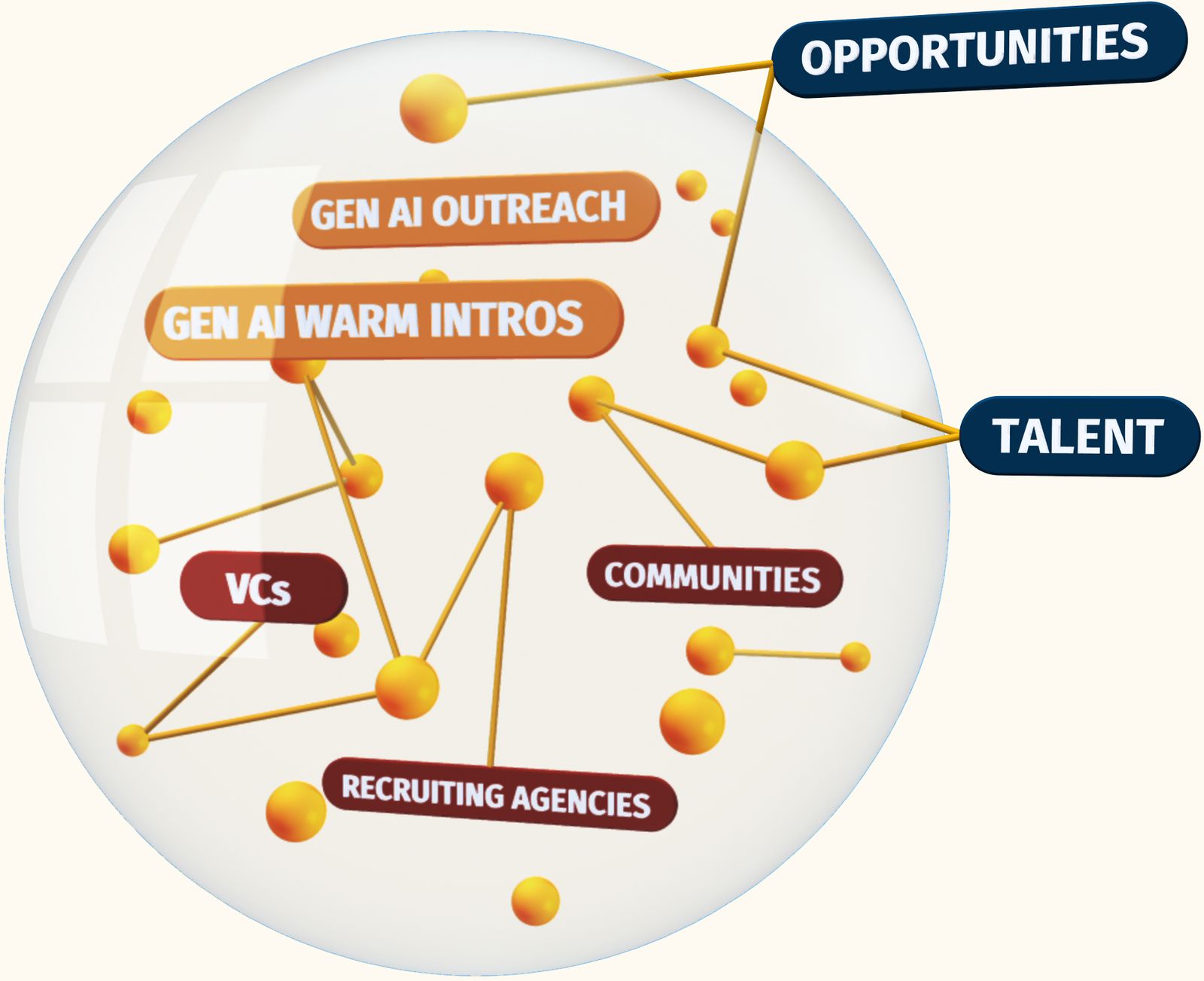
Recruiters get the other half of the loop. They can open a hiring project, describe the role, seniority, location and skills, then review suggestions from outside sources, their applicant-tracking system and colleagues’ networks. Candidate cards expose mutual connections. An integration can collect employee referrals through Slack. Accepted prospects move into outreach, where Consider can draft personalized email sequences, stop follow-ups after a reply and report opens and responses.
The loop is the differentiation. Gem, Lever, hireEZ, LinkedIn Recruiter, SeekOut and a shelf of referral or job-board products can handle parts of it. Consider’s position is between systems: not quite the canonical ATS, not merely a database, and not simply a careers-page designer. It is the connective layer that makes a group of companies look and act like one opportunity network.
“We weren’t sharing open roles because it was too hard.”Pauline Paquet, XAnge
02 / Why this buyer
The venture fund is the clever wedge
Recruiting software usually begins with one employer. Consider noticed a stranger customer: an investor responsible for none of the hiring decisions but expected to help with all of them. A fund may have dozens or hundreds of portfolio companies, each using different career sites and tracking systems. Meanwhile, the fund owns a valuable reputation and a broad professional network. The ingredients exist. They are simply scattered.
Consider packages that fragmentation. The fund gets a careers destination bearing its own brand, a cross-portfolio talent pool, analytics on what candidates browse and a record of job creation it can discuss with limited partners. Founders get distribution without adopting a shared ATS. Candidates get a single window into companies that share an investor or thesis. Consider says it can launch a board in roughly two to three weeks after receiving a company list, and prices the product according to the number of companies covered.
This is a useful bit to copy. Start with an awkward organizational boundary, not a fashionable feature. Ask where several teams share an outcome but lack shared infrastructure. Aggregate the public inputs first. Add private network context second. Automate the repetitive handoff third. AI belongs late in that sentence. Consider added generative email sequences in 2023, years after it had begun building job boards and talent networks.
Where Consider sits in the recruiting stack
The company has since widened the doorway. Its home page now addresses hiring companies and staffing agencies alongside investors. Recruiter Intelligence alerts agencies to hiring activity at target accounts. A 2025 HubSpot integration can turn a fresh job signal into an account-linked task. Gmail and Outlook integrations send Consider sequences from a recruiter’s own address, place replies in the ordinary inbox and keep outreach searchable. The expansion makes sense because the same connective problem appears in different clothes.
03 / The bill and the bargain
What it costs - and what buyers are really purchasing
Consider does not post dollar prices. It sells through demos and contracts, and its public job-board FAQ says price depends on how many companies appear on the careers page. That is an informative meter. The customer is paying for coverage, continuous collection and reduced coordination, not for a fixed pile of user seats. A portfolio of 100 companies creates more crawling, normalization and support work than a portfolio of ten.
The economic comparison is not “software versus free.” It is software versus a platform employee chasing founders for links, maintaining a board, tagging candidates, spotting introductions and producing reports. XAnge’s first workaround made portfolio companies share an ATS, transferring cost into confusion. Consider’s board changed the mind because it demanded less from those companies and could demonstrate outcomes. The renewal is stronger evidence than a landing-page claim.
There are constraints. Network aggregation only helps when people contribute current connections and trust the rules around visibility. Automated suggestions still need a well-described role and a human willing to judge candidates. Email personalization becomes spam when scale outruns taste. Consider completed a SOC 2 Type II audit in 2022, but compliance is the floor for handling recruiting data, not a substitute for careful governance.
Likely good fit
A fund or operator with many companies, many live roles, recurring founder requests and one person accountable for talent support.
Likely poor fit
A small group with few openings, stale source pages, no participating network or nobody prepared to follow up on candidate interest.
The playbook would also weaken for a single employer already satisfied with its ATS, sourcing suite and careers site. Bundling is valuable when the seams are painful. If the seams are already stitched, another layer can become another login. Likewise, a beautiful portfolio board with three old jobs is simply a tasteful empty room.
04 / The quieter moat
The graph is useful only when somebody acts
Consider’s public product history is a study in adding small bridges. Analytics arrived to show which companies and jobs needed promotion. An API let funds place current job and company counts elsewhere on their websites. Talent-profile tags and user permissions made the shared pool manageable. Salary search improved the candidate’s side of the board. Gmail, Outlook and HubSpot then carried signals out of Consider and into tools where work already happened.
That progression is more defensible than “we use AI.” Models that draft recruiting email are widely available. A maintained graph of jobs, candidate interests, ATS activity and trusted introduction paths is harder to assemble, and the workflow data grows more useful when customers keep using it. Yet the graph is not magic. Its value depends on freshness, permission and response. The final mile is still a recruiter or founder behaving like a person.
“My favorite part? I don’t have to connect to make it work. It just runs.”Pauline Paquet, XAnge
The latest moves are almost aggressively practical. In 2024, Consider opened branded boards and talent networks to individual companies. In 2025 it announced JetBlue Ventures’ portfolio board, inbox integrations and HubSpot job signals. In January 2026, it launched a public status page. None is a moonshot. Together they show a company making itself easier to trust, embed and forget about until a hire appears.
That is the part worth stealing. Find a recurring promise that an organization makes but cannot operationalize. Replace the heroic spreadsheet with a live system. Charge according to the complexity you absorb. Measure an outcome the buyer can repeat to a boss or an investor. And be honest about the necessary conditions: enough activity to aggregate, enough trust to share signals, and enough human attention to turn a match into a conversation.
Consider calls itself “The Opportunity Network.” The phrase risks sounding grander than the company’s day-to-day work, which involves career pages, filters, candidate records and follow-up emails. But the modest mechanics are precisely the point. Opportunity rarely fails for lack of another database. It fails in the gap between a job someone posted, a person someone knows and the colleague who never realized the two belonged together.