Whit Broders was not searching for a job in the usual way. He had spent years in enterprise software sales and would entertain a move only if the opportunity made sense for the career he had already built. Then an email arrived from Brian Hollinger at Celential.ai. It mentioned the size of deals Whit knew how to close. It connected that experience to Celential's sales cycle. It felt, Whit later said, as though Brian had done his homework.
Brian had supplied the hiring brief. The first email, according to Celential's account of its own hire, was generated by its Virtual Recruiter. Whit joined the company before learning the machine had helped write the note that got his attention. There is a neat sales pitch hiding in that sequence: the product won over a person the company itself wanted to hire.
- 01 / The jobFind and contact qualified people who are not applying.
- 02 / The outputInterested candidates delivered into an employer's normal hiring workflow.
- 03 / The endingWellfound bought Celential in 2024 and integrated its technology into RecruiterCloud.
The expensive part is the silence
Most recruiting tools are good at showing names. The hard part is getting a relevant person to answer. A company can search a database for an engineer, but the result is still a profile on a screen. Someone must judge whether that engineer suits the role, learn what might appeal to them, send a message, follow up, and discover whether they are interested at all. An impressive list can evaporate at the first reply rate.
Celential's founders, Andrew Dong and Ilias Beshimov, aimed at that stretch of work. Their company, founded in Sunnyvale, packaged AI sourcing with human assistance. Its Virtual Recruiter searched for potential matches, contacted them with tailored messages and passed engaged candidates to a customer's recruiting team. The company described the handoff as candidates ready to interview, delivered to an inbox or applicant tracking system. For a busy hiring manager, that was a more tangible unit than a search seat.
The engine underneath was a talent graph: Celential's connected view of candidates, companies, skills and career paths. For engineers, it drew on places such as GitHub, Stack Overflow, company sites, personal sites and professional networks. The company argued that a narrow technical model could see relationships a broad keyword search might miss. “Python” and “machine learning,” for instance, are more useful together when tied to the projects, roles and employers in which someone used them. The graph was also the basis for outreach that cited a person's actual background rather than calling them a “top candidate” without saying why.
A service disguised as software, or perhaps the reverse
Celential sat between a self-service sourcing database and a traditional recruiting agency. Customers did not simply buy access to profiles. They bought sourcing capacity and a flow of warm candidates, with humans still involved in quality control and candidate relationships. Its own data sheet said candidates could arrive directly in an ATS or inbox, avoiding a new workflow for the hiring team. Greenhouse documented an integration. In 2022, Celential announced a partnership with HackerRank, joining its discovery work with a tool for assessing technical skills.
The model was custom quoted and flexible, with customers able to adjust or stop sourcing as hiring needs changed. Celential advertised savings against conventional agency fees, but it did not publish a reliable standard price. So the honest answer to “what did it cost?” is that a buyer needed a quote and a clear count of expected hires. It would make little sense to compare the fee with a search tool alone: the product included service work that the customer's team would otherwise do or pay someone else to do.
“Our engineering candidate pipeline has improved drastically with Celential's ability to deliver warm leads.”Long Vo, COO and co-founder, OneSignal
OneSignal's case study puts numbers to the proposition. It reported 23 warm engineering candidates submitted each month, four hires across three months, and a 65% increase in its warm engineering pipeline. The roles included full-stack and mobile engineers. OneSignal already had in-house recruiters; Celential extended their reach into backgrounds and experience they were struggling to find through familiar channels.
OneSignal case
in three months
Affinity offers a longer view. Celential says the relationship began in November 2020, as the CRM company sought engineering talent across the United States and Canada. Over roughly two years, Affinity reported about 30 hires from Celential's pipeline, about 40% of them women. It also reported an approximately 80% present-to-interview ratio. These are customer case results, not a controlled comparison with every other recruiting method. What they show clearly is the kind of problem Celential was selling against: a team with real hiring demand and too little time to find, contact and engage enough suitable people.
The first failure was an ordinary one
Heartbeat Health's account is unusually useful because it starts before Celential. The healthtech company needed senior engineering talent with a feel for healthcare. Its talent team lacked sourcing capacity, so it first tried recruiting agencies. According to Heartbeat, the candidates it received rarely matched the qualifications it needed. That disappointment sent it looking for a different way to build the top of its hiring funnel. Celential then supplied an average of 29 warm candidates per month over the initial three and a half months, and Heartbeat reported four hires in frontend, backend, DevOps and data engineering.
The change of mind was about fit, not a sudden love of algorithms. Heartbeat needed people who could work close to clinicians and a team that could keep talking to them once interest was established. Celential could broaden discovery and write the first approach; Heartbeat still had to interview, decide and close. The service works best where that division of labor is clear. If an employer cannot describe the role, review people promptly or offer a reason to move, better outbound messages have little to attach themselves to.
Why Wellfound wanted the graph
Celential said its recurring revenue grew sevenfold in 2020. In March 2021 it announced a $9.5 million Series A led by GSR Ventures, with Spider Capital and TSVC participating. Amer Akhtar, already an adviser, became CEO. The company expanded its Virtual Recruiter into technology sales roles later that year. The move made sense: sellers, like engineers, leave signals about specialties, industries, deal sizes and career trajectory. Celential even used that expanded service to find Whit Broders.
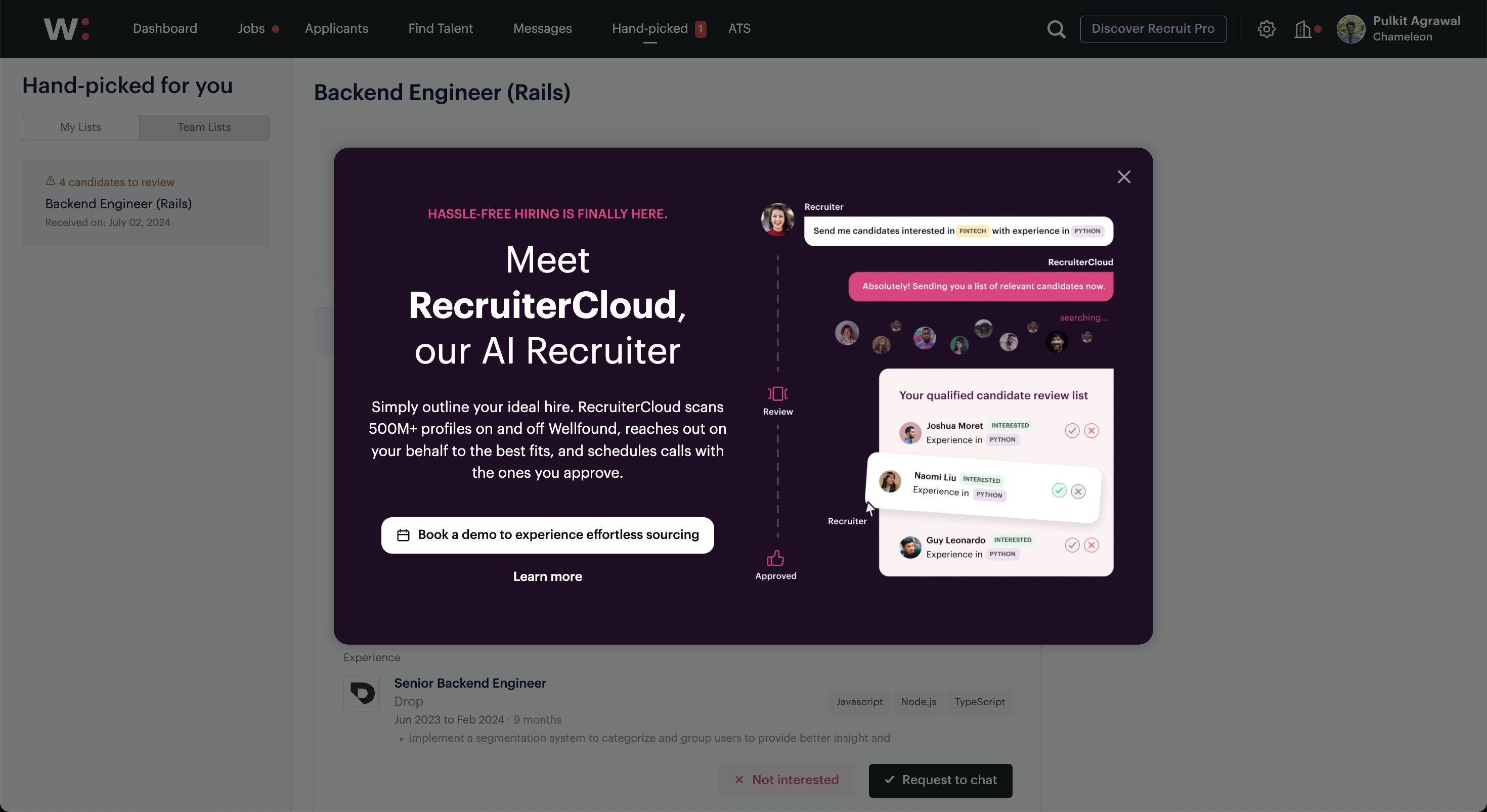
Wellfound announced the acquisition in April 2024. Its explanation was straightforward. Celential had a system for finding and engaging people, including passive candidates. Wellfound had its own data on candidates' backgrounds, preferences and activity, plus an established place where startups already hired. Wellfound said Celential's technology was integrated into RecruiterCloud, which aimed to deliver qualified, interested candidates to a recruiter's calendar. The acquisition price was not disclosed.
The useful idea to copy is smaller than the transaction. Start with one kind of role, study the signals that actually predict suitability, and write outreach that names a credible reason for the person to care. Measure replies and interviews, not just the size of the scraped pool. Build the handoff into whatever system the hiring team already uses. Celential's case studies suggest those steps can help when roles are specialized and recruiting capacity is scarce. They do not establish that an automated message can repair an unattractive role or make a rushed interview process humane.
Whit remembered an email that understood his work. That was the clever part of Celential's pitch: after all the graphs and machine learning, the proof arrived in the oldest recruiting format there is - a note from one person to another.