The short version
- Juicebox turns plain-English hiring requests into ranked searches across more than 800 million public profiles.
- Its customers range from founders and recruiting agencies to teams at Ramp, Cursor, Notion, Samsara, and Fortune 100 companies.
- The platform combines PeopleGPT search, outreach, recruiting workflows, market intelligence, and autonomous sourcing agents.
- The company has raised $116 million and was valued at $850 million in March 2026.
- The useful lesson is not “add AI.” It is to find a repetitive decision where context is scattered and the existing query language is hostile.
The first impressive thing David Paffenholz and Ishan Gupta built together was the wrong company. Their music app collected 50,000 users and the kind of attention that can make a young founder confuse velocity with direction. Paffenholz had worked in growth at Snap, though, and the retention curve looked familiar in the bad way. People arrived. Too few stayed. So the pair did something that sounds sensible only after the fact: they shut down the viral product.
The second idea was closer. Juicebox entered Y Combinator's Summer 2022 batch as a zero-commission marketplace for independent developers, designers, and consultants. The founders did the sourcing, vetted the talent, spoke with hiring teams, and discovered that they were running a recruiting service while wishing they were building software. Marketplaces already existed. What their customers truly hated were the tools around the marketplace - the rigid filters, Boolean incantations, scattered profiles, and hours spent deciding whether a stranger's work history added up to the job at hand.
“The product was, like, barely functional, but we had this message market fit.”Ishan Gupta, co-founder
A new machine for an old inference
Then large language models became useful. A recruiter does not merely match the words “machine learning” to a résumé. She infers that a researcher who moved from a small lab to a difficult product team may be unusually adaptable, or that a sales leader who opened three regions has probably built rather than inherited a playbook. Those clues live in unstructured prose. LLMs could read them. Juicebox's founders had finally found a technical change that fit a pain they had already experienced.
The first internal version, built in late 2022, summarized profiles, generated interview questions, and performed small recruiting chores. In May 2023, Paffenholz posted a 90-second PeopleGPT demonstration on LinkedIn. The founders hoped 200 people might try it. Roughly 30,000 arrived in about 60 hours. The service kept crashing. Around 100 bought inexpensive subscriptions anyway.
This was not product-market fit. The distinction matters. A sharp demo can create signups; only a useful habit creates renewal. Early Juicebox was interesting but not yet dependable enough to become a recruiter's default. The team spent the following months watching customers work, repairing weak results, and handling support manually. The dramatic launch supplied a queue. The unglamorous customer work supplied a company.

The search box climbs the stack
PeopleGPT remains the front door. A recruiter can describe a candidate in ordinary language, let the system translate that request into filters, then rank matching profiles by semantic fit. Juicebox says the index covers more than 800 million profiles across more than 30 sources. The result is not just a list of familiar names from a single professional network. It can combine work history, technical activity, education, public writing, company data, and contact information into a richer profile.
Around that wedge, Juicebox added Talent Insights, candidate projects, email sequencing, contact enrichment, collaboration, and connections to ATS and CRM systems. In 2025 it introduced Agents that work continuously on a role. By May 2026 those agents could ask clarifying questions and revise their own strategy. Agent 4.0, released in August, added a Context Intelligence Layer: it can study ATS notes, meeting transcripts, previous searches, recent hires, and organization preferences before it looks for anyone.
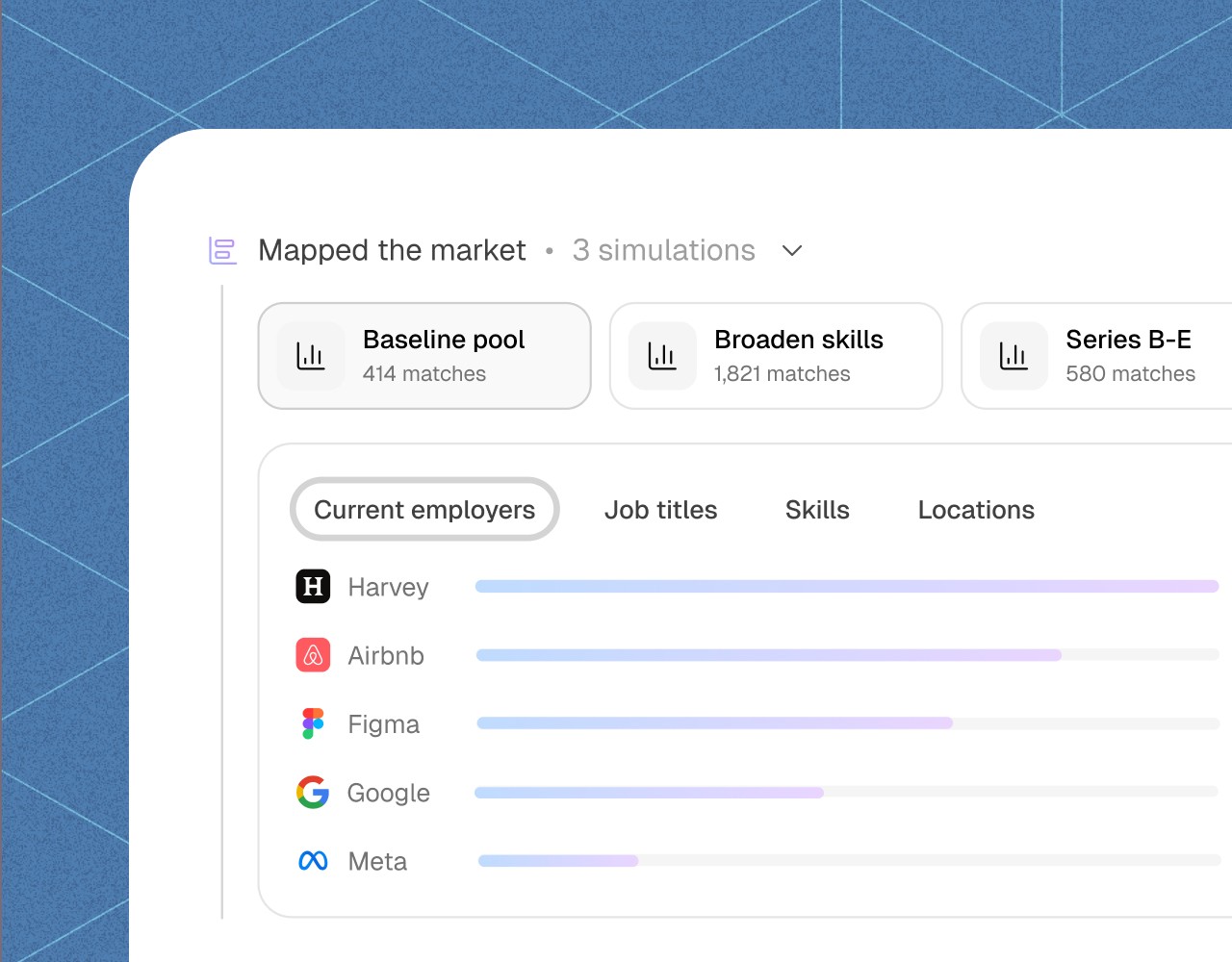
Its new Intake product pushes that idea one step earlier. Juicebox can join a kickoff call, record what the hiring manager actually says, and update the available talent pool as requirements are discussed. Add a rare specialty, a narrow city, and an unusually specific background; the pool contracts on screen. The product's best trick may be preventing a week of doomed sourcing before the meeting has even ended.
What customers are actually buying
Juicebox is sold as leverage, and its strongest public customer stories attach numbers to the claim. Vapi sent more than 3,500 personalized emails, reported a 70 percent open rate and 12 percent interested rate, and said it avoided more than $100,000 in executive-search fees. Binti reported that nine of its previous 12 critical hires came through Juicebox and that average time-to-hire fell from 40 days to 21. Skylight, while doubling headcount, reported a 90 percent reduction in outbound sourcing time.
As of September 2026, annual plans list Starter at $99 per seat each month and Growth at $179. Business pricing is custom. An autonomous Juicebox Agent costs $199 per month as an add-on. The free tier allows limited searches.
Those outcomes also explain the customer spread. A founder without a recruiting department can run an early search. A boutique agency can increase the number of roles each recruiter covers. An enterprise team can keep its ATS while replacing several top-of-funnel tools. Juicebox says it integrates with 41 ATS products and 21 CRMs. It does not present itself as the system that runs payroll, performance reviews, or the entire employee lifecycle.
That boundary is important. Public profiles are most useful when the sought-after talent leaves enough evidence online. A deeply niche or offline profession can still produce a thin pool. Automated outreach can save hours, but generic AI copy can also sound generic at industrial scale. Recruiters still need to check edge cases, calibrate the brief, protect candidate experience, and make the human judgment that follows discovery. This is sourcing software, not an alibi for careless hiring.
The business hidden inside the correction
In September 2025, Juicebox announced $36 million in financing: a $30 million Series A led by Sequoia and a previously undisclosed $6 million seed led by NFDG. It had crossed $10 million in annual recurring revenue and reached roughly 2,500 customers. Sequoia's introduction came through users, including one founder who had hired a dozen people without a professional recruiter and Sequoia's own recruiting team. Six months later, DST Global led an $80 million Series B at an $850 million valuation. Total disclosed capital reached $116 million.
Capital arrives after the pivot
The competitive field is crowded: LinkedIn Recruiter owns the familiar network; SeekOut, hireEZ, Gem, and Findem span search and workflow; Pin and Noon push agentic sourcing. Juicebox's answer is to remain narrow enough to be sharp. Its stated aim is not to become a full HR suite. It wants to own the top of the funnel - search, evaluation, market calibration, and first contact - then pass the work onward.
“Message market fit is when you have people signing up and starting to use the product. Product market fit is when they retain.”David Paffenholz, co-founder and CEO
The parts worth stealing
Juicebox's history offers a more practical playbook than “build with AI.” The founders had already done the manual job before they automated it. They chose one painful, repeated decision. They launched with a short demonstration that showed the result rather than explaining the machinery. Then, when demand arrived before reliability, they treated support as product research.
- Use retention to kill seductive ideas. Fifty thousand users did not rescue a music app people did not keep using.
- Earn the workflow knowledge manually. Running a marketplace taught the founders where recruiting time actually disappeared.
- Find the new capability, not the fashionable label. LLMs mattered because they could infer meaning from messy profiles.
- Separate a resonant message from a durable product. The viral launch proved curiosity; renewal proved usefulness.
- Keep the wedge legible. Juicebox continues to describe its job plainly: find the right candidates and help teams reach them.
The amusing twist is that a company obsessed with finding the right person had to perform the same search on itself. Music was exciting but fleeting. A marketplace was close but operationally heavy. Recruiting search was the fit. Juicebox did not discover it in a brainstorm. It found it by firing two plausible answers and paying attention to the work left on the table.