Ariel Saban had a peculiar problem for someone selling technical expertise: explaining what his company actually did. GlobalTask was already exporting services to the United States. Yet its chief executive depended heavily on word of mouth, and the pitch needed work. There is a certain comedy in helping other businesses communicate with machines while struggling to introduce your own business to a human.
In 2018, help arrived through InvestBA’s network of Argentine professionals abroad. Saban was connected with a mentor in Miami who had faced a similar challenge. Their conversations led to changes in the company’s website, marketing materials and online advertising. Sales activity acquired clearer steps and measurable goals; inquiries became more consistent. It was a practical lesson in making a business legible.
“No podíamos explicar qué es lo que hacíamos,” Saban said: we couldn’t explain what we did. The admission is a useful place to begin his story. Founders are usually introduced at the moment of applause. Here is one caught doing the rather more interesting work of correcting the introduction.
Before the bank, the builder
Saban’s professional roots are in software. His education includes Universidad Tecnológica Nacional, and his earlier publishing concerned mobile development: choosing a development company, weighing native applications against hybrid alternatives, and celebrating a team’s participation in a smartphone competition. These are the concerns of someone close to the work itself, where a decision eventually has to survive contact with a device.
GlobalTask’s origins go back to 2006. In 2015, Saban partnered with Nicolás Vidal. Their early Buenos Aires operation grew to about 20 people, with an informal atmosphere and opportunities for people beginning their programming careers. That small-company beginning matters. Before there were arguments about institutional AI, there was the ordinary challenge of bringing people together to build software.
A later academic study of the business described a philosophy document created by its CEO: work towards objectives, allow flexibility, teach and learn from colleagues, and keep communication flowing. These are pleasantly modest ambitions. They also become harder to preserve as a business grows. An informal office can run on proximity; a dispersed company has to give connection a place in the calendar.
The useful question at an AI event
By October 2024, Saban was writing about AI events GlobalTask had held with AWS in Mexico and Argentina. A point raised by Vidal, the company’s COO, prompted a familiar question: where should an organisation begin? Saban’s answer began with the business problem. Which process was inefficient? Where was the bottleneck? What needed improving enough to justify the work?
His advice was to start with a specific need, measure its improvement, and build from there. He also resisted treating generative AI as the whole field. Different problems might call for different tools. A fashionable technology can make a very expensive ornament when nobody has decided what it should accomplish.
“Good data, good AI” was his compact formulation. Alongside the technology, he stressed people, skills and the transfer of knowledge so that teams could eventually take ownership. This helps explain the business he now leads: GlobalTask works with banks, fintechs and insurers on AI, data and cloud projects. The work includes integrating information and modernising infrastructure, as well as implementing new capabilities.
“Good data, good AI.”
Ariel Saban, October 2024
That combination gives his career a recognisable continuity. The subject has expanded from applications to financial institutions, but the question still concerns fit: what should be built, for whom, and under what conditions will it work? The elegance of the proposal matters rather less once somebody has to use it on Monday.
Good technology needs a working organisation
In August 2023, Saban had already explored generative AI as a way to connect an organisation with its accumulated knowledge. He was interested in what happened beyond the conversational interface: helping employees find information, understand complex services and get useful answers from material scattered across the business.
The examples were close to everyday work. A new employee could learn through an assistant. A marketing team could explain a complicated service more clearly. A customer could obtain support without waiting for office hours. His attention went to the passage between possessing information and making it usable. A company can know a great deal collectively while leaving each employee to hunt for the relevant paragraph.
In May 2025, he returned to the gap between employees adopting AI tools and employers adapting around them. People could discover faster ways to work, then encounter restrictive policies, missing licences or inadequate internal support. His argument placed responsibility on the organisation to catch up with its own people. Buying software, in that account, was only one part of management’s task.
A prize, and a change of scenery
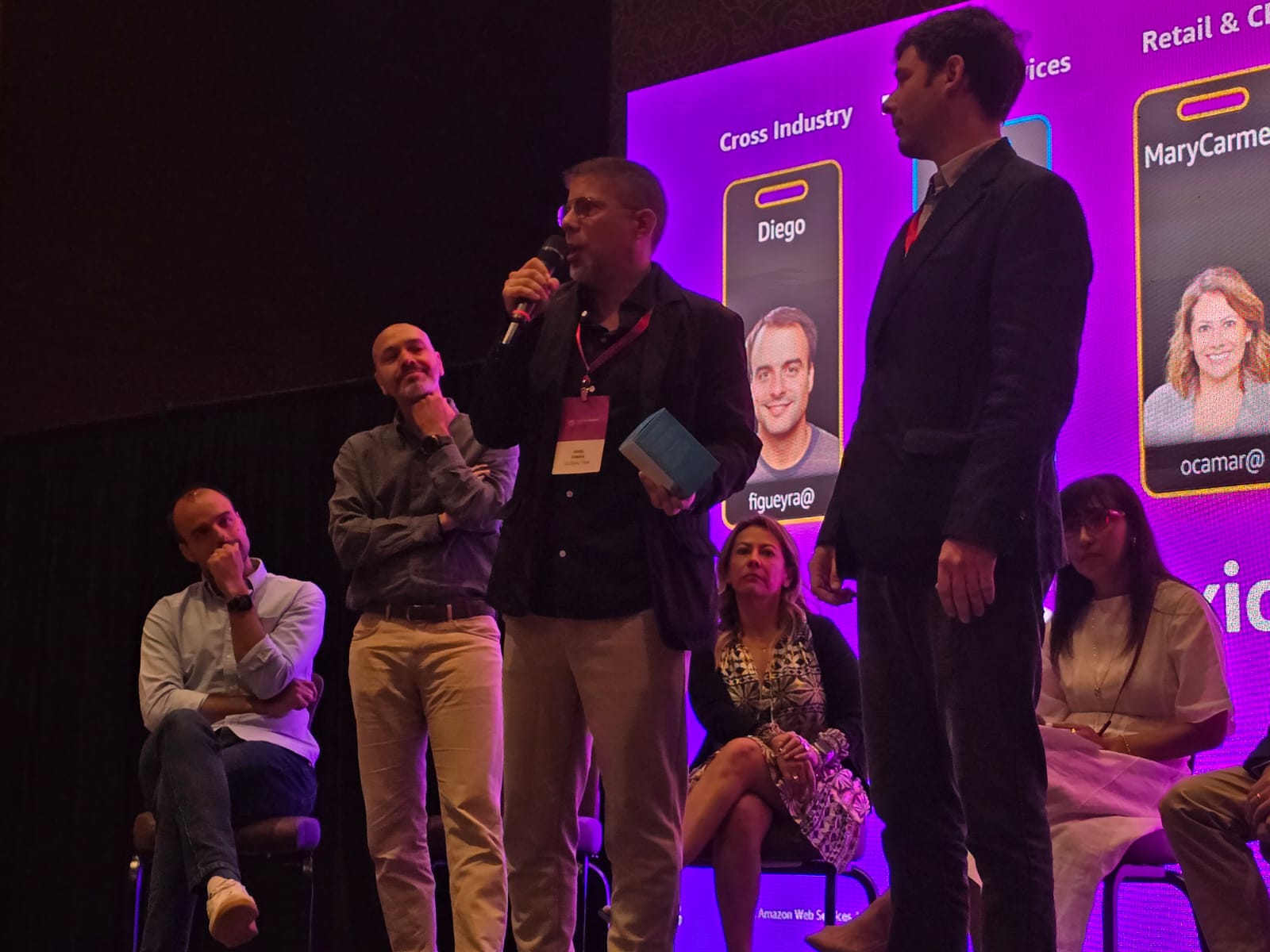
GlobalTask received the “Best Practice FSI México” recognition at the AWS Partner Summit in Miami in 2025. Saban described it as a shared result, connecting the award to teamwork and understanding the financial sector’s needs. The distinction belonged to the company. In his telling, its meaning came from the work and relationships behind it.
Later that year, he explained a different change: GlobalTask was retiring a brand identity built around space exploration. The company had used the language of journeys and discovery. Saban felt that imagery had grown distant from its role alongside financial institutions. The new identity would put more emphasis on proximity, experience and execution.
There is a small, appealing reversal here. Technology companies often reach for the stars when describing a revised colour palette. Saban’s explanation brought his company closer to the ground, to processes and decisions. He wanted the identity to communicate the work more clearly. Years after those conversations with the Miami mentor, the problem of explaining the business remained worth his attention.
The clock enters the conversation
In May 2026, Saban turned to time lost inside Latin American banks. His subject was the accumulation of ordinary delays: searching across systems, waiting for approvals, reconciling information and assembling reports. Each might seem tolerable in isolation. Together, he argued, they reduce an institution’s capacity to respond.
He called the accumulated burden “deuda temporal”, or time debt. It is an expressive phrase for a decidedly unglamorous problem. Old systems do more than require maintenance; disconnected processes keep charging the organisation in waiting. His argument extended beyond staff productivity to delayed decisions, customer experience and opportunities that disappear before a business can act.
By August, he was examining how a slow banking core could constrain commercial growth. The subject followed naturally from that concern with delay. The customer experiences the service as a whole; a quick screen cannot settle every difficulty behind it. Saban’s attention was moving through the machinery that determines whether a promise can actually be kept.
His proposed remedies included cleaner information, processes with fewer unnecessary interventions, faster visibility and infrastructure that could adapt. The cultural part was to recognise operational friction as a strategic concern. That puts the conversation within a chief executive’s remit. Someone has to decide that a familiar delay deserves investment, even when the delay has become so routine that nobody bothers to complain.
Who decides what happens next?
His 2026 writing also considered the leadership demands of AI agents, systems able to carry out sequences of work. In April, he argued that leaders needed to set priorities, establish governance and reconsider human roles. Running several promising experiments was easier than deciding which deserved to become part of the organisation.
Elsewhere, he examined the difficulty of understanding AI expenditure as use spread across teams, and the role of memory in agents’ performance. These are questions that emerge after the first demonstration, when tools begin to acquire responsibilities, costs and histories. Saban was asking how a business could remain accountable for what it had introduced.
There is a useful discipline in these less theatrical subjects. A budget needs an owner. An automated sequence needs boundaries. A team needs to understand where its judgment belongs. Each brings the discussion back to the people expected to make the technology work.
His public writing now appears in AI Ready Spotlight, GlobalTask’s fortnightly newsletter for financial and insurance industry leaders. That gives him a recurring occasion to explain the work. Topics change, from open finance to the architecture behind AI, but the intended reader still needs to make a decision rather than merely admire a possibility.
The early admission about GlobalTask’s pitch gives all this a human scale. Saban once needed help making his own business understandable. He now spends much of his public professional life examining what allows other organisations to act with greater clarity. There is enough work in that ambition to keep both the engineer and the chief executive occupied. Even the most promising future eventually needs someone to explain the next step.