In April 2022, Anurag Singh stepped away from the daily running of Education Management Solutions. Matt Merino became chief executive. Singh would remain on the Collegis board and work on special projects. It was a carefully qualified departure: fewer operating responsibilities, several reasons to keep the calendar open.
Four years later, that calendar had acquired a venture fund and a programme for faculty founders at IIT Kanpur. The entrepreneur who had spent decades building an education technology business was helping researchers work out how to build businesses of their own. Retirement, in this version, seems to have involved a change of stationery.
His route makes the word “exit” feel slightly inadequate. There was a sale in 2020, a leadership handover in 2022, and eventually a move from running an incubator to concentrating on investment. Each changed his relationship with the work. None supplied a particularly convincing full stop.
The connection between those chapters is practical. Singh has been the person seeking an investor, the executive explaining a product to an institutional customer, and the founder preparing a company to continue under someone else. At IIT Kanpur, those experiences now sit behind a fairly specific proposition: give researchers access to capital and to people who understand the work of operating a company.
Before the exit, a partnership
Singh graduated from IIT Kanpur with a B.Tech in 1986 and later earned an MBA at the University at Albany, completing it in 1990. At Albany he met Sharada, another MBA student, who graduated a year before him. Their eventual business partnership followed their meeting at business school. The case study, as it were, came home with them.
After working for other companies, the couple responded to a request for proposals to automate a testing process. They won the contract. That is a wonderfully unornamental beginning for a technology business: an identifiable customer had a job that needed doing, and two people persuaded it they could do the job.
EMS was founded in 1994. Anurag became its chief executive; Sharada, its co-founder and chief operating officer, handled finance, human resources and operations. The division of responsibility matters. A founder story told through one title can make the everyday machinery of a company disappear. Here, the partnership was part of the machinery.
Over the following years, the company built software and audiovisual systems for educational assessment and training. Its work included recording activity, managing sessions and making video available for review. The business joined a physical setting to a digital record, then gave instructors ways to use that record. Building it required attention to both the equipment and the person expected to operate it.
- 1994Build EMS
- 2020Sell to Collegis
- 2022Hand over operations
- 2026Build an investment platform
A company measured in working parts
By 2011, EMS was reporting a fifth consecutive appearance on the Inc. 500|5000. Its announcement put three-year sales growth at 153 percent and its overall position at 1,742. Those are company figures from a particular period, rather than a score for Singh’s entire career. They give the long stretch between founding and sale some useful texture.
The product story continued in smaller, less photogenic increments. In January 2019, EMS introduced MEDIASHAREiQ, a platform for creating, managing and sharing educational video. It combined media tools with features such as in-video quizzes, comments and polling, and connected with learning management systems including Blackboard, Canvas and D2L.
Those details locate Singh’s business in the ordinary frustrations of teaching with technology. A recording needs to be found. A student needs access. An instructor wants a response inside the material rather than somewhere in a separate inbox. A product acquires value by taking a succession of such annoyances seriously.
Later that year, EMS described DashboardKPI, which let users monitor activity, follow trends and generate charts. Video recording, evaluations, users and system usage became things an institution could examine together. The emphasis was on helping the people running a programme see what was happening inside it.
Public recognition arrived alongside the product work. Singh was an EY Entrepreneur Of The Year finalist in Greater Philadelphia in 2017. In 2019, both Anurag and Sharada were finalists. The distinction was a regional finalist selection; its most revealing feature for this story is the appearance of both founders on the same line.
EMS’s reported three-year sales growth in its 2011 Inc. 500|5000 announcement.
First, he sat on the founder’s side
In October 2014, Renovus Capital Partners acquired a minority stake in EMS and supplied expansion capital. Singh had already spent more than a year getting to know the team. He singled out its understanding of the sector and its relationships, describing a partner whose contribution extended beyond the cheque.
“They brought more to the table than just money,” he said.
Anurag Singh
The phrase has a certain afterlife when read beside his later work. He was describing the kind of investor he wanted while still responsible for a company’s next stage. Years later, his own institutional investment work would again combine money with access and operating support. The recurrence is visible without turning a single deal into a lifelong manifesto.
Collegis acquired EMS on August 20, 2020. The transaction brought the company’s learning technology together with Collegis’s managed services for higher education. EMS continued as a subsidiary, with normal day-to-day operations continuing. A sale changed ownership while the products and customer relationships still needed attention.
Singh stayed through the next transition. Merino’s appointment took effect on April 5, 2022, with Singh leaving daily operations while retaining board and project responsibilities. The two-year interval between sale and handover is a useful corrective to the fantasy that a business ends neatly when a transaction closes. There is still a Monday morning.
Twenty pitches, then the follow-up
By 2025, Singh was chief executive of SIIC/FIRST at IIT Kanpur. His alma mater had become the setting for another kind of company building. The Startup Incubation and Innovation Centre worked with founders across areas including artificial intelligence, energy, aerospace and cybersecurity.
In September, he described FUEL 2025: twenty startups presenting to more than twenty-five venture capital and angel investors. He noted that follow-up conversations were already happening. The presentations supplied the event; the conversations afterwards supplied a more interesting test of its usefulness.
He then used LinkedIn to introduce individual ventures. One was Baud GESS, working on gravity-based energy storage. In that post, he explained the problem, the proposed system and the team. The format put him in the role of an interpreter, taking a technical business and making its investment argument legible to a broader audience.
Another public appearance showed the same curiosity in conversation. In an episode of Pioneers of Innovation, Singh interviewed IIT Kanpur’s Rajiv Sinha about Terra Aqua’s geospatial work. His questions included what prompted the company and whether it was exploring commercial customers beyond government. For all the technical context, the business question remained plain: who else might buy this?
At SIIC’s first in-person Mentors’ Meet in November 2025, he argued for mentors to work together with greater coordination. “Mentorship is the backbone of our startup ecosystem,” he said. The programme brought mentors and founders into discussions about practical difficulties, including market access, funding preparedness and retaining talent.
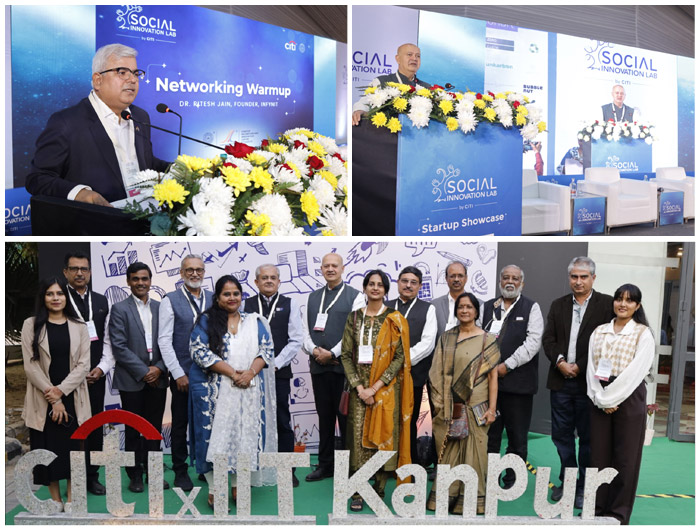
People before pitch decks. A startup gathering pictured by IIT Kanpur. Photograph: IIT Kanpur.
The alumni connection becomes capital
In January 2026, Singh shifted from chief executive to Chief Investment Officer at FIRST, the Foundation for Innovation & Research in Science & Technology. His own public update set out priorities around an IIT Kanpur-backed investment fund, preparing startups for investment, and improving access to capital and mentors.
By June, Dhanavritti Ventures had received registration as a Category I Alternative Investment Fund from SEBI. Singh was named its managing partner. Sponsored by IIT Kanpur through FIRST and SIIC, the fund was designed to support early-stage ventures emerging from the institute’s research community.
Its stated approach included operational support and access to institutional expertise alongside investment. An independent investment committee and technical and market due diligence formed part of its governance. For a founder returning to his university, the task had acquired the paperwork and accountability of an investment institution.
Kanpur gives that work a personal geography. Singh studied there before the MBA, the Pennsylvania company and its eventual sale. Now the campus is a place where he helps other people attempt the transition from technical capability to a commercial proposition. The return connects two periods of his career without requiring them to resemble each other.
Six teams, ten weeks, a customer to find
On October 5, 2026, IIT Kanpur announced SCALE-Transcend, with Singh identified as its architect and as managing partner of Dhanavritti LLP. The first cohort comprised six faculty-led teams in a ten-week programme combining individual industry mentorship, institutional financial support and exposure to investors.
The subjects included temperature-sensitive smart paints, legal technology AI agents, computational fluid dynamics, energy-efficient edge intelligence and sulfur-based batteries. The commercial work covered customer discovery, market validation, strategy and routes to market. A sophisticated research result still had to find someone with a reason to use it.
“Great research alone doesn’t build great companies,” Singh said.
Anurag Singh
That observation lands differently coming from someone whose company began with a successful response to a customer’s request. The distance between a useful technical idea and a working business had occupied him for years. Now he was helping organise a setting in which faculty could address that distance with experienced company builders beside them.
The second act has its own scale and its own obligations. Singh once concentrated on the products, people and prospects of EMS. His present work asks him to help several young ventures clarify their next decisions. There are committees to satisfy, introductions to make and assumptions about customers to test. After the sale and the handover, the work has come back to a familiar place: somebody has a problem, and a company needs to earn the right to solve it.