Anupam Nandwana found a lesson in management while watching someone else have a difficult day at work. The workplace happened to be a baseball mound. The employee was Mariano Rivera. Nandwana, a Yankees fan, admired the closer’s ability to endure a conspicuous defeat and return to the job. A founder could use that skill. There is rarely a shortage of opportunities to practise.
The lesson he took was composure: the people around a leader need confidence when things go badly, and perspective when they go well. P360, the technology business he co-founded with Edward Vaz, gives him plenty of both responsibilities. Today, its own company overview lists more than 300 employees. The operation has grown considerably beyond the scale at which a founder can settle every question personally.
That makes Nandwana an interesting person to watch. He likes building products. He also likes being close enough to customers to hear what is bothering them. As the organisation expands, those useful instincts require judgement. When should he enter the conversation? When should he leave someone else to finish it?
“Removing the fear of failing does wonders for the team.”
Anupam Nandwana
A mechanical engineer learns the business
His degree is in mechanical engineering, from the University of Mumbai. His professional life took him into software and enterprise technology. In the 1990s, he moved from India to the United States for IT projects involving pharmaceutical companies. Large organisations interested him: how they worked, how they coordinated across countries, how the business operated behind the technical assignment.
There is a particular education available to someone who builds systems for an established enterprise. The diagram may be tidy. The organisation using it has reporting lines, habits, approvals and people with reasons for doing things a certain way. Nandwana’s career developed at that intersection of technical work and commercial understanding.
He now leads corporate strategy and innovation at P360. Vaz, its co-founder and chief operating officer, oversees global operations. Their leadership biographies describe complementary responsibilities: Nandwana’s focus is the direction of the product and business; Vaz’s includes the integrity and performance of what the company delivers. Between an idea and a working enterprise sits a considerable amount of coordination.
The engineering qualification remains an apt detail. Building something useful involves constraints. Materials have limits; so do budgets, existing systems and the patience of the person expected to use the finished product. His subsequent work has kept those practical considerations close to the centre.
The customer shortened the name
P360’s current iteration dates to 2016. Its name has a pleasingly unceremonious origin. The company had a database called Prescriber360. Customers were already shortening it to P360, so the co-founders acquired the domain and adopted the abbreviation. The customers had done a little unpaid branding work.
It is a revealing episode because the name followed an existing behaviour. Someone noticed what people were actually saying and made the business easier to recognise. There was no need to persuade customers to learn a clever new word. They had supplied a perfectly serviceable one themselves.
For a founder, accepting that sort of answer requires a modest surrender of authorship. The market gets a vote in how a product is understood. A name can emerge from the people using it, just as the next useful feature can emerge from a problem they keep mentioning.
Nandwana’s business operates in a specialised corner of enterprise technology, where knowing the customer’s workflow matters. The story of its name gives that abstract principle a small, memorable form. First listen to the shorthand. Then put it on the door.
The CEO is coming to the meeting
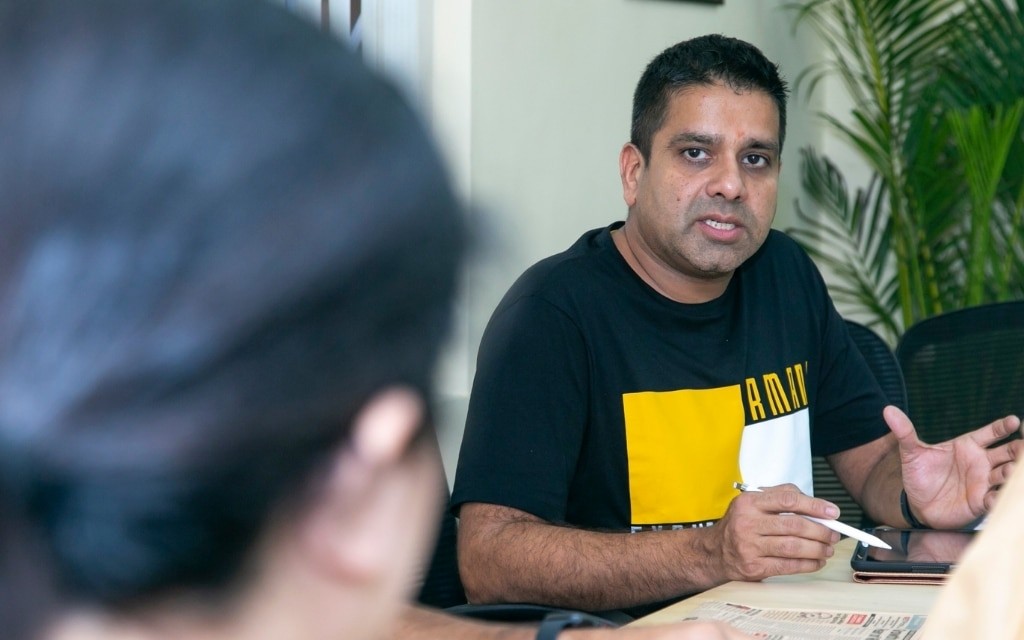
In 2021, a P360 colleague described Nandwana joining sales meetings of different sizes. The reason was straightforward: he wanted to understand the clients. The account describes a founder whose experience with technology and customer organisations could help shape a proposed solution while the conversation was still taking place.
A CEO’s presence can change the temperature of a meeting. It can make an ordinary discussion feel like an inspection. In this account, his participation served a practical purpose: connecting a customer’s request with the people and tools that might answer it. The commercial conversation also became a place for product thinking.
This is a demanding way to stay informed. A report can compress a customer into a status, a forecast and a next step. A conversation exposes hesitation, context and the question that failed to fit into the presentation. Those details can determine whether a proposal is useful.
It also helps explain why his story belongs partly in meeting rooms. Enterprise software gets sold through explanations and adopted through daily use. A founder who attends the early discussion has an opportunity to understand the distance between the two. The calendar invitation can be an instrument of research.
An editorial map of the responsibilities running through his public career.
Four buttons, and a little artistic licence
Swittons brought a physical object into that software story. Launched in 2020, the connected device could be configured with up to four predefined functions and integrated with existing enterprise systems. A button could initiate a request or a scheduled interaction. Considerable machinery sat behind a small action.
The device offers a useful way to understand Nandwana’s product interests. A customer encounters the button. The company must handle the systems behind it. The visible action is brief precisely because other work has already been arranged. Simplicity has to be manufactured somewhere.
There was room for play, too. In September 2020, P360 announced a competition inviting people to design their own Swittons artwork. The prize was a $250 Amazon gift card. Entrants could customise the graphic and select a button menu. The judging panel consisted of P360 staff.
It is an unexpectedly cheerful detail in a career spent around enterprise systems. The same object could be discussed as an integration problem or treated as a small design canvas. Nandwana described the contest as an opportunity for creative expression. Even a device with a serious business purpose could tolerate a little personality on its face.
Three verbs replace the product names
By September 2025, P360 was simplifying its vocabulary again. ZING became Connect, BirdzAI became Activate, and EdenHelp became Automate. The company introduced the unified brand architecture around three functions: communication, data and automation. Nandwana’s explanation emphasised helping clients understand what each solution delivered.
There is a family resemblance to the earlier naming story. P360 had emerged from customer shorthand. These later names made the intended action explicit. A buyer encountering Connect has less decoding to do than one encountering an unfamiliar brand name. The product still needs explaining, but the opening sentence gets shorter.
The change also shows the scope of the business he now leads. Data, communication and workflow automation involve different activities, yet a customer may need them to cooperate. His job includes making that relationship intelligible, both inside the company and to the organisations considering its software.
That is strategy expressed through language. A portfolio can accumulate names faster than a customer can remember them. Choosing three ordinary verbs imposes a little discipline. It asks each product to answer a plain question: what will this help someone do?
Giving away the deciding vote
Growth changes the founder’s relationship with the work. Nandwana has described learning to let colleagues make decisions about user interface and user experience design, including decisions that differed from his own preferences. For someone who enjoys building products, that is a fairly personal form of delegation.
The difficulty is easy to recognise. A founder can hire capable people and still remain the unofficial approval desk for every detail. Responsibility has been distributed on paper; permission continues to queue outside one office. Letting a team choose differently tests whether the transfer is real.
Nandwana connects the next stage of P360’s growth with empowering others and changing his own role. His public conversations return to service, availability and keeping ego out of the relationship. Those commitments become more complicated as a company adds people. Being available must coexist with letting someone else be responsible.
His industry recognition includes selection for the 2020 PharmaVOICE 100. He also writes as a Forbes Business Council member and an Entrepreneur contributor. These are visible markers in a career. The quieter test is whether the organisation can carry his standards without needing his intervention in every decision.
Back to the next pitch
His recent public agenda still puts people inside the technology story. Ahead of a June 2026 speaking appearance in Princeton, Nandwana described his planned argument: AI could make commercial field teams matter more. In May 2025, he had discussed practical uses including summaries and recommendations, with people continuing to exercise expertise and approval.
That position fits the pattern of his work: technical systems arranged around someone trying to accomplish a task. It also leaves the founder with a task of his own. He has to keep learning which decisions require his attention and which require his trust.
Rivera’s lesson returns here. A leader cannot carry the last result into every new exchange. Customers still need an answer. Colleagues still need room. The next decision arrives with no particular interest in the previous score.