Somewhere between noticing that a laboratory instrument needs attention and telling the right person, there is a small administrative expedition. Find the service portal. Find the instrument. Find the form. Swittons asks a pleasingly literal question: why not put the request beside the machine? Its answer is a connected device with programmable buttons. The visible part takes a fingertip. The less visible part routes that instruction into an organization’s software.
- A physical shortcut: buttons trigger predefined requests, from samples to equipment service.
- A particular audience: pharma teams, physician offices and life sciences laboratories.
- A software business underneath: connected devices, dashboards, customization and enterprise integration.
The company sits within P360, the life sciences technology business led by founders Anupam Nandwana and Edward Vaz. Its commercial debut in February 2020 presented a desktop “Virtual Rep” for pharmaceutical organizations and physicians. The timing gave remote communication fresh urgency. But the underlying problem was already familiar: a doctor’s need for information does not necessarily coincide with a representative’s visit.
Four useful things, close at hand
Swittons’ proposition starts with a small menu. A physician might need samples, medical information, a sales representative or a medical science liaison. Assign those requests to four buttons and the device becomes a little directory of useful actions. The physician initiates the exchange. The pharmaceutical organization receives a signal it can route, record and follow through.
This is a distinctive position in the market for pharmaceutical engagement technology. A CRM stores the relationship. A messaging service carries the conversation. Swittons supplies a physical place to start it. The company advertises integrations with existing CRM and ERP systems, rather than asking an organization to move its operations into an entirely separate application.
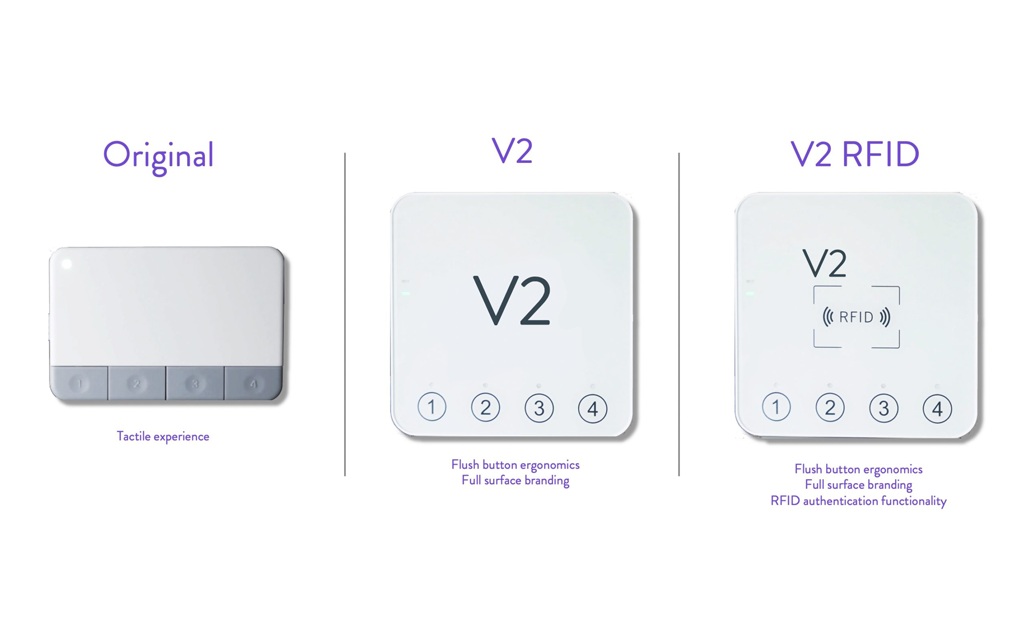
The hardware also has a commercial surface. Devices can carry a pharmaceutical brand’s identity, while their functions can be configured around the requests that brand expects. The current website calls its three models Original, Advanced and Touch; the November 2021 announcement introduced V2 and V2+, with flat buttons, full-face branding and optional RFID authentication. Here, packaging and workflow occupy the same few square inches.
One anonymous customer example describes a mid-sized pharmaceutical company that had eliminated its sales force and wanted to maintain contact with primary care physicians. Swittons’ account says it selected the devices to automate basic requests and sampling. The case illustrates the intended job: keep a request channel available in a territory without a representative on the ground.
Another customer example describes a large pharmaceutical company responding to pharmacy substitution of a branded product. Its chosen labels included sales contact, samples, a savings program and medical information. The website says customization, branding and analytics influenced the selection. These are accounts of what buyers wanted the devices to accomplish, rather than controlled evidence of prescription growth.
The same request, a different desk
In August 2020, Swittons announced devices configured for pharmaceutical laboratories. The labels changed. Equipment maintenance, reagent orders and service tickets joined the vocabulary. The organizing idea stayed remarkably consistent: place a short, recognizable action where someone is likely to need it.
A lab’s software can be sophisticated while the handoff to it remains awkward. Swittons describes connections to laboratory information management systems and ticketing platforms, including ServiceNow, Salesforce Service Cloud and Microsoft Dynamics. A scientist can initiate a request beside an instrument; the existing system can handle the next stage. Teams integration, announced in June 2020, also allows a press to trigger voice or video communication.
What needs doing?
Choose a button to follow the request.
Nandwana described the laboratory goal as “allowing scientists to spend more time on science.” It is a useful test for the product. A button earns its place if it removes enough interruption from the work around it. A service request still needs an owner, and a reagent order still needs fulfillment. The device simplifies the beginning of that chain.
The work behind the easy part
The engineering account is more interesting than the familiar language about digital transformation. Developer Avirup Basu describes experiments with open-source components, breadboards and Veroboards. The team weighed connectivity, power and the choice of microcontroller. Swittons used MQTT messaging with the Azure IoT stack, favoring low overhead, low bandwidth and low power consumption.
Those choices reflect the modest task at the edge. The device sends an event; cloud software and integrations give that event meaning. The platform manages devices, users and campaigns, with dashboards for usage and requests. Wi-Fi and LTE-M versions offer different deployment options. The mobile setup app’s listing specifies 2.4 GHz Wi-Fi, a practical detail for an IT team planning installation.
The RFID option adds another question: who or what is making the request? Swittons describes applications in authentication, inventory and asset movement. That extends the interface beyond an anonymous press, although each installation still needs its own process design. A physical button and an identification step can serve different purposes even when they share one small enclosure.
The button earns its place when it removes an interruption.
The economics are equally concrete at the starting line. Salesforce AppExchange lists Swittons for Pharma at $25 per device per month, with quantity discounts above 5,000 and 10,000. At the displayed rate, ten devices imply $250 a month before any other deployment charges. Buyers should ask what the proposal includes for hardware, connectivity, configuration, integration and support.
Choose the request before the button
There is a useful lesson here for anyone designing enterprise tools. Start by watching the request, rather than sketching the interface. Which action happens repeatedly? Where does the person stand when the need appears? Who receives the message? Swittons makes those questions unusually tangible, because every available button asks for a specific job.
That also defines the conditions for a sensible deployment. Repeated, recognizable requests suit a fixed menu. Complicated decisions requiring fresh context may need a richer interface. Connectivity must work at the point of use; authentication must fit the task; the receiving team must be ready to act. A reasonable pilot would measure completed requests and response times alongside button presses. Swittons puts the next step within reach. The organization still has to take it.