The lathe cost $1,000. Anthony Maglica had $125. For someone preparing to build a machine shop, this was an inconvenient discrepancy. He persuaded the seller to take the money as a down payment and let him pay the rest in installments. It was 1955. The famous flashlight was still twenty-four years away.
That interval is the useful part of the story. The Maglite arrived after years of making other people's parts, learning what metal would tolerate and figuring out how to produce things accurately enough that customers would come back. The familiar aluminum cylinder had a long apprenticeship. So did the name stamped on it.
Maglica, usually called Tony, began in a Los Angeles-area garage. He would become a founder, manufacturer and product designer. But the job that explains the others is machinist. It accounts for the attention he gave a switch, the money he put into equipment and his recurring preference for spending another day at work. A lathe was a remarkably effective way of buying himself a lifetime of things to do.
$1,000 lathe
One-eighth paid. A machine shop begun.
A New Yorker, by way of Zlarin
He was born in New York City in November 1930, to Croatian parents. In September 1932, his mother took him to her home island of Zlarin, off the Dalmatian coast. His father stayed in America to work. The arrangement was supposed to be temporary. Tony would not return to the United States until 1950.
His childhood crossed the Depression and the Second World War. In his later recollections, the island was a place of family attachment and wartime fear. He described German soldiers gathering residents together and threatening them while searching for someone to blame for a killing. Those memories gave his subsequent enthusiasm for American opportunity a very personal reference point.
There was also a more domestic encounter with machinery. At seven or eight, Tony dismantled the family alarm clock to see how it worked. The adults objected. He reassembled it, and it ran. For a child with a mechanical curiosity, a working clock was a useful defense argument.
After the war he trained as a machinist in Šibenik. He returned to America with a trade, but little English. Language limited the work he could get; sewing piecework came before the machine-shop career he wanted. He learned English incrementally, while moving toward employment that would use the skills already in his hands.
Twenty-four years before the flashlight
New York led to Denver, then California. In Long Beach, Maglica worked at Pacific Valve. The eventual garage operation in South El Monte gave him a chance to take on jobs himself. He made precision components for industrial, aerospace and military customers. The early business sold the ability to make a difficult part properly.
There is a particular discipline in that arrangement. The customer already knows what the part must do. The machinist has to find a way to make it, repeatedly, at an acceptable cost. Maglica's later interest in manufacturing methods makes sense against this background: a clever drawing still needs a workable production process.
The business was incorporated as Mag Instrument in 1974. Five years later, it introduced the Maglite. By then Maglica had spent nearly a quarter-century running the operation that would produce it. The company name may suggest the flashlight was inevitable. The dates suggest a working shop that eventually found a product of its own.
A flashlight was familiar territory for a machinist supplying flashlight components. Police users wanted equipment that stood up to their work. Maglica developed a light with an anodized aluminum body and an adjustable beam. Its shape carried an argument you could hold: this was equipment intended to stay in service.
The argument inside the aluminum
The original Maglite reached the market in 1979, aimed at public-safety users. Its design addressed mundane frustrations: a fragile housing, an inconvenient beam, electrical contacts that could deteriorate. Turning the head changed the spread of the light. The switch mechanism moved the battery contact to help clear corrosion. Small actions did useful work.
Those details explain why the product deserves a closer look than the silhouette alone. The cylinder was easy to recognize, but the behavior mattered. A user could change the beam without reaching for a separate accessory. The housing and controls belonged to an object expected to be handled, carried and used, rather than carefully admired.
In 1984 came the AA-powered Mini Maglite. The smaller format took the idea beyond a large professional flashlight. An AAA version followed in 1987, then the single-AAA Solitaire in 1988. Maglica kept returning to the same category, changing the scale and use of an object he understood.
Design recognition followed the tools into another setting. New York's Museum of Modern Art lists his 1982 Mag Charger Rechargeable Flashlight in its collection. It is a pleasing destination for an inventor whose education began with dismantling a household clock: an everyday object, taken seriously enough to stand among designed things.
Payment accepted: 23,000 flashlights
Maglica's appetite for machinery produced a transaction with an unusual unit of currency. Machinery dealer Graff-Pinkert traded Eubama transfer machines to him for 23,000 flashlights. Several thousand carried the dealer's name. The company spent about twenty years giving them away. Most businesses order promotional merchandise; this one acquired enough to outlast several stationery cupboards.
The exchange catches a less ceremonial version of Maglica than an award citation does. There were machines he could use and products he could supply. A deal could be made. It also shows the industrial relationships around the brand: equipment dealers, machinists and manufacturers who understood the value sitting on each other's floors.
In 2010, his interests still reached into machine-tool production. He had bought the German Eubama business out of bankruptcy and was considering how to make its components in the United States. The attraction included the engineering challenge of refining a machine he respected. Owning a successful flashlight business had left him with a continuing appetite for better ways to make things.
That same year, he showed photographs of a villa on Zlarin and spoke about olive trees and harvesting equipment. Even the imagined island retreat came with machinery. Yet he could not find time to visit that summer. A new flashlight and the Eubama purchase were occupying him. The olive trees had competition.
“The harder I work, the luckier I get.”
Anthony Maglica · 2019
The factory is part of the product
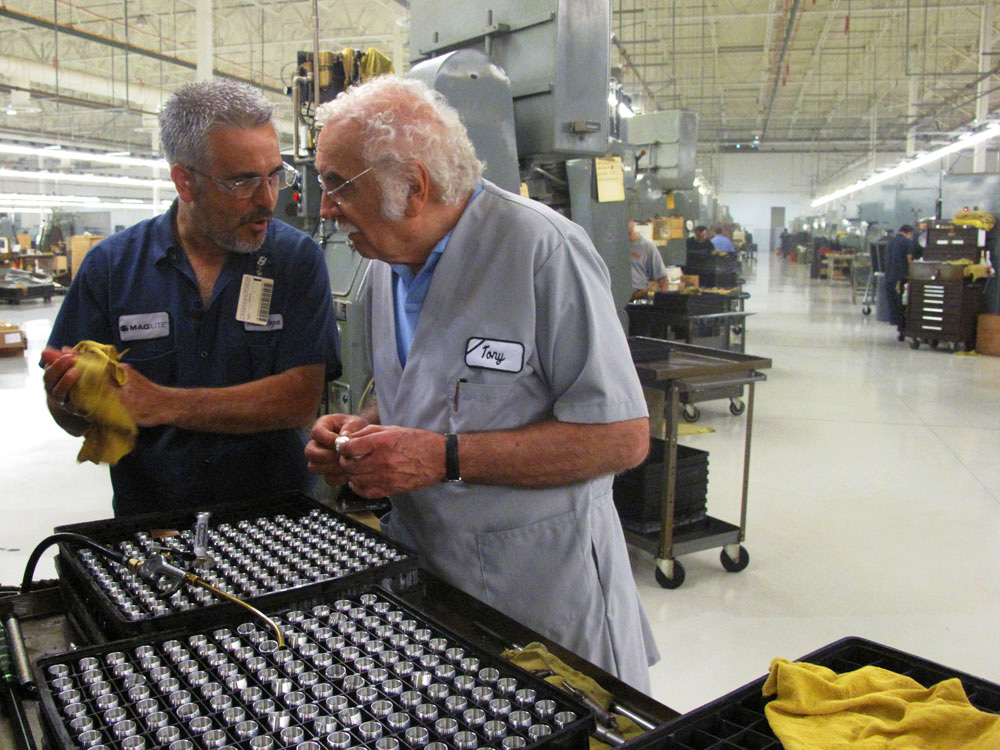
Mag Instrument has been headquartered in Ontario, California, since 1982. For Maglica, the location of production became part of the business's purpose. He wanted American workers making the products, and he wanted the manufacturing knowledge to remain close enough to use. The company describes a factory workforce that includes development engineers, automation specialists and machinists.
The details matter here. Maglite's own account says its flashlights are designed and engineered in America, with assembly and shipping at its American factory. All body parts and most other parts are made there. Some components and accessories come from overseas suppliers. The company says it identifies foreign content on the packaging.
Keeping a factory going involves procurement, prices and the availability of suppliers as well as conviction. Maglite acknowledges that some domestic suppliers have declined even to bid on component contracts. Maglica's preference therefore has to operate amid the practical limits of a supply chain. The manufacturing policy is a continuing piece of work.
It also made him a recognizable figure locally. On August 25, 2025, he accepted the Fourth District Distinguished Business Award at the Ontario headquarters. Supervisor Curt Hagman praised the decision to keep manufacturing in California. Maglica's response brought the subject back to his employees: “We have to do it here, for our people.”
- 1955The garage machine shop
- 1979The first Maglite
- 1984The Mini Maglite AA
- 2025Recognition for staying in California
Something useful to do tomorrow
There is a recurring obstacle to retirement: Maglica enjoys having work to do. In 2019, his routine included long weekdays at the Ontario office, Saturdays there too, and product development from home on Sundays. Asked about stopping, he contemplated fishing, swimming and walking near his island home, then suggested that he would probably start another company.
His activities outside the factory have often stayed near the people who use its products. In 2025, he presented an engraved flashlight to Eagle Scout and UCLA student Andrew Grinsfelder, recognized for helping protect his family's home during the Palisades fire. The ceremony honored resourcefulness in a difficult situation, a quality Maglica had spent his working life finding uses for.
He also supported the National Police Dog Foundation through a collection of engraved flashlights. In a May 2025 announcement, he described himself as a dog lover and spoke about his companion Lola. That small personal detail sits alongside the machining and business accounts: a founder with attachments that extended beyond the equipment he built.
In July 2026, Mag Instrument announced another project requested by Maglica: a free road-safety curriculum developed by the Pedestrian Safety Institute for children in kindergarten through fifth grade. Its five weekly lessons use workbooks, drawings, songs and animated characters. The practical concern is visibility and learning how to cross a road safely.
The flashlight remains a useful way into his life because it gives his preoccupations a physical shape. Precision. Work. An object that does its job. A factory full of people who know how to make it. He began with a deposit on a machine and a balance still to pay. Decades later, he was still finding another job worth taking on.
Keep the light on
Explore the collection, hear Tony’s account, and follow the company he founded.