Adam Johnson’s company bought a factory whose parent had announced plans to liquidate it. The purchase involved copper foil, an industrial material with little prospect of becoming fashionable. It also involved nearly 50 people in Camden, South Carolina, who could keep coming to work. For a founder concerned with America’s industrial supply chains, that was a fairly direct way to begin.
Principal Mineral acquired the former Denkai America assets in April 2025 and established Camden Copper. The plant made defense-grade electrodeposited copper foil, used in the electronics beneath military systems and other technology. Its Japanese parent had begun bankruptcy proceedings the previous November. A production capability with decades behind it had become a question about what would happen next.
Johnson approached that question with experience in corporate development, rare earths, and investment. Today he is Principal Mineral’s co-founder and chief executive. His career follows the difficult passage from having a useful material to having a dependable business that can produce it. The distance between those two things can accommodate a surprising number of problems.
A factory with people still inside the story
At Camden, the economic argument had a local address. The business began its new chapter with nearly 50 employees and average pay 41 percent above Kershaw County’s manufacturing average. Retaining the workforce preserved more than a headcount. An operating factory includes people who know its equipment, its product, and the demands of making that product consistently.
For employee Alan McManus, continuing to supply material used in defense systems was a point of pride. For Johnson, the acquisition also represented a commitment to the surrounding economy. Discussing Camden in May 2025, he said, “We believe that this is going to be a meaningful economic driver for Kershaw County.” The expectation was specific: work and production in a particular community.
The factory makes a useful introduction to his business. Modern electronics depend on materials most users never encounter separately. Copper foil is one of them. The finished system may command attention; the supplier several stages below it still has to make the required input. A problem there can travel a long way before it becomes visible to the person buying the finished product.
Learning to finance the missing steps
Before Principal Mineral, Johnson worked at MP Materials, where he led corporate development and strategy. His work concerned the effort to build an integrated American rare-earth supply chain. The metals and magnets at the end of that effort require several industrial steps beyond extracting material. Each step needs equipment, technical capability, financing, and a reason for customers to commit.
His congressional biography credits him with leading the company’s $700 million expansion strategy into rare-earth metals and magnets. At Ara Partners, he subsequently designed the investment strategy behind the acquisition of Vacuumschmelze. That effort helped unlock more than $550 million in public and private investment for a South Carolina rare-earth magnet facility intended to support General Motors and the Pentagon.
Those figures describe industrial projects and investment strategies. They also help explain the scale at which Johnson had learned to work before becoming a founder. In a capital-intensive business, recognizing demand is an early step. Getting money, production capacity, and long-term commercial relationships to arrive together is a much larger assignment.
His public work has followed the same subject. He contributed a chapter on closing the American critical-minerals midstream gap to Critical Minerals and the Future of the U.S. Economy. At the February 2025 CSIS launch event, he joined a panel with minerals and policy specialists including Gracelin Baskaran, Rohitesh Dhawan, Frank Fannon, and Joseph Majkut. The factory floor and the policy discussion were addressing connected questions.
He has also presented an Ames Critical Materials Innovation Hub webinar on navigating volatility in critical-mineral markets. It is a revealing subject for someone whose work involves financing physical production. A factory needs commitments that can outlast a changing market. That question runs beneath the technology itself: how does a promising industrial project attract the support to keep developing when its commercial environment refuses to sit still? Johnson has made those investment conditions part of his public discussion.
Two careers meet in the middle
Johnson met Wes Spurlock in 2020. They stayed in contact and founded Principal Mineral in 2024. Spurlock brought a career in government and national security, including 25 years in the Air Force and service at the Pentagon and White House. Johnson brought private-sector experience in materials and capital. Their company gave those backgrounds a shared operating task.
Spurlock’s earlier responsibilities included carrying the presidential emergency satchel, commonly called the nuclear football, as military aide to Presidents Obama and Trump. His work also included the initiative that became the Office of Strategic Capital. The contrast in subject matter is striking: a recognizable symbol of national-security responsibility on one side, copper foil and industrial finance on the other. The latter supplies the systems behind the former.
Principal Mineral’s approach is to acquire, develop, and scale capabilities where a supply chain has a weakness. The company describes its territory as the industrial midstream. Think of the manufacturers between a metal producer and a finished electronic device. Following the material through those businesses makes the strategy easier to understand than the terminology does.
- 01Copper foilCamden Copper
- 02Laminate + prepregIsola
- 03Circuit boardsDownstream manufacturers
The customer becomes the next chapter
On June 16, 2026, Principal Mineral acquired Isola, a manufacturer of copper-clad laminates and dielectric prepregs used in printed circuit boards. Isola was founded in 1912. The young parent company was taking responsibility for a business with more than a century of history, along with manufacturing, research, customer support, and sales operations spread internationally.
The deal brought neighboring materials businesses together. Copper foil and copper-clad laminates belong to the same wider electronics supply chain. At the transaction, Principal Mineral described the combined organization as roughly 1,300 people across 10 facilities. Johnson would serve as CEO, with Isola president Sean Mirshafiei leading that business’s daily operations and reporting to him.
Principal Mineral also announced approximately $280 million in new funding. Overmatch Ventures and The New Industrial Corporation co-led the funding, with other investors participating and a credit facility from Lane42 Investment Partners alongside it. The stated uses included integration, additional manufacturing capacity, technology development, and investment across North America, Europe, and Asia. Acquiring a company leaves plenty of work on the calendar.
“Our priority is continuity.”
Adam Johnson, July 2026
For customers, Johnson’s July explanation of the deal emphasized continuity and investment in Isola’s people and capabilities. That is a quieter proposition than the announcement of an acquisition. It is also the proposition customers have to live with. The materials must still arrive, meet requirements, and work in the products being built around them.
A signature is only the beginning
Another part of Johnson’s work appears in a photograph from Ames National Laboratory. He sits at the center of the front row, holding a signed document. Researchers and fellow signatories stand and sit around him. The subject is a technology license: the laboratory’s Rare Earth Metals via Alternative Fluoride Salt process, known as REMAFS.
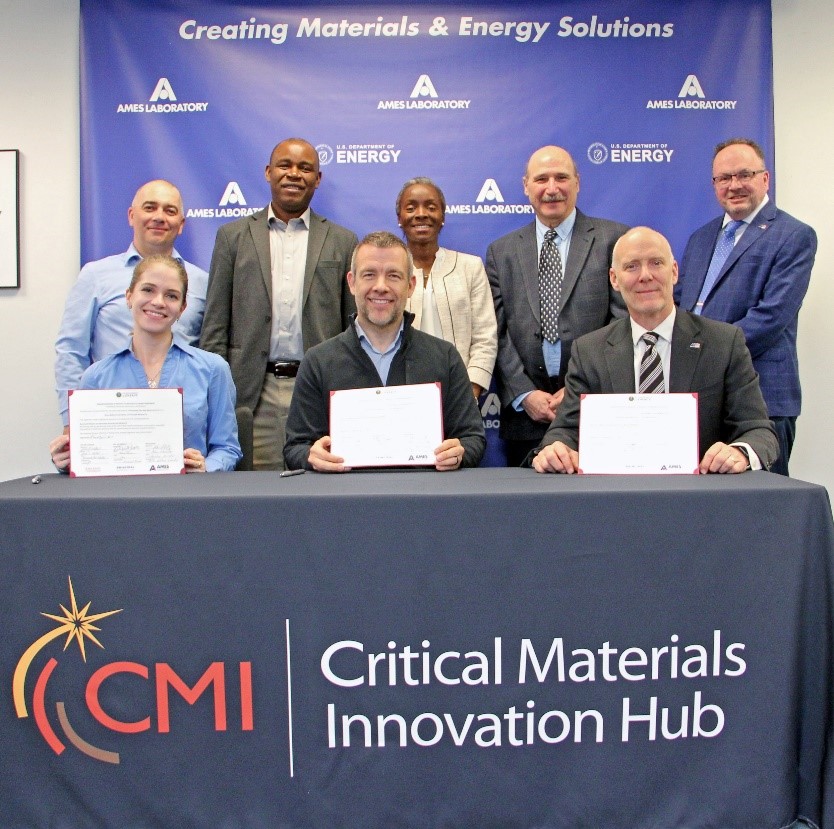
Announced by Ames in September 2025, the license connects Principal Mineral to research developed at the Critical Materials Innovation Hub. The process uses metallothermic reduction and can enter the rare-earth production chain earlier, reducing the number of steps needed to reach metal. The laboratory reported research showing magnet grades comparable with those made using commercially available rare-earth metals.
A license supplies a route into development. Principal Mineral describes its work as further developing, optimizing, and scaling the process. The distinction matters to Johnson’s story: some of his company’s industrial capacity comes from acquiring established operations, while another part requires technical work to become dependable production. Research agreements and factory acquisitions put different responsibilities on a chief executive’s desk.
In August 2025, ReElement and Principal Mineral also announced a memorandum of understanding to co-develop integrated rare-earth production. Their proposed arrangement would connect separation with fluoride and metal production at a shared site. It was an agreement to pursue development, with locations under consideration. The plan addressed the handoffs between processes, another version of the middle that keeps recurring in Johnson’s work.
The clocks have to agree
On February 24, 2026, Johnson testified before the House Natural Resources Subcommittee on Energy and Mineral Resources. His written remarks linked industrial investment to permitting, price transparency, capital formation, coordination with allies, and certainty about defense needs. Investors planning over years, he argued, need conditions that make future production financeable.
That argument gives his acquisitions a wider frame. A processing project, a manufacturer, and a customer can all have different schedules. Money committed at one stage does not automatically synchronize the others. Johnson’s policy position asks for the conditions across those stages to work together. It is the same coordination problem seen from a congressional witness table.
Principal Mineral kept adding capabilities during 2026. In August it acquired Conductive Group, a Utah-based business whose conductive composites provide electromagnetic shielding, radio-frequency protection, and structural conductivity. The portfolio now extended from foil and laminates into materials that help protect electronics. These businesses serve different functions within the systems that Johnson wants supplied more reliably.
Later that month, a federal announcement described a $37.2 million, 30-month contract awarded in April to support Camden Copper. The project returned attention to the plant where this story began. For Johnson, the continuing assignment is to make acquisitions, technical development, financing, and customer needs work together. For the people in Camden, one measure remains pleasingly concrete: a factory that continues to make something.
Follow the work
- Adam Johnson on LinkedIn
- Official biography
- Principal Mineral
- The Isola interview
- Watch: Navigating Volatility in Critical Mineral Markets
- Congressional testimony
- Camden’s April 2025 relaunch
- Ames technology announcement
- CSIS discussion
- Isola and funding announcement
- Conductive Group acquisition
- Camden federal contract