There are two sorts of hard work in Angela Stark’s world. One arrives in a boardroom disguised as a naming exercise. The other arrives before dawn, on a trail, wearing several dozen miles and a bad attitude. Both punish vagueness. Both reward preparation. And both, she has learned, become manageable when the grand objective is reduced to the next useful step.
Stark is the chief marketing officer of Legion Technologies, the Redwood City company building workforce-management software for hourly employees and the businesses that employ them. She joined in December 2025 after a career spent inside the marketing machinery of Cisco, Workday and Dayforce. Those are companies where a new phrase can ricochet through websites, sales decks, office walls, analyst briefings and thousands of employee conversations. A brand decision does not remain a brand decision for long. It becomes plumbing.
At Legion, the pipes lead to an unusually plainspoken mission: turn hourly jobs into good jobs. The product uses forecasting, scheduling and automation to help employers match labor to demand while giving workers more flexibility and control. Stark’s assignment is to give that proposition a distinct voice, connect it to measurable demand and help the company expand globally. It is the sort of brief that sounds tidy in a press release and becomes gloriously untidy on Monday morning.
The brand mechanic
Stark learned enterprise scale over roughly 16 years at Cisco. She moved through small-business marketing, enterprise marketing, communications, planning and operations before leading brand strategy and experience. It was an education in the hidden physics of a large company: how an idea gains allies, how language travels and how a customer experiences the accumulation of many internal choices.
In 2015, she moved to Workday. There she built the global brand practice and eventually held responsibility spanning brand and performance marketing. Former colleagues describe sharp brand instincts, data discipline and an ability to break down silos. One called her “cool under pressure.” The compliment is apt, although incomplete. Coolness is temperament. Her record suggests something more constructed: a system designed so pressure has somewhere useful to go.
That system faced a serious test after she joined Ceridian, later Dayforce. Stark led the company’s global rebrand from Ceridian to Dayforce in eight months. The conversion covered 33 entities, 20 offices and a full website overhaul. The company reported that the new site lifted traffic by 40 percent and engagement by 14 percent. A rebrand at that scale is less like changing a sign and more like changing the street while traffic continues to move.
The numbers are impressive because they hint at the number of opportunities for the work to go sideways. A new brand must agree with legal documents, domain names, product screens, local conventions, employee habits and customer expectations. The glamorous portion is the reveal. The consequential portion is the spreadsheet nobody photographs.
Stark’s public advice on naming makes the same practical point. Product names, she argues, need not carry the entire burden of differentiation. If a company will not invest in one like a corporate brand, clarity is usually the wiser bargain. A customer should be able to find the product, understand it and recognize its value without translating an internal brainstorm. Save the fireworks for the messaging. Search engines, salespeople and mildly impatient buyers will be grateful.
The long run and the small piece
It would be convenient if Stark’s tolerance for complicated work had been developed entirely in conference rooms. It was not. Running has been her reset button for most of her adult life: early miles, quiet roads, a world briefly reduced to breathing and forward movement. In May 2025, she completed the Sedona Canyons 125M, a point-to-point ultramarathon from Jerome to Flagstaff, Arizona.
Her account of the race focused on resilience, leadership and asking for help. That last item matters. Endurance is often narrated as solitary heroism, but a 125-mile finish is an ecosystem: volunteers, crew, course markers, food, patience and the humility to admit when another person can get you through the next hour. The same is true of any corporate transformation, though aid stations generally offer better snacks.
In June 2026, Stark published an essay titled “Progress Happens in Pieces.” The thought is modest enough to print on a sticky note, which may be why it works. Large projects terrify us by presenting themselves whole. The useful response is to shorten the view. Start small. Move one piece. Let action create enough momentum for the next action.
For Stark, this is more than executive productivity advice. Her writing returns to transitions, uncertainty and the discipline of continuing before the resolution is visible. The runner and the marketer meet here. One knows that mile 83 cannot be negotiated with a vision statement. The other knows that a global rollout cannot be completed by admiring the launch film.
A quiet person in a loud profession
Marketing leadership rewards public confidence. Stark complicates the type. She has described herself as introverted, stoic, tremendously sensitive and painfully shy in new settings. Connection, she writes, has required deliberate effort: letting down her guard, asking deeper questions and risking the mess that comes with being known.
This could sound like a personal footnote. It is closer to her theory of management. In her view, the work people remember is not only the campaign launched or target achieved. It is the difficult conversation handled with grace, the colleague helped across a finish line and the room where someone felt safe enough to contribute honestly. Her preferred legacy is not a title. It is whether another person felt seen and became more capable because of the encounter.
The belief gives an interesting edge to her role at Legion. Workforce-management software lives in a world of labor models, forecast accuracy, compliance rules and schedule optimization. Those nouns can turn people into cells on a grid. Legion’s stated promise is that better systems can improve efficiency while giving hourly employees more flexibility. Stark’s humanism does not replace the math. It insists the math remember whom it is scheduling.
Her approach to measurement is equally social. In a report about bringing brand and demand marketing together, Stark suggested asking sales teams whether it is becoming easier to have conversations and whether people are more open to connecting. It is a wonderfully unfashionable metric: talk to the humans nearest the market. Dashboards can show movement. A salesperson can tell you whether the story has begun to travel.
Brand, demand and the useful “and”
Stark’s career has unfolded across a recurring argument in marketing. Brand people defend long-term meaning. Performance people defend near-term evidence. Each side suspects the other of owning a fog machine. Stark’s work rejects the choice. She has built brand practices while modernizing analytics; strengthened global positioning while keeping pipeline in view.
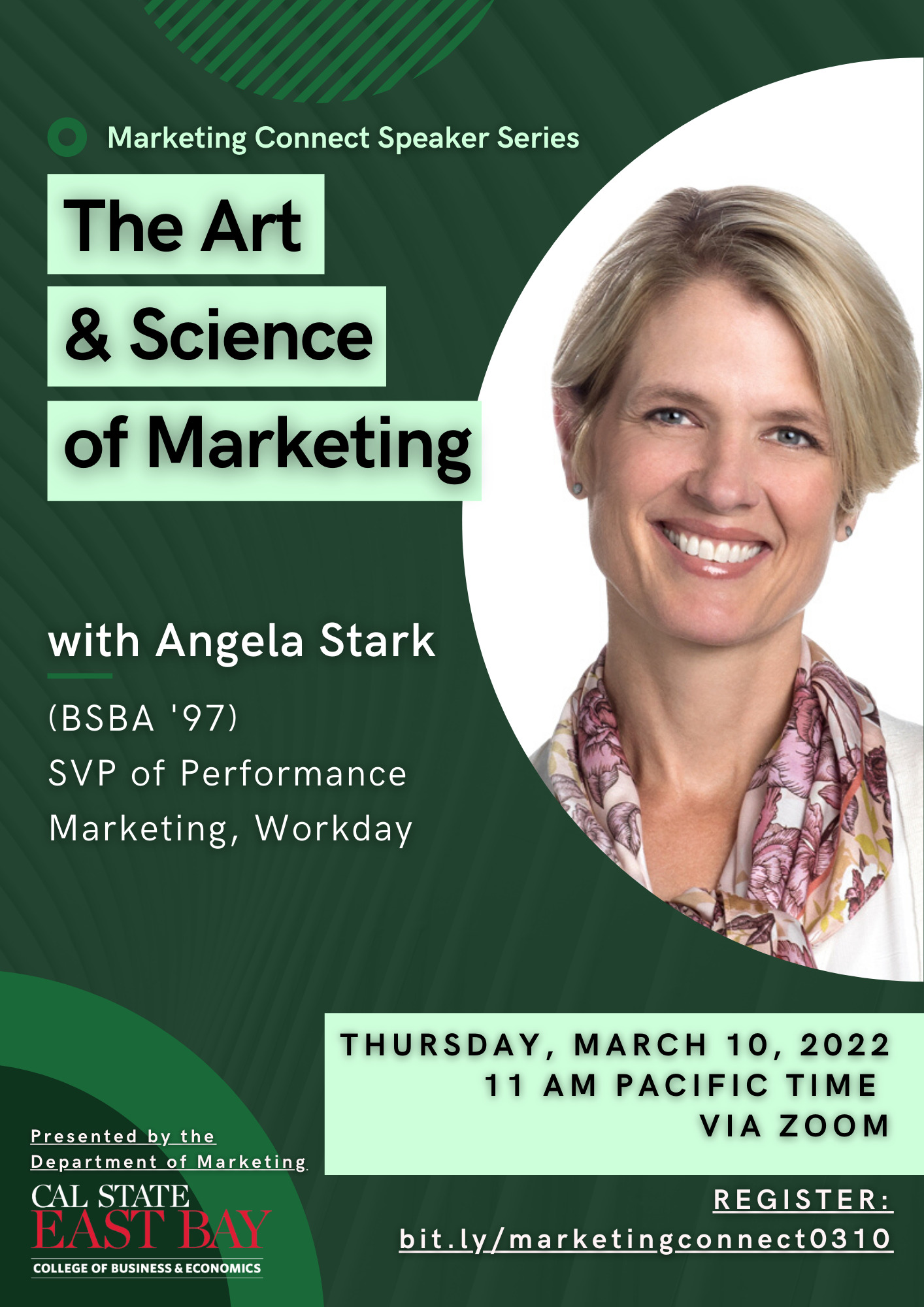
The integration requires more than putting two teams under one leader. Marketing has to build working relationships with finance, IT, product and sales. Metrics need enough consistency to guide investment without pretending that every human feeling can be traced to a click. The narrative must be bold enough to matter and precise enough to test. Art and science, as the title of her Cal State East Bay alumni talk had it.
Now the experiment moves to Legion. Stark left established global brands for what she called more speed, impact and creative runway. She arrived at a company with AI at its core, a decade of product development behind it and a mission that can be understood without a glossary. Her declared goal is to pair sharp insight with a bold narrative and make the result measurable.
The timing adds another wrinkle. AI gives workforce software new capabilities, but it also gives every technology company an irresistible new adjective. Stark’s task is to keep the language attached to lived experience: a manager building a schedule, an employee trading a shift, a business preparing for demand it cannot yet see. Abstraction is easy. The daily usefulness has to remain legible. Her instinct for straightforward names and sales-floor feedback may prove especially valuable when the market is crowded with machines promising intelligence.
There is no need to romanticize the assignment. Enterprise software remains enterprise software. Schedules are stubborn, categories crowded, budgets finite. But Stark seems well matched to this particular mixture of ambition and chores. She knows the name must be clear, the systems must hold and the people doing the work must believe the story belongs to them.
Then comes the next piece. And the next. Brand building, like ultrarunning, offers ample time to discover that inspiration is pleasant company but a poor logistics plan. The miles still require doing.